View all detail and faqs for the ISO-14001-Lead-Auditor exam
You are conducting a Stage 2 certification audit of VitalSpark, a pharmaceutical organisation manufacturing vitamins and other healthcare medicines. In a separate area in the centre of their large site, a supplier produces oxygen supplies piped directly into the manufacturing processes of VitalSpark. They also deliver oxygen in bulk tankers to other customers. When you review the environmental aspects register, you find that the only environmental aspect recorded for this arrangement relates to the heavy goods vehicles of the supplier transiting the site.
You ask the EMS Manager about the environmental consequences to VitalSpark of this arrangement and are told that they are not significant since the supplier has its own services for water, sewage, waste and energy. The EMS Manager tried unsuccessfully to communicate with the supplier who is located inside the VitalSpark site and outside the scope of the EMS.
You raise a non-conformance against clause 6.1.2 of ISO 14001:
" VitalSpark does not maintain documented information on aspects/impacts related to activities, products and services of the oxygen supplier. "
Which combination of two of the following actions proposed by VitalSpark would permit you to close out the nonconformity?
A large public library established an EMS following the requirements of ISO 14001, which was third-party certified 10 years ago. You are performing the second surveillance audit of the third certification cycle. The audit plan included an audit of the Director as the last interview before the closing meeting.
During the interview with the Director, you audit clause 6.2, Objectives and planning to achieve them. The dialogue is as follows:
You: Could you please tell me which environmental objectives were defined for last year and show evidence of their achievement?
Director: Yes. We had defined three objectives. As you can see from our Annual Plan, one of them was to separate our waste into four categories: paper, plastics, metals, and food. Before, we had only three, because plastic and paper were disposed of together. We developed an Action Plan to achieve this objective.
Which six of the questions would you ask related to the Action Plan?
During a Stage 1 audit, the EMS Manager asks that the audit includes coverage of a new storage site on the other side of town that they have taken over since the application was made.
Which two of the following actions should the auditor take?
Which two of the following options are an advantage of using a sampling plan for the audit?
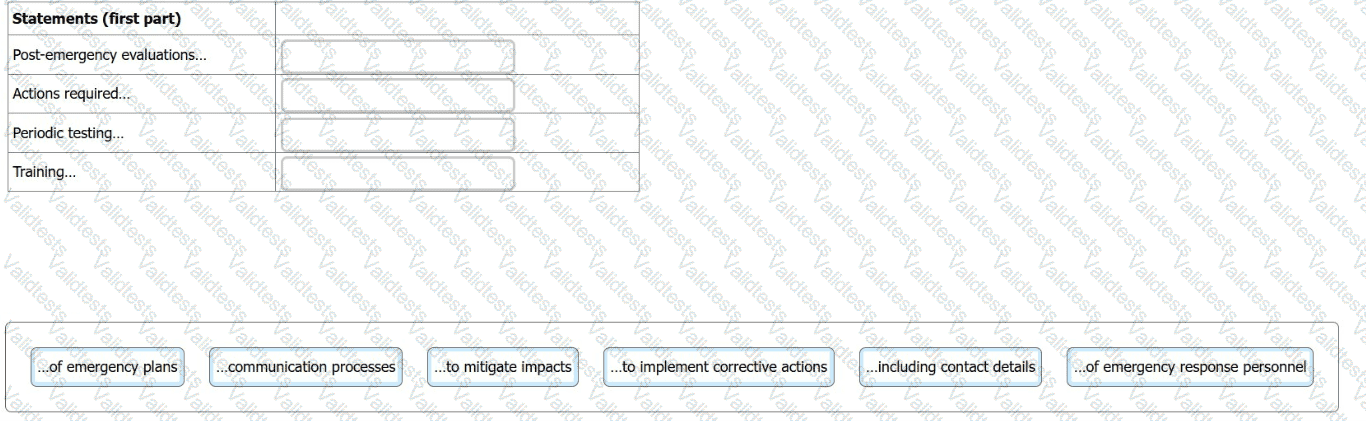
The following four statements relate to planning to respond to emergencies. Each statement is divided into two parts. Match the first part to the corresponding second part of each statement:
The following statements are related to audit methods. Review each one and select the two that are true:
A multi-level shopping centre is open every day to the public from 09:00–21:00 hours. During an external audit of the centre to ISO 14001, you establish that there are 40 vending machines that are permanently switched on. Thirty of them do not sell perishable foodstuffs. You also note that there are eight escalators in the complex that run constantly during public access. When asked about environmental performance improvement objectives, the Centre Manager says that there are plans to increase the natural daylight by installing more skylights thus saving on lighting costs, but the estimated budget for this has not yet been approved by the board.
You: I note that energy consumption is a significant environmental aspect in the centre. How do you mitigate the impacts of this?
EMS Manager: We try to reduce our energy costs by negotiating a better deal from the energy company. We are considering changing to one that only supplies electricity from renewable sources.
You: What steps have you taken to reduce overall consumption?
EMS Manager: We conducted awareness training for staff. For example, turning off lights in staff areas not being used.
You: I see that the escalators account for the highest usage of energy. Are there any objectives to try and reduce this?
EMS Manager: No, it would be too costly to change them.
You: How do you measure electricity consumption?
EMS Manager: We have meters installed in each floor of the centre. We take readings every hour and we plot the consumption graph for every staff shift.
You continue the interview and find that energy consumption has increased steadily over the past five years. Select the two statements that are true.
You are starting the opening meeting of an unannounced audit of MX, a spare parts supplier of ABC; you are an external consultant who regularly performs second-party audits for ABC.
MX’s Production Manager seems to be quite surprised. He says:
PM: I do not understand what you are doing here. I am fully aware that our contract with ABC includes unannounced audits, but under the condition that ABC keeps placing orders to MX. In the last 12 months, after ABC’s last audit, we did not get any orders. So, what are you planning to see?
You: ABC gave me a list of external providers to audit 10 months ago. I am just following the plan. I think that I can audit the production processes of whatever product you are manufacturing.
PM: Sorry, Sir. You should audit our processes when we are manufacturing products for ABC. So, therefore, I propose to close the meeting right now.
What would you say?
Which one of the following conclusions in the audit report is not required by the certification body when deciding to grant certification?
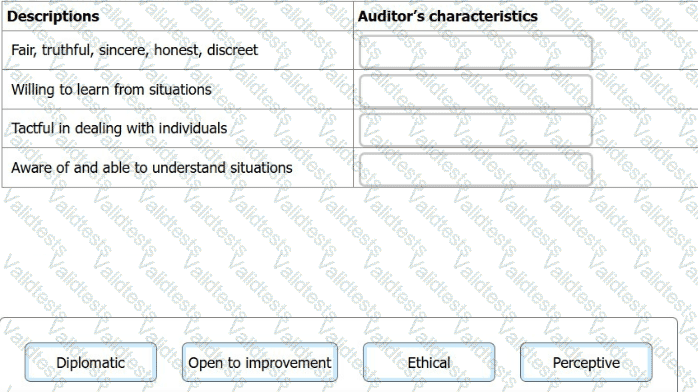
Auditors need to communicate effectively with auditees. Therefore, their personal behaviour is a key characteristic in ensuring a successful audit.
Below is a list of these characteristics and a brief related description. Match the characteristics to the descriptions.