Pre-Summer Special Limited Time 70% Discount Offer - Ends in 0d 00h 00m 00s - Coupon code: validbest

Pass the VMware Certified Specialist - vSAN 2023 5V0-22.23 Questions and answers with ValidTests

Exam 5V0-22.23 All Questions
Exam 5V0-22.23 Premium Access

View all detail and faqs for the 5V0-22.23 exam

Viewing page 2 out of 3 pages
Viewing questions 11-20 out of questions
Questions # 11:

The DevOps team of an organization wants to deploy with persistent storage on a dedicated vSAN cluster. The storage administrator is tasked to configure the vSAN cluster and leverage the vSAN Direct feature.

Which two requirements must the administrator meet to complete this task? (Choose two.)

Options:

A.

A valid vSAN license for the vSAN cluster

B.

HA enabled on the vSAN cluster

C.

A dedicated network for vSAN Direct

D.

An integration with vSAN File Services

E.

Unclaimed disks in the hosts forvSAN Direct

Expert Solution
Questions # 12:

A vSAN administrator has a vSAN cluster that is using vSphere Lifecycle Manager (vLCM) to manage hypervisor, server drivers, and firmware. All hosts in the cluster are compliant according to the vLCM image.

A 10GB NIC on the servers is experiencing issues, and the vSAN administrator determines a new network driver will resolve the problem. Unfortunately, the required NIC driver is a newer version compared to the driver provided by the most recent Vendor Add-on.

Which action should the vSAN administrator take to ensure the latest network driver is installed on the NIC before remediation?

Options:

A.

Make sure the vLCM image is configured to use the most recent version of the Vendor Add-on

B.

Add an individual component to the vLCM image that has the updated NIC driver

C.

Remove theVendor Add-on from the vLCM image, and then manually install the network driver on the servers

D.

Modify the vLCM image to omit the NIC Driver, and then manually update the servers with the required NIC driver

Expert Solution
Questions # 13:

What is the maximum amount of capacity disks an administrator can have in disk groups on a single vSAN OSA host?

Options:

A.

35

B.

40

C.

30

D.

25

Expert Solution
Questions # 14:

What are two characteristics of the vSAN Data-At-Rest Encryption (DARE)? (Choose two.)

Options:

A.

it requires Self-Encrypting Drives in order to work.

B.

it needs to be enabled together with the vSAN Data-In-Transit encryption.

C.

it is Software Defined and works independently of the Cache or Capacity drives installed on the Nodes.

D.

it is not supported on Stretched Cluster environments.

E.

it continues to operate unaffected during downtime on vCenter Server.

Expert Solution
Questions # 15:

A vSAN administrator has a group of requirements from the application team, which mandates spreading the components across storage devices as much as possible.

What should the vSAN Administrator consider to achieve such a requirement for building a new vSAN cluster? (Choose two.)

Options:

A.

Configure disk striping in OSA

B.

Configure disk striping in ESA

C.

Enable Force Provisioning in OSA

D.

Enable deduplication for vSAN

E.

Create a dedicated Storage Pool in ESA

Expert Solution
Questions # 16:

Refer to the exhibit.

An administrator uses SSH to log into a vSAN ESA host and runs theesxcli vsan debug object overviewcommand.
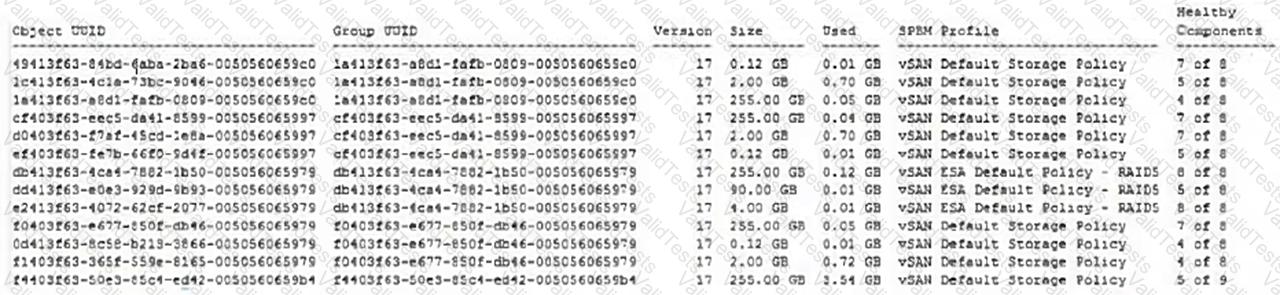
Question # 16

The administrator notices the Healthy Components column, the last column, is reporting some components are not in a fully healthy state.

What could cause this behavior?

Options:

A.

New physical disks have been claimed and a rebalance operation is underway.

B.

The applied Storage policy has been updated.

C.

New VMDKs have been added to multiple VMs, but the storage policy has not finished applying.

D.

One host is in maintenance mode with ensure accessibility.

Expert Solution
Questions # 17:

A vSAN administrator is tasked to perform an upgrade of a vSAN cluster, including firmware and drivers for its hardware. The vSAN administrator already created an image using vSphere Lifecycle Manager (vLCM).

Prior to selecting Start Remediation, which step should be taken to upgrade the complete vSAN cluster as a single task?

Options:

A.

Select Remediate All through vLCM to upgrade all hosts in the cluster

B.

Place all hosts in the vSAN cluster into Maintenance Mode

C.

Stage the upgrade of the vSAN cluster through vLCM

D.

Manually remediate one host at a time in the vSAN cluster

Expert Solution
Questions # 18:

A vSAN administrator notices that the VMware Skyline Health: Network Latency Check reports indicate that three hosts are noncompliant.

Which action should the vSAN administrator take?

Options:

A.

Immediately reboot the non-compliant hosts

B.

Check VMKNICs, uplinks, physical switches, and associated settings

C.

Rerun the VMware Skyline Health: vSAN Cluster Partition report

D.

Place the non-compliant hosts into an isolated network partition

Expert Solution
Questions # 19:

After reviewing various performance charts at a cluster level, an administrator found an individual VM impacting overall performance of the vSAN cluster.

What feature should be used to introspect multiple performance metrics of a single virtual machine?

Options:

A.

esxci

B.

Skyline Health

C.

I/O Trip Analyzer

D.

llOlnsiqht

Expert Solution
Questions # 20:

A vSAN administrator is responsible for managing a customer's production vSAN cluster that is going to be used to provide SMB file shares to a number of host clients. The vSAN administrator must take action so the performance of all services in the production vSAN cluster can be monitored.

Which two services must be enabled for this monitoring to occur? (Choose two.)

Options:

A.

vSAN Performance Diagnostic Service

B.

iSCSI Target Service

C.

vSAN File Services

D.

vSAN Health Service

E.

vSAN Performance Service

Expert Solution
Viewing page 2 out of 3 pages
Viewing questions 11-20 out of questions