Summer Certification Special Limited Time 70% Discount Offer - Ends in 0d 00h 00m 00s - Coupon code: validbest

Pass the Cisco CCNP Service Provider 300-510 Questions and answers with ValidTests

Exam 300-510 All Questions
Exam 300-510 Premium Access

View all detail and faqs for the 300-510 exam

Viewing page 4 out of 8 pages
Viewing questions 31-40 out of questions
Questions # 31:

Question # 31

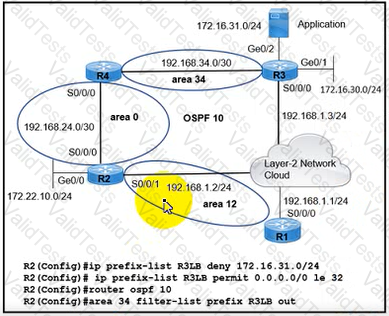
Refer to the exhibit Networks 172.16.31.0/24 and 172 16 30.0/24 are advertised in area 34. and network 172.22 10.0/24 is advertised in area 0. A recent security review discovered that users connected to routers R1 and R2 have been making unauthorized access to an application running on network 172 16 31 0/24 An engineer determined that routers R1 and R2 are receiving updates for network 17 16 31 0/24 Which action resolves the issue?

Options:

A.

Apply route filtering on routers R3 and R4.

B.

Apply route filtering on router R3 only.

C.

Apply route filtering on routers RI and R2

D.

Apply route filtering on router R4 only.

Expert Solution
Questions # 32:

Refer to the exhibit.

Question # 32

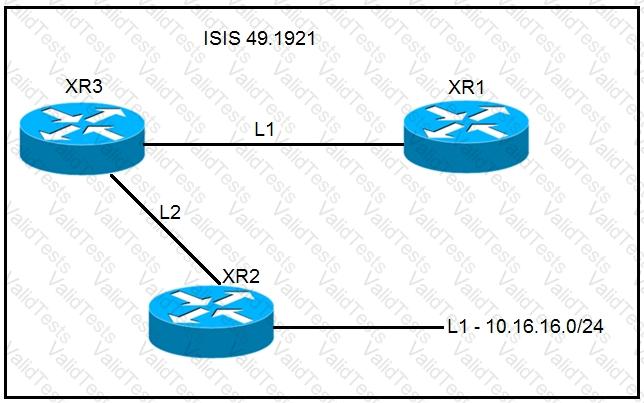
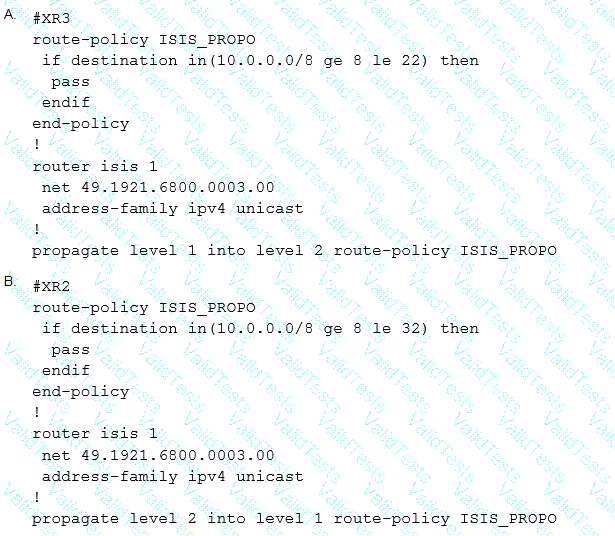
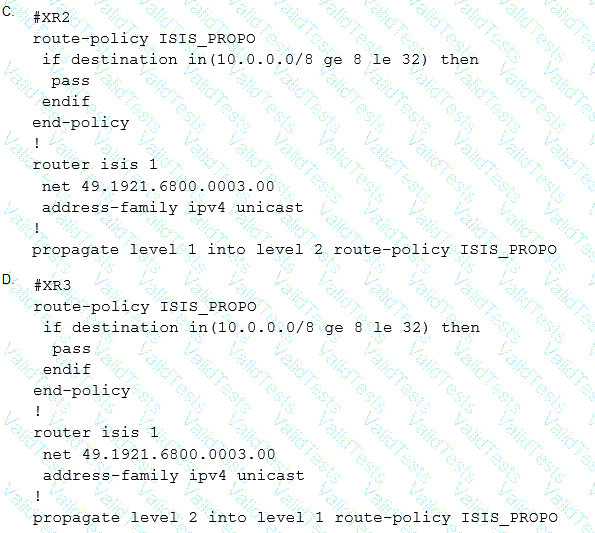
A network operator must inject a Level 1 route from XR2 (10.16.16.0/24) into the ISIS

topology. Which configuration allows the injection in a way that XR3 and XR1 have a valid and working route for 10.16.16.0/24?
Question # 32

Question # 32

Options:

A.

Option A

B.

Option B

C.

Option C

D.

Option D

Expert Solution
Questions # 33:

Refer to the exhibit.

Question # 33

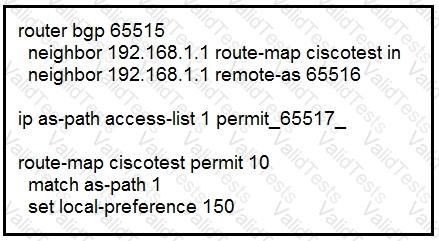
After troubleshooting BGP traffic steering issue, which action did the network operator

take to achieve the correct effect of this configuration?

Options:

A.

Routes that have passed through AS 65517 have the local preference set to 150.

B.

Routes that have originated through AS 65517 have the local preference set to 150.

C.

Routes directly attached to AS 65517 have the local preference set to 150.

D.

Routes that have passed through AS 65517 have the local preference set to 150 and the traffic is denied.

Expert Solution
Questions # 34:

Refer to the exhibit.

Question # 34

A service provider is running IS-IS in the core, and all routers use the default IS-IS configuration and reside in the same area. All routers maintain a different 6 bytes for the system ID. but the attached bits in the NET are the same. After an engineer added router R6 to the network. R3 and R5 began to experience CPU processing issues. Which action must the engineer take to resolve the issue?

Options:

A.

Configure all routers lo operate as IS-IS Level 1 routers by altering the attached bit to ensure that a default route is Injected Into the routing tables.

B.

Configure R6 to operate as a Level 1 router only so that it maintains the Level 1 database for all routers.

C.

Configure routers R5 and R3 to operate as Level 1 routers only so that they inject a default routing into the routing tables of the other routers

D.

Configure all routers to operate as IS-IS Level 2 routers so that only a Level 2 database is maintained.

Expert Solution
Questions # 35:

A network engineer recently deployed a wireless network for users at a new office to join video conferences wirelessly The existing network consists of routers that are configured for EIGRP and BGP. which are located at several data centers in different physical locations The engineer configured PIM-SSM within a single domain from a single source However, during the testing phase, the video conference failed to work for any of the users. The IPs are reachable and firewalls in the network are configured correctly to allow the traffic. Which action resolves the issue?

Options:

A.

Configure PIM dense mode to replace P1M-SSM.

B.

Configure PIM dense mode with multidomain multicast

C.

Configure the devices to send join messages toward a multicast SPT

D.

Configure PIM sparse mode to replace PIM-SSM.

Expert Solution
Questions # 36:

Refer to the exhibit.

Question # 36

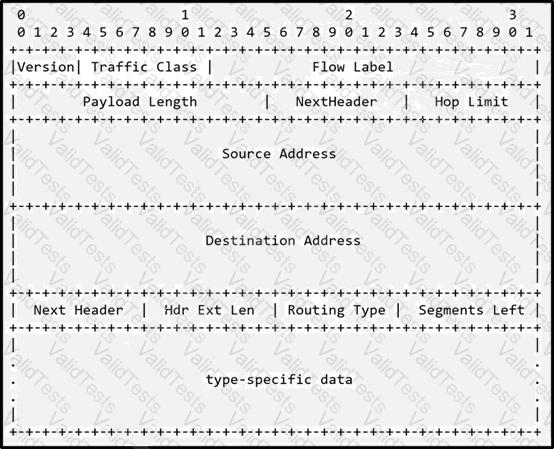
The extension header of the IPv6 header is ignored when which value is equal to zero?
Options:

A.

Segments Left

B.

Hdr Ext Len

C.

Routing Type

D.

Next Header

Expert Solution
Questions # 37:

Question # 37

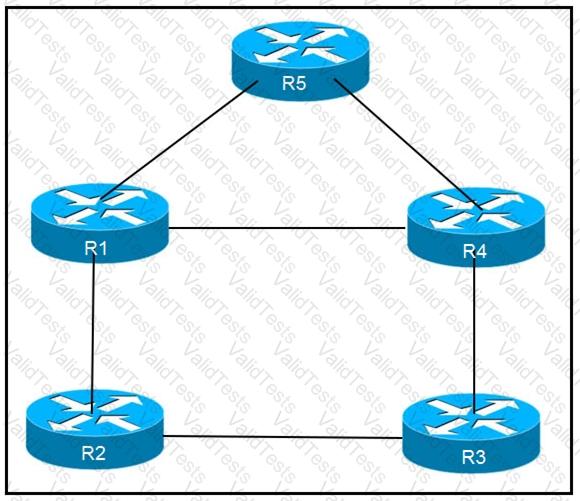
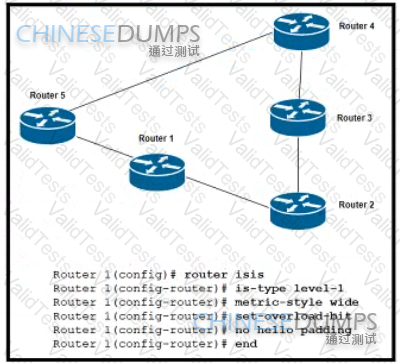
Refer to the exhibit. A network engineer commissioned Router 1, which connects lo Router 2 and Router 5 Router 1 participates in IS-IS routing with other routers, but it is not used for transit traffic. Traffic from Router 2 to Router 5 is expected to travel via Router 1 but the traffic is travelog via Router 3 and Router 4 Which action reserves this problem?

Options:

A.

Add hello padding on Router 1

B.

Remove the hello padding on Router 5

C.

Add the overload bit on Router 5

D.

Remove the overload bit on Router 1.

Expert Solution
Questions # 38:

Refer to the exhibit.

Question # 38

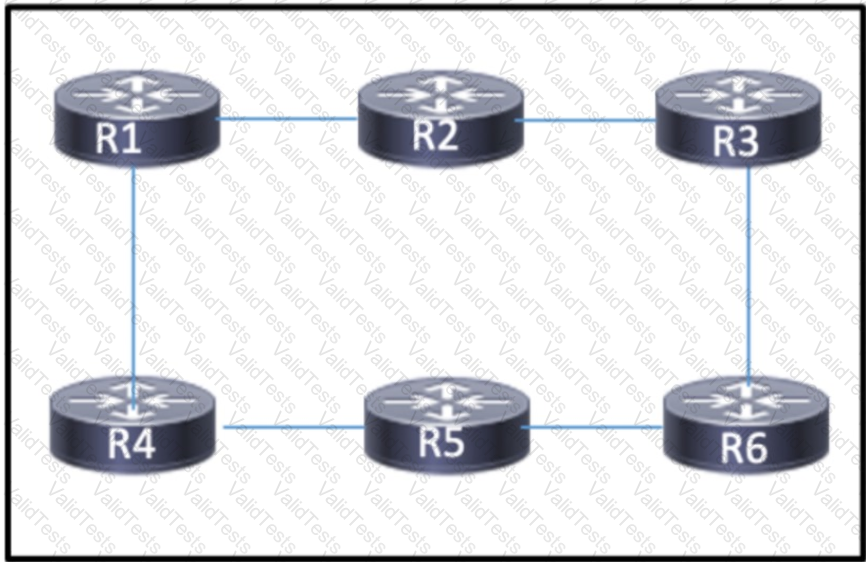
An engineer is addressing an IS-IS design issue which is running within the topology. All

links are running on FastEthernet, except the link between R5 and R4, which is Gigabit Ethernet. Which statement about the design is true?
Options:

A.

R4 prefer to reach R5 using R1 as the next hop

B.

All links have equal cost if the default metric is used

C.

R5 prefers to use R4 as the next hop for all routes

D.

R1 prefer to use R5 as the next hop to reach R4

Expert Solution
Questions # 39:

Question # 39

Question # 39

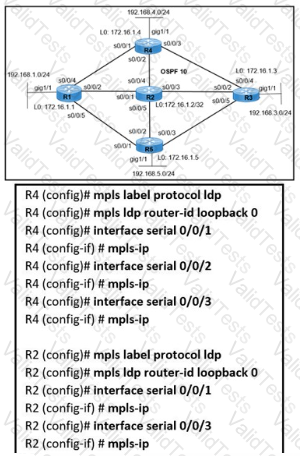
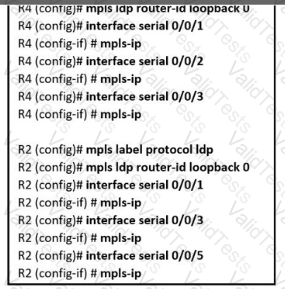
Refer to the exhibit. MPLS traffic from 192.168.4.0/24 to 192.168.5.0/24 is failing to pass over the link from R4 to R2. The engineer verified that:

    Cisco Express Forwarding Is enabled on all routers.

    All routers reach all networks via OSPF.

    MPLS traffic from 192.168.1.0/24 to 192.168.3.0/24 is passing normally over the link from R1 to R2.

Which action resolves the issue?

Options:

A.

On router R4, remove the mpls ip command on the s/O/O/2 interface.

B.

On router R2, configure the mpls ip command on the SIO/O/4 interface.

C.

On router R4, configure the mpls label protocol Idp command on all serial interfaces.

D.

On router R2, configure the mpls label protocol Idp command on the interface.

Expert Solution
Questions # 40:

Refer to the exhibit.

Question # 40

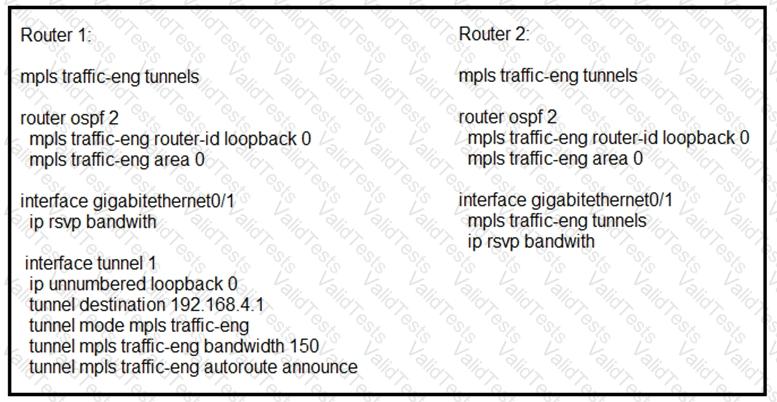
Router 1 has attempted to establish a Cisco MPLS TE tunnel to router 2, but the tunnel

has failed. Which statement about this configuration is true?

Options:

A.

Router 1 must define an explicit path to router 2

B.

Router 1 and router 2 must define the RSVP bandwidth reserved on the physical interfaces

C.

Router 2 must have a tunnel interface created with router 1 as the destination

D.

Router 1 must have Cisco MPLS TE enabled on interface gigabitethernet0/1

Expert Solution
Viewing page 4 out of 8 pages
Viewing questions 31-40 out of questions