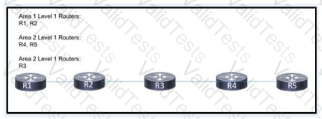
Refer to the exhibit. This network is deployed with all connected links configured to run IS-IS. The routing protocol is enacted globally on each router, and the network engineer expects full routing Information to be shared among all routers. R5 is receiving routes from R4 but is missing routes from R1. Which action corrects the issue so that all routes are shared among the routers?
Which task is performed when troubleshooting LDP?
Refer to the exhibit.
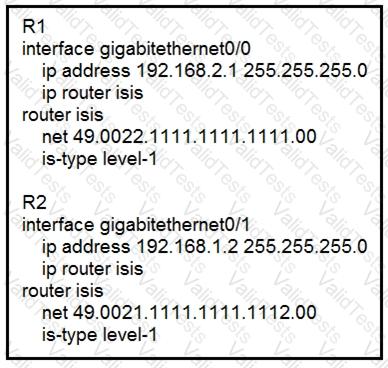
Routers R1 and R2 cannot form a neighbor relationship, but the network is otherwise
configured correctly and operating normally. Which two statements describe the problem? (Choose two.)
Which two conditions must be met before separate ISPs can provide interdomain multicast routing? (Choose
two.)
You have configured routing policies on a Cisco IOS XR device with routing policy language. Which two statements about the routing policies are true? (Choose two.)
Which statement about BFD on Cisco IOS XR Software is true?
Refer to the exhibit.
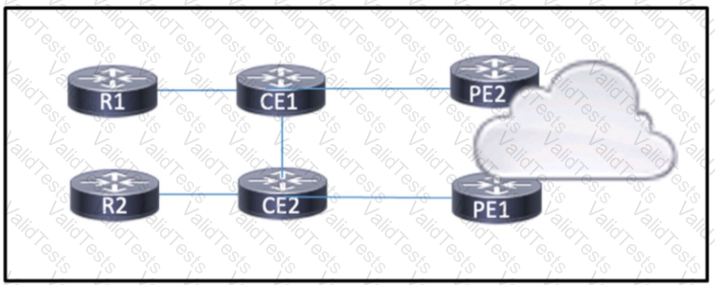
BGP is running on the network, and CE1 currently prefers routes to the internet via PE 1 A network engineer must manipulate the BGP routes that CE1 receives from PE2 to be more desirable The engineer configured a route map using MED and applied it on CE1 outbound from PE2. However, after a BGP soft reset. PE1 is still preferred. Which action must the engineer take so that PE2 is chosen as the next hop?
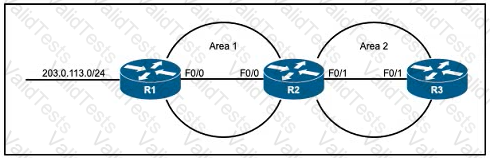
Refer to the exhibit After recent configuration changes to a customer's network, a network engineer notices that R2 cannot communicate with R3 Both FastEthemet interfaces on R2 and R3 are up and configured with the correct IP addresses MD5 password configured en R2 and R3 match with no issues What is the minimum change the engineer must make to enable R2 and R3 to communicate and fix the problem?
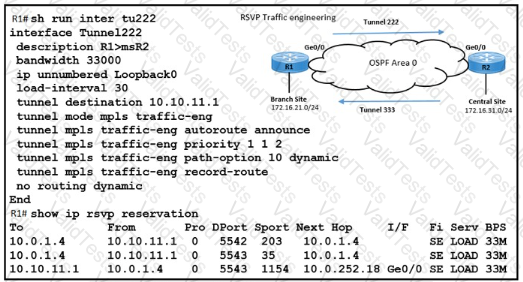
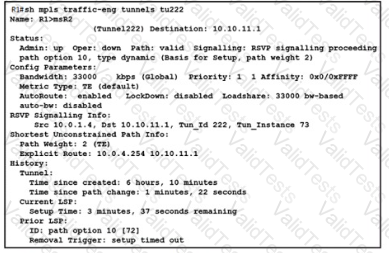
Refer to the exhibit. A network engineer is investigating a report of packet drops between the branch site and the central site.
The two sites are connected via OSPF and RSVP-TE tunnels.
Traffic from the central site to the branch site is passing normally.
Technicians at both sites successfully ping the loopback IP addresses on routers R1 and R2.
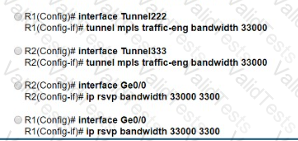
Which configuration corrects the packet-drop problem?
What is the difference between basic IS-IS and OSPF packet types?


