Summer Certification Special Limited Time 70% Discount Offer - Ends in 0d 00h 00m 00s - Coupon code: validbest

Pass the Cisco CCNP Service Provider 300-510 Questions and answers with ValidTests

Exam 300-510 All Questions
Exam 300-510 Premium Access

View all detail and faqs for the 300-510 exam

Viewing page 6 out of 8 pages
Viewing questions 51-60 out of questions
Questions # 51:

What can be used to determine a path from the head-end to a tail-end router when implementing SR-TE with a head-end, with little information on the network topology?

Options:

A.

traffic controller

B.

path computation engine

C.

tail-end router

D.

SNMP server

Expert Solution
Questions # 52:

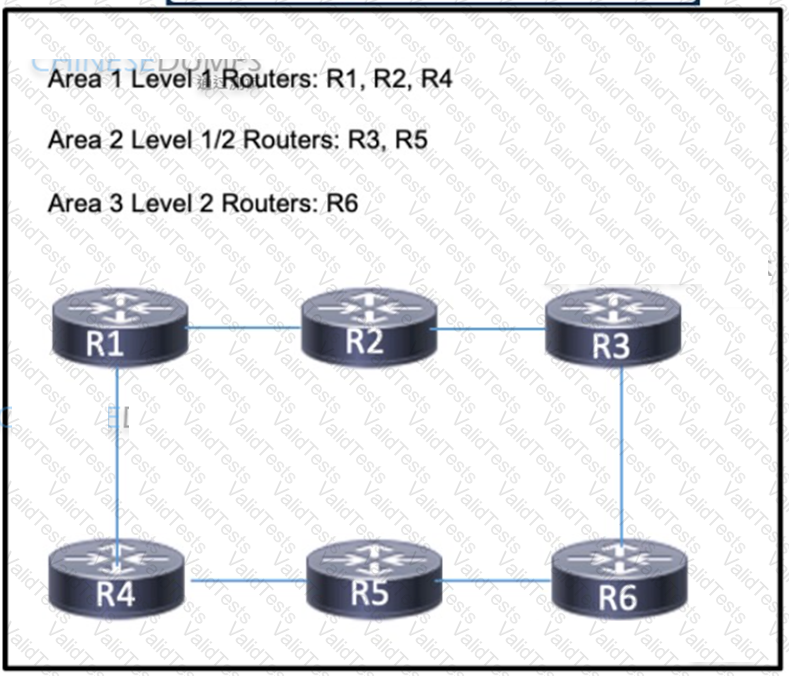
Refer to the exhibit.

Question # 52

IS-IS is the routing protocol on the network. After the team noticed excessive CPU usage on all routers, particularly routers R2 and R6, they configured route summarization on all routers. However, a network engineer noticed that summary routes and more specific routes are present in the routing table on R1. Which action must the team take so that R1 receives only the summary routes?

Options:

A.

Configure R2 and R4 to perform summarization for Level 1 routers.

B.

Configure R3 to perform summarization for Level 1 routers, and configure R6 to perform summarization for Level 2 routers.

C.

Configure R3 and R5 to perform summarization for Level 1 and Level 2 routers.

D.

Configure R6 only to perform summarization for all routers.

Expert Solution
Questions # 53:

Refer to the exhibit.

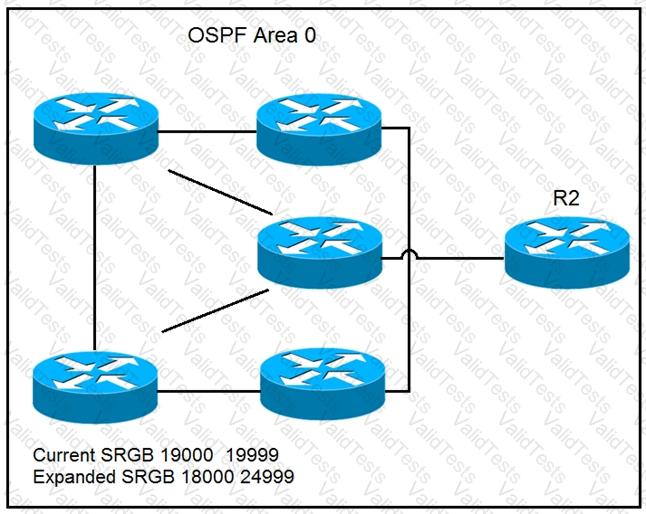
Question # 53

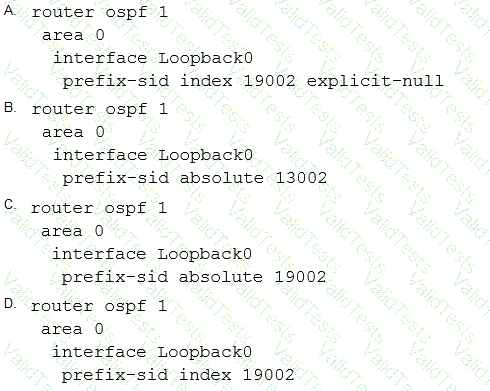
A network operator wants to expand the segment routing global block in upcoming

maintenance. The operator must ensure that the changes to the segment routing global block have no adverse impacts on the prefix-sid associated with the loopback0 interface used within the OSPF domain.

Which command can the operator use to enforce R2 to have a strict prefix-sid assignment to loopback0?
Question # 53

Options:

A.

Option A

B.

Option B

C.

Option C

D.

Option D

Expert Solution
Questions # 54:

Refer to the exhibit.

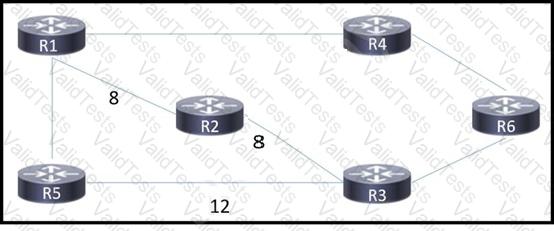
Question # 54

A network engineer configured routers R1 and R5 to run in IS-IS Level 1 mode and router R6 to run in IS-IS Level 2 mode. All other routers are running as Level 1 / Level 2 routers. An engineer expects traffic from R1 to R6 to pass via R2, but IS-IS routing has calculated the best path via R4. Which action corrects the problem?

Options:

A.

Configure all routers as Level 1 routers.

B.

Remove the link metric for the link from router R1 to router R2.

C.

Change the link metric for the link from router R1 to router R2 to 1.

D.

Configure all routers as Level 1 / Level 2 routers.

Expert Solution
Questions # 55:

Refer to the exhibit.

Question # 55

A network engineer applied configuration on R5 to summarize all OSPF routes, but R4 is still receiving specific routes from R5. The engineer has confirmed that both R5 and R4 routers are configured with correct summarization configuration but R5 Is not sending the summary routes What action must the engineer take to fix the problem?

Options:

A.

Remove summarization configuration on R5 and configure it on R4

B.

Configure a sham link between R4 and R5 to support summarization within Area 2

C.

Move R4 and R5 in separate areas as now they maintain the same link-state database

D.

Clear link-state database on both R4 and R5 routers for summarization to work

Expert Solution
Questions # 56:

Which cost is the default when redistributing routes from BGP to OSPF?

Options:

A.

20

B.

1

C.

infinite

D.

automatic

Expert Solution
Questions # 57:

Refer to the exhibit.

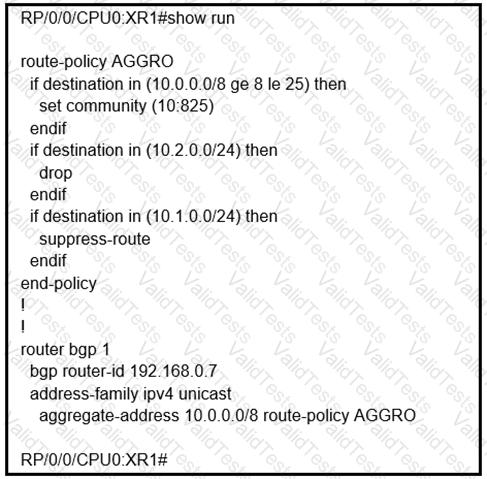
Question # 57

A network operator is working to filter routes from being advertised that are covered under

an aggregate announcement. The receiving router of the aggregate announcement block is still getting some of the more specific routes plus the aggregate. Which configuration change ensures that only the aggregate is announced now and in the future if other networks are to be added?

Options:

A.

Configure the summary-only keyword on the aggregate command

B.

Set each specific route in the AGGRO policy to drop instead of suppress-route

C.

Filter the routes on the receiving router

D.

Set each specific route in the AGGRO policy to remove instead of suppress-route

Expert Solution
Questions # 58:

What is a feature of SR-PCE?

Options:

A.

It learns the topology information via OSPF or IS-IS only

B.

It learns the topology information via OSPF or IS-IS or through BGP-LS.

C.

It uses the IGP metric in its path calculations to optimize reachability.

D.

It uses the TE metric in its calculations to optimize the cumulative TE metric

Expert Solution
Questions # 59:

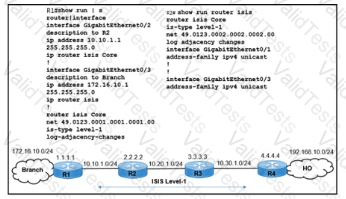
NO: 170

Question # 59

Refer to the exhibit. Users at the branch office on R1 reported issue with an application at the home office on R4. While troubleshooting the issue, a network engineer determined that

    The branch-office users can connect to the home office.

    The IS-IS adjacencies between R1 and R2 and R1 and the branch office are up.

    Traffic from R1 to the R2 10.20.1.0/24 network is moving normally.

    The application at the home office is experiencing packet drops on the connection to the Branch, and R3 cannot reach the R1 172.16.10.0/24 network.

Which action resolves the issues?

Options:

A.

Redistribute static connected routes in IS-IS on router RI.

B.

Configure the IS-IS core instance on the RI GigabitEthernet0/3 interface.

C.

Redistribute static connected routes in IS-IS on router R4.

D.

Configure the IS-IS core instance on the R2 GigabitEthernet0/1 interface.

Expert Solution
Questions # 60:

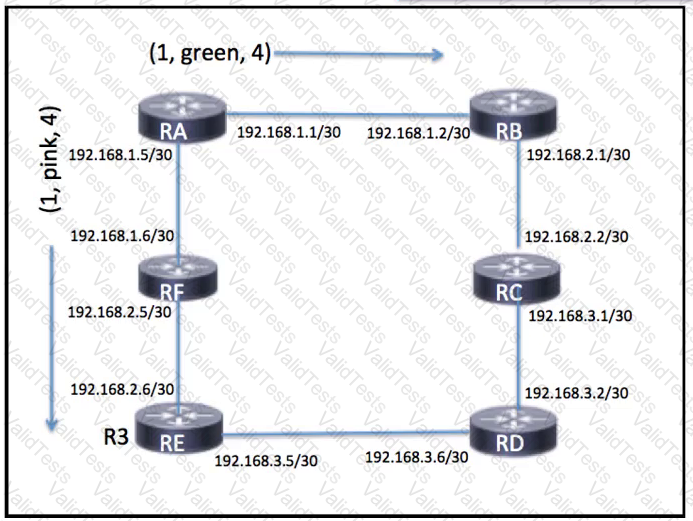
Refer to the exhibit.

Question # 60

The green policy is designed with low delay, and the pink policy is designed with low cost. What is the next hop for node A on its way to node D, with the objective of achieving a low delay?

Options:

A.

192.168.3.2

B.

192.168.1.6

C.

192.168.3.6

D.

192. 168.1.2

Expert Solution
Viewing page 6 out of 8 pages
Viewing questions 51-60 out of questions