Pre-Summer Special Limited Time 70% Discount Offer - Ends in 0d 00h 00m 00s - Coupon code: validbest

Pass the Databricks Databricks-Certified-Associate-Developer-for-Apache-Spark-3.5 Questions and answers with ValidTests

Exam Databricks-Certified-Associate-Developer-for-Apache-Spark-3.5 All Questions
Exam Databricks-Certified-Associate-Developer-for-Apache-Spark-3.5 Premium Access

View all detail and faqs for the Databricks-Certified-Associate-Developer-for-Apache-Spark-3.5 exam

Viewing page 3 out of 5 pages
Viewing questions 21-30 out of questions
Questions # 21:

A data scientist is working with a Spark DataFrame called customerDF that contains customer information.The DataFrame has a column named email with customer email addresses. The data scientist needs to split this column into username and domain parts.

Which code snippet splits the email column into username and domain columns?

Options:

A.

customerDF.select(

col("email").substr(0, 5).alias("username"),

col("email").substr(-5).alias("domain")

)

B.

customerDF.withColumn("username", split(col("email"), "@").getItem(0)) \

.withColumn("domain", split(col("email"), "@").getItem(1))

C.

customerDF.withColumn("username", substring_index(col("email"), "@", 1)) \

.withColumn("domain", substring_index(col("email"), "@", -1))

D.

customerDF.select(

regexp_replace(col("email"), "@", "").alias("username"),

regexp_replace(col("email"), "@", "").alias("domain")

)

Expert Solution
Questions # 22:

A data engineer is running a batch processing job on a Spark cluster with the following configuration:

10 worker nodes

16 CPU cores per worker node

64 GB RAM per node

The data engineer wants to allocate four executors per node, each executor using four cores.

What is the total number of CPU cores used by the application?

Options:

A.

160

B.

64

C.

80

D.

40

Expert Solution
Questions # 23:

A developer is working with a pandas DataFrame containing user behavior data from a web application.

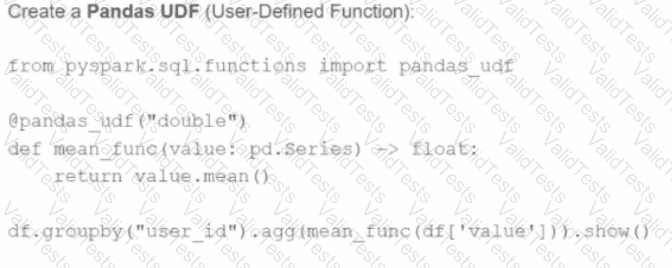
Which approach should be used for executing agroupByoperation in parallel across all workers in Apache Spark 3.5?

A)

Use the applylnPandas API

B)

Question # 23

C)

Question # 23

D)

Question # 23

Options:

A.

Use theapplyInPandasAPI:

df.groupby("user_id").applyInPandas(mean_func, schema="user_id long, value double").show()

B.

Use themapInPandasAPI:

df.mapInPandas(mean_func, schema="user_id long, value double").show()

C.

Use a regular Spark UDF:

from pyspark.sql.functions import mean

df.groupBy("user_id").agg(mean("value")).show()

D.

Use a Pandas UDF:

@pandas_udf("double")

def mean_func(value: pd.Series) -> float:

return value.mean()

df.groupby("user_id").agg(mean_func(df["value"])).show()

Expert Solution
Questions # 24:

A data engineer has been asked to produce a Parquet table which is overwritten every day with the latest data. The downstream consumer of this Parquet table has a hard requirement that the data in this table is produced with all records sorted by themarket_timefield.

Which line of Spark code will produce a Parquet table that meets these requirements?

Options:

A.

final_df \

.sort("market_time") \

.write \

.format("parquet") \

.mode("overwrite") \

.saveAsTable("output.market_events")

B.

final_df \

.orderBy("market_time") \

.write \

.format("parquet") \

.mode("overwrite") \

.saveAsTable("output.market_events")

C.

final_df \

.sort("market_time") \

.coalesce(1) \

.write \

.format("parquet") \

.mode("overwrite") \

.saveAsTable("output.market_events")

D.

final_df \

.sortWithinPartitions("market_time") \

.write \

.format("parquet") \

.mode("overwrite") \

.saveAsTable("output.market_events")

Expert Solution
Questions # 25:

A data scientist has identified that some records in the user profile table contain null values in any of the fields, and such records should be removed from the dataset before processing. The schema includes fields like user_id, username, date_of_birth, created_ts, etc.

The schema of the user profile table looks like this:
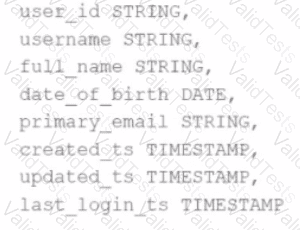
Question # 25

Which block of Spark code can be used to achieve this requirement?

Options:

Options:

A.

filtered_df = users_raw_df.na.drop(thresh=0)

B.

filtered_df = users_raw_df.na.drop(how='all')

C.

filtered_df = users_raw_df.na.drop(how='any')

D.

filtered_df = users_raw_df.na.drop(how='all', thresh=None)

Expert Solution
Questions # 26:

A developer notices that all the post-shuffle partitions in a dataset are smaller than the value set for spark.sql.adaptive.maxShuffledHashJoinLocalMapThreshold.

Which type of join will Adaptive Query Execution (AQE) choose in this case?

Options:

A.

A Cartesian join

B.

A shuffled hash join

C.

A broadcast nested loop join

D.

A sort-merge join

Questions # 27:

3 of 55. A data engineer observes that the upstream streaming source feeds the event table frequently and sends duplicate records. Upon analyzing the current production table, the data engineer found that the time difference in the event_timestamp column of the duplicate records is, at most, 30 minutes.

To remove the duplicates, the engineer adds the code:

df = df.withWatermark("event_timestamp", "30 minutes")

What is the result?

Options:

A.

It removes all duplicates regardless of when they arrive.

B.

It accepts watermarks in seconds and the code results in an error.

C.

It removes duplicates that arrive within the 30-minute window specified by the watermark.

D.

It is not able to handle deduplication in this scenario.

Questions # 28:

A Spark developer wants to improve the performance of an existing PySpark UDF that runs a hash function that is not available in the standard Spark functions library. The existing UDF code is:
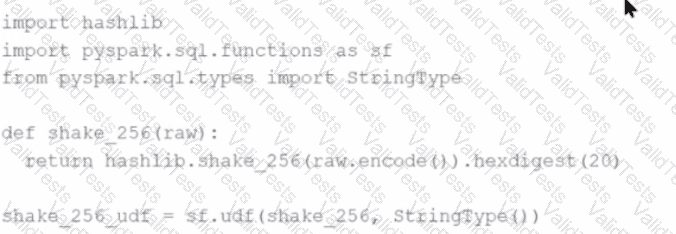
Question # 28

import hashlib

import pyspark.sql.functions as sf

from pyspark.sql.types import StringType

def shake_256(raw):

return hashlib.shake_256(raw.encode()).hexdigest(20)

shake_256_udf = sf.udf(shake_256, StringType())

The developer wants to replace this existing UDF with a Pandas UDF to improve performance. The developer changes the definition of shake_256_udf to this:CopyEdit

shake_256_udf = sf.pandas_udf(shake_256, StringType())

However, the developer receives the error:

What should the signature of the shake_256() function be changed to in order to fix this error?

Options:

A.

def shake_256(df: pd.Series) -> str:

B.

def shake_256(df: Iterator[pd.Series]) -> Iterator[pd.Series]:

C.

def shake_256(raw: str) -> str:

D.

def shake_256(df: pd.Series) -> pd.Series:

Questions # 29:

A Spark DataFrame df is cached using the MEMORY_AND_DISK storage level, but the DataFrame is too large to fit entirely in memory.

What is the likely behavior when Spark runs out of memory to store the DataFrame?

Options:

A.

Spark duplicates the DataFrame in both memory and disk. If it doesn't fit in memory, the DataFrame is stored and retrieved from the disk entirely.

B.

Spark splits the DataFrame evenly between memory and disk, ensuring balanced storage utilization.

C.

Spark will store as much data as possible in memory and spill the rest to disk when memory is full, continuing processing with performance overhead.

D.

Spark stores the frequently accessed rows in memory and less frequently accessed rows on disk, utilizing both resources to offer balanced performance.

Questions # 30:

A developer is working with a pandas DataFrame containing user behavior data from a web application.

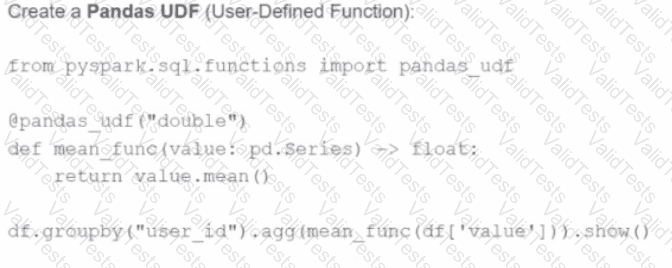
Which approach should be used for executing a groupBy operation in parallel across all workers in Apache Spark 3.5?

A)

Use the applylnPandas API

B)

Question # 30

C)

Question # 30

D)

Question # 30

Options:

A.

Use the applyInPandas API:

df.groupby("user_id").applyInPandas(mean_func, schema="user_id long, value double").show()

B.

Use the mapInPandas API:

df.mapInPandas(mean_func, schema="user_id long, value double").show()

C.

Use a regular Spark UDF:

from pyspark.sql.functions import mean

df.groupBy("user_id").agg(mean("value")).show()

D.

Use a Pandas UDF:

@pandas_udf("double")

def mean_func(value: pd.Series) -> float:

return value.mean()

df.groupby("user_id").agg(mean_func(df["value"])).show()

Viewing page 3 out of 5 pages
Viewing questions 21-30 out of questions