A client is attempting to log in to a web application that requires authentication. The following HTTP headers are sent by the client:
GET /owa/ HTTP/1.1
Authorization: Basic dXNlcm5hbWU6cGFzc3dvcmQ=
User-Agent: curl/7.26.0
Host: 10.0.0.14
Accept: */*
Accept-EncodinG. gzip,deflate
The web server is responding with the following HTTP headers:
HTTP/1.1 401 Unauthorized
Content-TypE. text/html
Server: Microsoft-IIS/7.5
WWW-AuthenticatE. NTLM
DatE. Wed, 16 Aug 1977 19:12:31 GMT
Content-LengtH. 1293
The client has checked the login credentials and believes the correct details are being entered.
What is the reason the destination web server is sending an HTTP 401 response?
An LTM Specialist decides to offload SSL traffic on the LTM device instead of just passing it through. The LTM Specialist needs to change the configure from a Performance (Layer 40 virtual server to a Standard virtual server with SSL offload.
Which two element the LTM Specialist consider when performance this task? (Choose two.)
A web application sends information about message integrity and content life time to the client.
Which two HTTP headers should be used in sending the client information? (Choose two.)
What is the status of a pool member when manual resume is enabled and a health check first fails and then passes?
An LTM Specialist must create a new virtual server for HTTP access. The LTM Specialist creates a forwarding virtual server to reach the resource.
What is a potential result of this action?
A BIG-IP Administrator suspects that one of the BIG-IP device power supplies is experiencing power
outages.
Which log file should the BIG-IP Administrator check to verify the suspicion?
Refer to the following iRule:
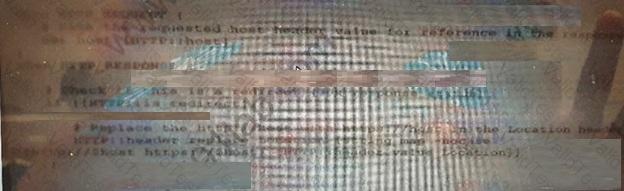
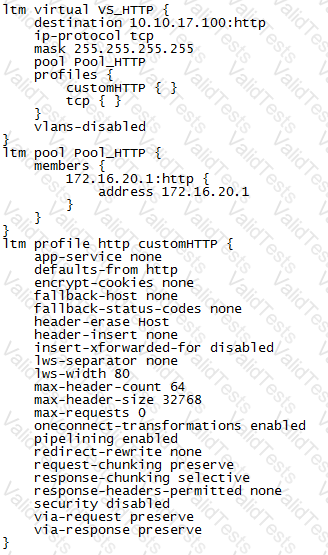
What is a complete list of profiles that must be applied to the virtual server for this iRule?
What is the correct command to reset an LTM device to its default settings?
An LTM Specialist needs to configures virtual server that uses PVA or OPVA Which virtual server type should be used?
An LTM Specialist needs to terminate client SSL traffic and based on the cookie presented by client.
Which set of profiles should the LTM Specialist use?
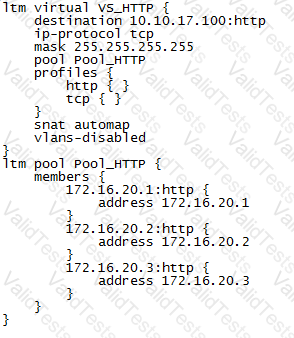
A BIG-IP Administrator creates an HTTP Virtual Server using an iApp template. After the Virtual Server is
created, the user requests to change the destination IP addresses. The BIG-IP Administrator tries to
change the destination IP address from 10.1.1.1 to 10.2.1.1 in Virtual Server settings, but receives the
following error:
The application service must be updated using an application management interface
What is causing this error?
-- Exhibit –
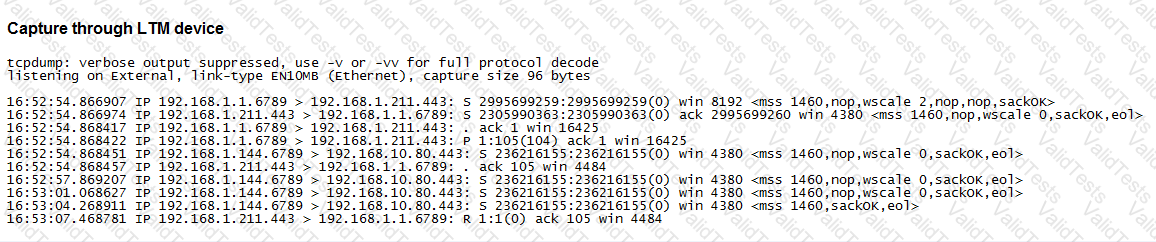
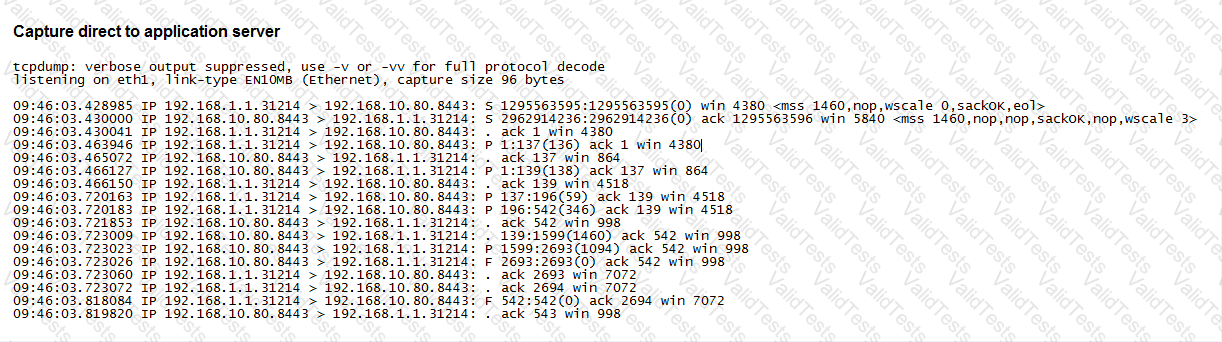


-- Exhibit --
Refer to the exhibits.
An LTM Specialist is troubleshooting an application configured on an LTM device on a one-armed configuration. The application is NOT working through the LTM device but does work when accessed directly via the application servers. The virtual server 192.168.1.211:443 is configured to SNAT using the address 192.168.1.144 and references a pool with the member 192.168.10.80:443. No Client or Server SSL profiles are associated. The LTM Specialist has collected two traffic captures to help determine the issue.
What is the problem with the configuration on the LTM device?
An application is configured on an LTM device:
Virtual server: 10.0.0.1:80 (VLAN vlan301)
SNAT IP: 10.0.0.1
Pool members: 10.0.1.1:8080, 10.0.1.2:8080, 10.0.1.3:8080 (VLAN vlan302)
Which packet capture should the LTM Specialist perform on the LTM device command line interface to capture only server traffic specifically for this application?
A BIG-IP Administrator needs to apply a health monitor for a pool of database servers named DB_Pool
that uses TCP port 1521.
Where should the BIG-IP Administrator apply this monitor?
A custom TCP application using a single server is being migrated to the LTM device. A server is being added to the pool. The application is known to violate the TCP protocol RFC. Theapplication currently works without error from a user perspective.
Which virtual server type is appropriate in this situation?


