A LTM device needs to load balance active and passive FTP traffic while using only a single virtual server.
Which virtual server type should an LTM Specialist configure on the LTM device?
An LTM Specialist has recently taken over administration or an LTM devicethat has experienced resource availability issues. The LTM device will need to be solely used for load balancing and SSL offload. Previously, the LTM device was also used to provide statistical analysis of application traffic. However, that functionality has been moved to a third party solution.
Based on the output below, which configuration change should be made to ensure the LTM module receives the most amount of resources?

An LTM Specialist uploaded new releases .iso and .md5 files titled "BIGIP-FILENAME" via the GUI.
Which commands are run via the command line from the root directory to verify the integrity of the new .iso file?
The network team introduces a new subnet 10.10.22.0/24 to the network. The route needs to be configured on the F5 device to access this network via the 30.30.30.158 gateway.
How should the LTM Specialist configure thisroute?
An LTM Specialist is tasked with ensuring that the syslogs for the LTM device are sent to a remote syslog server.
The following is an extract from the config file detailing the node and monitor that the LTM device is using for the
remote syslog server:
monitor
Syslog_15002 {
defaults from udp
dest *:15002
}
node 91.223.45.231 {
monitor Syslog_15002
screen RemoteSYSLOG
}
There seem to be problems communicating with the remote syslog server. However, the pool monitor shows that the remote server is up.
The network department has confirmed that there are no firewall rules or networking issues preventing the LTM device from
communicating with the syslog server. The department responsible for the remote syslog server indicates that there may
be problems with the syslog server. The LTM Specialist checks the BIG-IP LTM logs for errors relating to the remote syslog
server. None are found. The LTM Specialist does a tcpdump:
tcpdump -nn port 15002, with the following results:
21:28:36.395543 IP 192.168.100.100.44772 > 91.223.45.231.15002: UDP, length 19
21:28:36.429073 IP 192.168.100.100.39499 > 91.223.45.231.15002: UDP, length 169
21:28:36.430714 IP 192.168.100.100.39499 > 91.223.45.231.15002: UDP, length 181
21:28:36.840524 IP 192.168.100.100.39499 > 91.223.45.231.15002: UDP, length 169
21:28:36.846547 IP 192.168.100.100.39499 > 91.223.45.231.15002: UDP, length 181
21:28:39.886343 IP 192.168.100.100.39499 > 91.223.45.231.15002: UDP, length 144
NotE. 192.168.100.100 is the self IP of the LTM device.
Why are there no errors for the remote syslog server in the log files?
An LTM device supports two power supplies. The value of the BigDB key "platform.powersupplymonitor" is equal to enable.
Where would the error message be visible if one of the power supplies fails or is NOT plugged in?
A virtual server with SNAT automap enabled selects pool member 10.20.0.10.443 for the server-side flow. The client side flow source IP is 192.168.0.10 .

Which source IP should be expected inthe server-side connection?
The BIG-IP Administrator configures an HTTP monitor with a specific receive string. The status is marked
'down'.
Which tool should the administrator use to identify the problem?
A virtual serverconfiguration for traffic destined to a server is as shown:
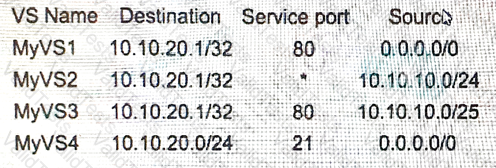
HTTP traffic is destined to the 10 10.20.1 server from the source
Based on precedence, which virtual server accepts this traffic?
An LTM Specialist is troubleshooting an issue with a new virtual server. When connecting through the virtual server, clients receive the message "The connection was reset" in the browser, although connections directly to the pool member show the application is functioning correctly.
ltm pool srv1_https_pool {
members {
192.168.2.1:https{
address 192.168.2.1
}
}
}
ltm virtual https_example_vs {
destination 192.168.1.155:https
ip-protocol tcp
mask 255.255.255.255
pool srv1_https_pool
profiles {
http { }
tcp { }
}
snat automap
vlans-disabled
}
How should the LTM Specialist resolve this issue?
-- Exhibit –
-- Exhibit --
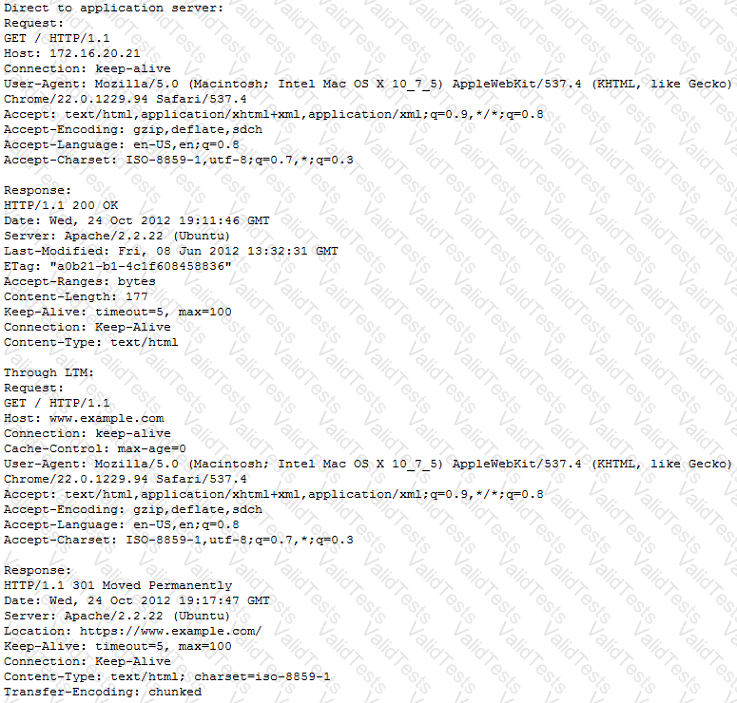
Refer to the exhibit.
An LTM Specialist configures a virtual server to perform client-side encryption while allowing the server-side traffic to be unencrypted. Application owners report that images are failing to load through the virtual server; however, images load when going directly to the server.
What is the problem with the images loading through the virtual server?
An LTM Specialist upgrades the switchinginfrastructure and the backend servers on the LAN segments.
The LTM Specialist notices a 20% memory usage increase on the BIG-IP device while handling the same number of concurrent connections.
A comparison of statistics pre-upgrade and post-upgrade showsa significant reduction on the following:
-RTT between the BIG-IP device and the backend servers
-Packet drops in the switch
Time to First Byte (TTFB)
The LTM Specialist is concerned with the scalability of the number of concurrent connections with the newmemory usage.
Which setting should be changed to reduce the memory usage on the BIG-IP device?
Refer to the exhibit.
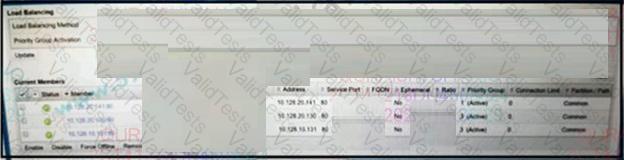
How are new connections load balanced?
An ecommerce company is experiencing latency issues with online shops during Black Friday's peak season.
The BIG-IP Administrator detects an overall high CPU load on the BIG-IP device and wants to move the
top utilized Virtual Servers to a dedicated BIG-IP device.
Where should the BIG-IP Administrator determine the problematic Virtual Servers?
An LTM Specialist needs to create a pool with a set of monitor that checks both the pool members and corresponding application service ports. The pool members have services on port 80. The application service is on port 8009.
The LTM device should load balance traffic to the pool member when the pool member and corresponding application service pass monitor.
Which monitor and parameter set meets this requirement?


