On the VCMP system, a BIG-IP host administrator imports a new ISO image into the host's /shared/images folder. The new ISO images that reside on the vCMP host are available for installation on the guest. How should the BIG-IP Administrator install one image from within the guest?
An LTM Specialist is removing some of the load off an existing cluster by adding a adding a third BIG-IP
device to the device group. The new device candeliver twice the performance of the other two devices.
The LTM Specialist needs to make sure that the BIG-IP device with the highest available capacity is
always selected to take over a traffic group in the event of a failover.
Which failover method is most appropriate?
Refer to the exhibit.
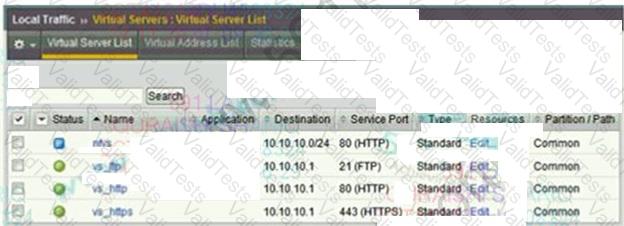
A user attempts to connect to 10.10.10.1.80 using FTP over SSL with an FTPS client. Which virtual server will match and attempt to process the request?
The BIG-IP Administrator needs to ensure the correct health monitor is being used lor a new HTTP pool
named P_example.
Where should the BIG-IP Administrator validate these settings in the Configuration Utility?
A node is assigned two monitors as seen in this configuration.
What is the status of a member that runs on that node and listens on port 443?
-- Exhibit –
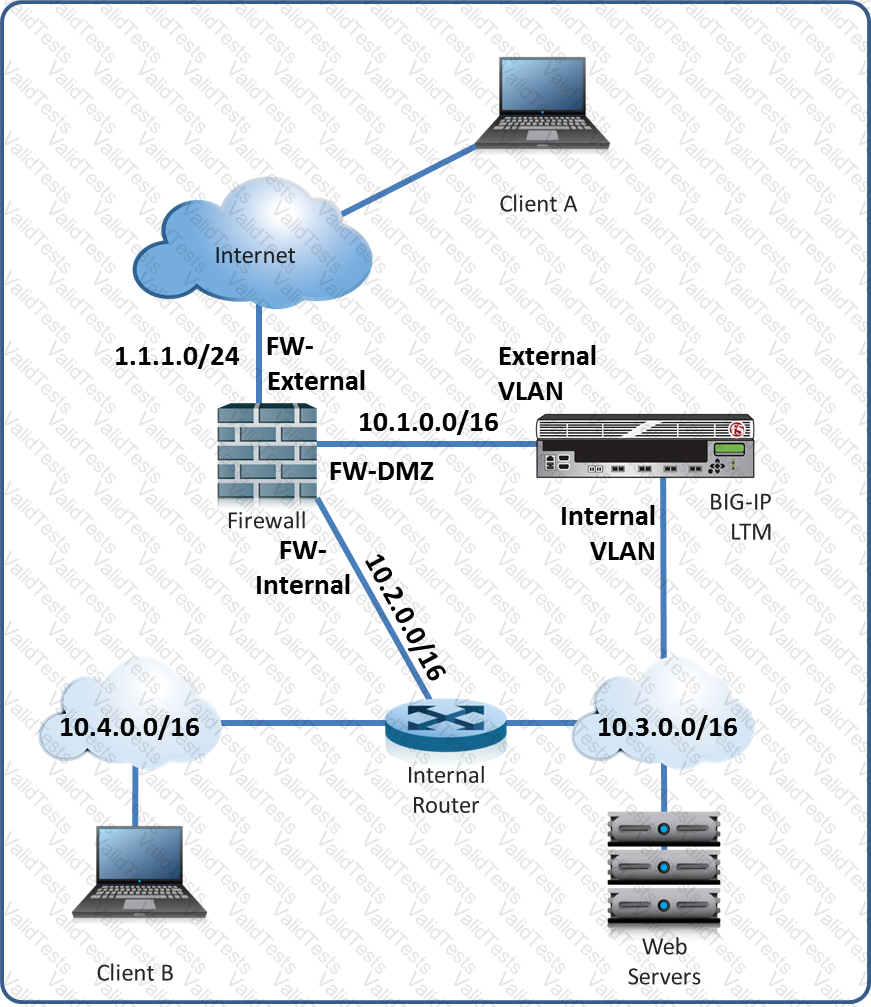
-- Exhibit --
Refer to the exhibit.
A layer 2 nPath routing configuration has been deployed. A packet capture contains a client connection packet with the following properties:
Source IP:
Destination IP:
At which two locations could the packet capture have been taken? (Choose two.)
Refer to the exhibit
The BIG-IP Administrator is unable to access the management console via Self-IP 10.10 1.33 and port 443.
What is the reason for this problem?
In preparation for a maintenance task, an LTM Specialist performs a "Force to Standby" on LTM device Unit 1. LTM device Unit 2 becomes active as expected. The maintenance task requires the reboot of Unit 1. Shortly after the reboot is complete, the LTM Specialist discovers that Unit 1 has become active and Unit 2 has returned to standby.
What would cause this behavior?
An LTM Specialist needs to rewrite text within an HTML response from a web server. A client is sending the HTTP request below:
GET / HTTP/1.1
Host: www.f5.com
User-Agent: Mozilla/5.0 (Windows NT 6.1; WOW64; rv:16.0) Gecko/20100101 Firefox/16.0
Accept: text/html,application/xhtml+xml,application/xml;q=0.9,*/*;q=0.8
Accept-LanguagE. en-US,en;q=0.5
Accept-EncodinG. gzip, deflate
Cache-Control: no-cache
Connection: keep-alive
CookiE. somecookie=1
Although a stream profile has been added to the virtual server, the content within the HTTP response is NOT being matched, and therefore NOT modified.
Which HTTP header should the LTM Specialist remove from the request to ensure the content can be matched and modified?
An LTM Specialist has been asked to configure a virtual server to distribute connections between a pool of two application servers with addresses 172.16.20.1 and 172.16.20.2. The application servers are listening on TCP ports 80 and 443. The application administrators have asked that clients be directed to the same node for both HTTP and HTTPS requests within the same session.
Virtual servers vs_http and vs_https have been created, listening on 1.2.3.100:80 and 1.2.3.100:443, respectively.
Which configuration option will result in the desired behavior?
An LTM Specialist is configuring a client profile to offload processing a new application Company policy requires that clients can resume session for up to 30 minutes, but must renegotiate a new session after that.
Which setting should the LTM Specialist change to satisfy this requirement?
While investigating the cause of a device failover, an LTM Specialist discovers the following events in /var/log/ltm:
01010029:5: Clock advanced by 518 ticks
01010029:5: Clock advanced by 505 ticks
01010029:5: Clock advanced by 590 ticks
01010029:5: Clock advanced by 568 ticks
01010029:5: Clock advanced by 1681 ticks
01010029:5: Clock advanced by 6584 ticks
01140029:5: HA daemon_heartbeat tmm fails action is failover and restart.
010c0026:5: Failover condition, active attempting to go standby.
Which issue caused the failover?
An LTM device provides load balancing to a web application? The LTM device has two dual-core processors and a licensed SSL Transactions Per Second (TPS) limit of 500 CMP is enabled.
TLS connections are used between client systems and virtual servers on the LTM device, as well as from the LTM device to servers used as part of LTM pool.
TLS enabled virtual servers utilize certificates based on 2048-bit keys
During a peak period. 2560 new TLStransactions per second are attempted to the web application via the LTM device.
What will happen in this scenario?
An LTM device has a virtual server mapped to www5f.com with a pool assigned. The objects are defined
as follows:
Virtual server. Destination 192.168.245.100.443 netmask 255.255.255.0
Persistence: Source address persistence netmask 255.0.0.0
SNAT:AutoMap
Profiles: HnP/TCP
How should the BIG-IP Administrator modify the persistence profile so that each unique IP address
creates a persistence record?
A user wants to use the iHealth Upgrade Advisor to determine any issues with upgrading TMOS from 13.0 to 13.1.
Where can the user generate the QKView to upload to iHealth?


