
View all detail and faqs for the FCSS_EFW_AD-7.6 exam
A user reports that their computer was infected with malware after accessing a secured HTTPS website. However, when the administrator checks the FortiGate logs, they do not see that the website was detected as insecure despite having an SSL certificate and correct profiles applied on the policy.
How can an administrator ensure that FortiGate can analyze encrypted HTTPS traffic on a website?
Which two statements about IKEv2 are true if an administrator decides to implement IKEv2 in the VPN topology? (Choose two.)
Refer to the exhibit, which shows a physical topology and a traffic log.

The administrator is checking on FortiAnalyzer traffic from the device with IP address 10.1.10.1, located behind the FortiGate ISFW device.
The firewall policy in on the ISFW device does not have UTM enabled and the administrator is surprised to see a log with the action Malware, as shown in the exhibit.
What are the two reasons FortiAnalyzer would display this log? (Choose two.)
An administrator received a FortiAnalyzer alert that a 1 ТВ disk filled up in a day. Upon investigation, they found thousands of unusual DNS log requests, such as JHCMQK.website.com, with no answers. They later discovered that DNS exfiltration was occurring through both UDP and TLS.
How can the administrator prevent this data theft technique?
Refer to the exhibits.


The Administrators section of a root FortiGate device and the Security Fabric Settings section of a downstream FortiGate device are shown.
When prompted to sign in with Security Fabric in the downstream FortiGate device, a user enters the AdminSSO credentials.
What is the next status for the user?
Refer to the exhibit, which shows an enterprise network connected to an internet service provider.

An administrator must configure a loopback as a BGP source to connect to the ISP.
Which two commands are required to establish the connection? (Choose two.)
Refer to the exhibit, which contains the partial output of an OSPF command.

An administrator is checking the OSPF status of a FortiGate device and receives the output shown in the exhibit.
What two conclusions can the administrator draw? (Choose two.)
Refer to the exhibit, which shows a partial troubleshooting command output.
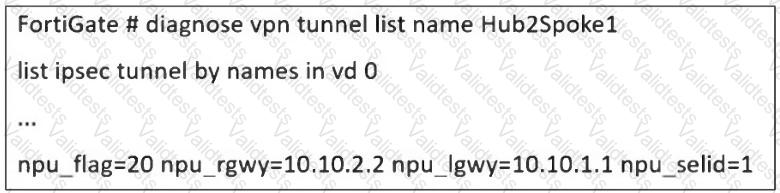
An administrator is extensively using IPsec on FortiGate. Many tunnels show information similar to the output shown in the exhibit.
What can the administrator conclude?
Refer to the exhibit, which shows a partial enterprise network.
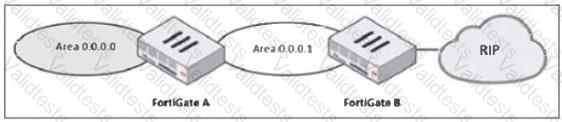
An administrator would like the area 0.0.0.0 to detect the external network.
What must the administrator configure?
A user reports that their computer was infected with malware after accessing a secured HTTPS website. However, when the administrator checks the FortiGate logs, they do not see that the website was detected as insecure despite having an SSL certificate and correct profiles applied on the policy.
How can an administrator ensure that FortiGate can analyze encrypted HTTPS traffic on a website?

 BGP normally expects directly connected neighbors, but since the ISP and FortiGate A are using loopback interfaces, packets will not be sent directly between their physical interfaces.
 The ebgp-enforce-multihop command allows BGP to form an eBGP peering over multiple hops.
 Since FortiGate is using a loopback interface as the source, the update-source command ensures that BGP updates originate from the loopback interface rather than a physical interface.
 This is essential because BGP peers must match the source IP with the configured neighbor address.