
View all detail and faqs for the FCSS_EFW_AD-7.6 exam
Refer to the exhibit, which contains a partial command output.
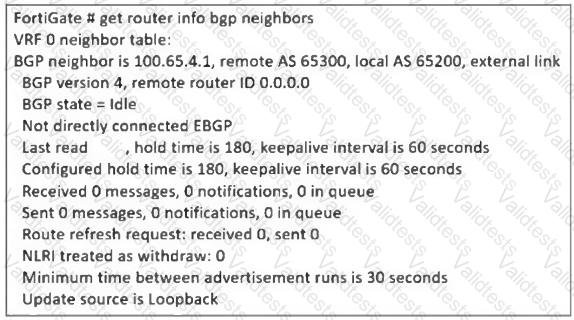
The administrator has configured BGP on FortiGate. The status of this new BGP configuration is shown in the exhibit.
What configuration must the administrator consider next?
Refer to the exhibit, which shows an ADVPN network.
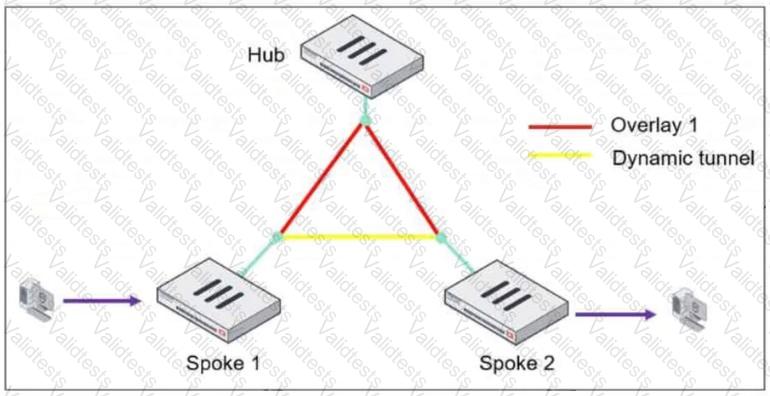
The client behind Spoke-1 generates traffic to the device located behind Spoke-2.
What is the first message that the hub sends to Spoke-1 to bring up the dynamic tunnel?
A FortiGate device with UTM profiles is reaching the resource limits, and the administrator expects the traffic in the enterprise network to increase.
The administrator has received an additional FortiGate of the same model.
Which two protocols should the administrator use to integrate the additional FortiGate device into this enterprise network? (Choose two.)
Refer to the exhibit, which contains the partial output of an OSPF command.
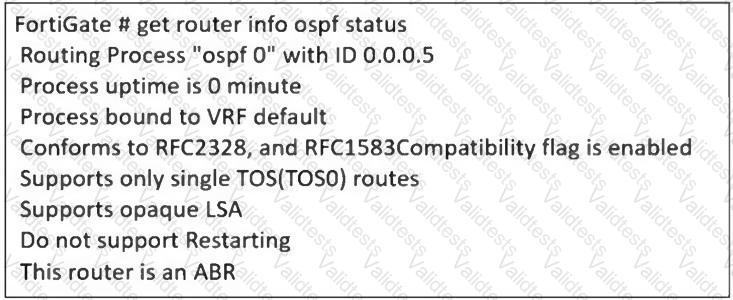
An administrator is checking the OSPF status of a FortiGate device and receives the output shown in the exhibit.
What two conclusions can the administrator draw? (Choose two.)
Which two statements about IKEv2 are true if an administrator decides to implement IKEv2 in the VPN topology? (Choose two.)
Refer to the exhibit.
A pre-run CLI template that is used in zero-touch provisioning (ZTP) and low-touch provisioning (LTP) with FortiManager is shown.
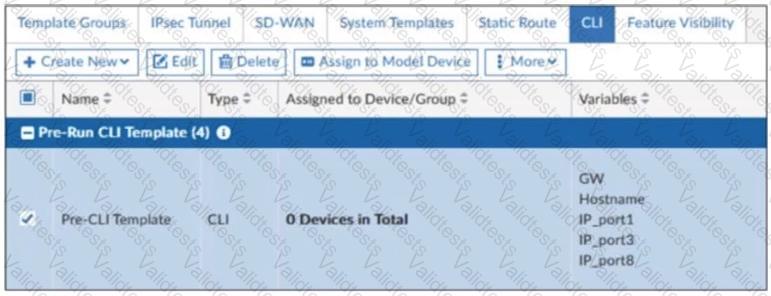
The template is not assigned even though the configuration has already been installed on FortiGate.
What is true about this scenario?
Refer to the exhibit.
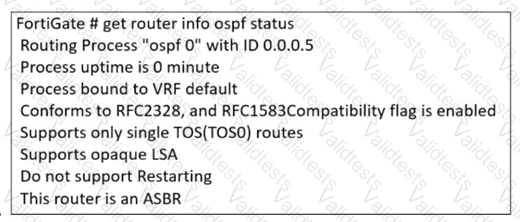
The partial output of an OSPF command is shown. You are checking the OSPF status of a FortiGate device when you receive the output shown in the exhibit. Based on the output, which two statements about FortiGate are correct? (Choose two answers)
Refer to the exhibit, which shows an enterprise network connected to an internet service provider.
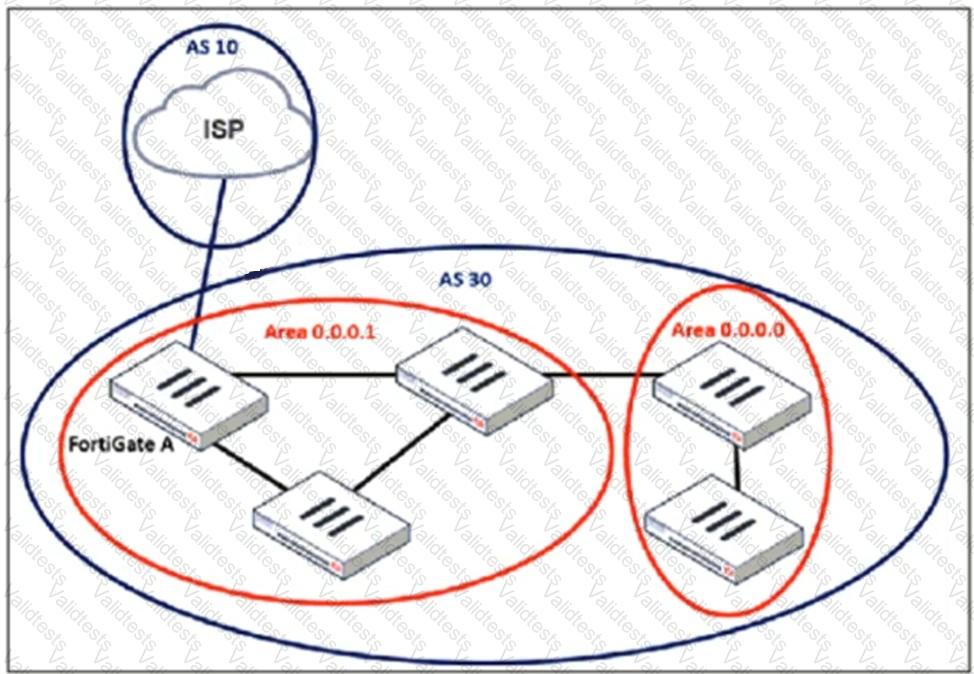
An administrator must configure a loopback as a BGP source to connect to the ISP.
Which two commands are required to establish the connection? (Choose two.)
The IT department discovered during the last network migration that all zero phase selectors in phase 2 IPsec configurations impacted network operations.
What are two valid approaches to prevent this during future migrations? (Choose two.)
An administrator needs to install an IPS profile without triggering false positives that can impact applications and cause problems with the user's normal traffic flow.
Which action can the administrator take to prevent false positives on IPS analysis?

 A client behind Spoke-1 sends traffic to a device behind Spoke-2.
 The traffic initially flows through the hub, following the pre-established overlay tunnel.
 The hub detects that Spoke-1 is communicating with Spoke-2 and determines that a direct shortcut tunnel between the spokes can optimize the connection.
 The hub sends a "Shortcut Offer" message to Spoke-1, informing it that a direct dynamic tunnel to Spoke-2 is possible.
 Spoke-1 and Spoke-2 then negotiate and establish a direct IPsec tunnel for communication.
 FGSP allows session-aware load balancing between multiple FortiGate units without requiring them to be in an HA (High Availability) cluster.
 With external load balancers, incoming traffic is evenly distributed across multiple FortiGate devices.
 This approach is useful for scaling out traffic handling capacity while ensuring that sessions remain synchronized between firewalls.
 FGSP is effective when stateful failover is required but without the constraints of traditional HA.
 FGCP active-active mode enables multiple FortiGate devices to share traffic loads, increasing throughput and efficiency.
 Active-active mode is suitable for balancing UTM processing across multiple FortiGates, making it ideal when resource limits are a concern.
 Using switches ensures redundancy and avoids single points of failure in the network.
 This mode is commonly used in enterprise networks where both scalability and redundancy are required.
 BGP normally expects directly connected neighbors, but since the ISP and FortiGate A are using loopback interfaces, packets will not be sent directly between their physical interfaces.
 The ebgp-enforce-multihop command allows BGP to form an eBGP peering over multiple hops.
 Since FortiGate is using a loopback interface as the source, the update-source command ensures that BGP updates originate from the loopback interface rather than a physical interface.
 This is essential because BGP peers must match the source IP with the configured neighbor address.