Pre-Summer Special Limited Time 70% Discount Offer - Ends in 0d 00h 00m 00s - Coupon code: validbest

Pass the HP Aruba-ACNSA HPE6-A78 Questions and answers with ValidTests

Exam HPE6-A78 All Questions
Exam HPE6-A78 Premium Access

View all detail and faqs for the HPE6-A78 exam

Viewing page 4 out of 6 pages
Viewing questions 31-40 out of questions
Questions # 31:

Refer to the exhibit.
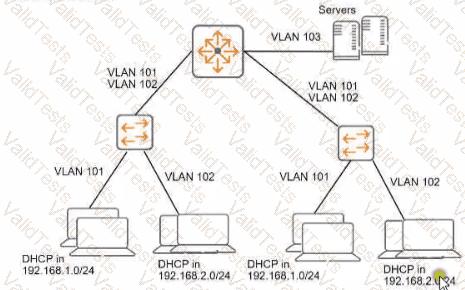
Question # 31

You need to ensure that only management stations in subnet 192.168.1.0/24 can access the ArubaOS-Switches' CLI. Web Ul. and REST interfaces The company also wants to let managers use these stations to access other parts of the network What should you do?

Options:

A.

Establish a Control Plane Policing class that selects traffic from 192.168 1.0/24.

B.

Specify 192.168.1.0.255.255.255.0 as authorized IP manager address

C.

Configure the switch to listen for these protocols on OOBM only.

D.

Specify vlan 100 as the management vlan for the switches.

Expert Solution
Questions # 32:

You are deploying a new wireless solution with an Aruba Mobility Master (MM). Aruba Mobility Controllers (MCs), and campus APs (CAPs). The solution will include a WLAN that uses Tunnel for the forwarding mode and WPA3-Enterprise for the security option.

You have decided to assign the WLAN to VLAN 301, a new VLAN. A pair of core routing switches will act as the default router for wireless user traffic.

Which links need to carry VLAN 301?

Options:

A.

only links in the campus LAN to ensure seamless roaming

B.

only links between MC ports and the core routing switches

C.

only links on the path between APs and the core routing switches

D.

only links on the path between APs and the MC

Expert Solution
Questions # 33:

A company has an ArubaOS controller-based solution with a WPA3-Enterprise WLAN. which authenticates wireless clients to Aruba ClearPass Policy Manager (CPPM). The company has decided to use digital certificates for authentication A user's Windows domain computer has had certificates installed on it However, the Networks and Connections window shows that authentication has tailed for the user. The Mobility Controllers (MC's) RADIUS events show that it is receiving Access-Rejects for the authentication attempt.

What is one place that you can you look for deeper insight into why this authentication attempt is failing?

Options:

A.

the reports generated by Aruba ClearPass Insight

B.

the RADIUS events within the CPPM Event Viewer

C.

the Alerts tab in the authentication record in CPPM Access Tracker

D.

the packets captured on the MC control plane destined to UDP 1812

Expert Solution
Questions # 34:

What is a guideline for managing local certificates on an ArubaOS-Switch?

Options:

A.

Before installing the local certificate, create a trust anchor (TA) profile with the root CA certificate for the certificate that you will install

B.

Install an Online Certificate Status Protocol (OCSP) certificate to simplify the process of enrolling and re-enrolling for certificate

C.

Generate the certificate signing request (CSR) with a program offline, then, install both the certificate and the private key on the switch in a single file.

D.

Create a self-signed certificate online on the switch because ArubaOS-Switches do not support CA-signed certificates.

Expert Solution
Questions # 35:

Which is a correct description of a Public Key Infrastructure (PKI)?

Options:

A.

A device uses Intermediate Certification Authorities (CAs) to enable it to trust root CAs that are different from the root CA that signed its own certificate.

B.

A user must manually choose to trust intermediate and end-entity certificates, or those certificates must be installed on the device as trusted in advance.

C.

Root Certification Authorities (CAs) primarily sign certificates, and Intermediate Certification Authorities (CAs) primarily validate signatures.

D.

A user must manually choose to trust a root Certification Authority (CA) certificate, or the root CA certificate must be installed on the device as trusted.

Expert Solution
Questions # 36:

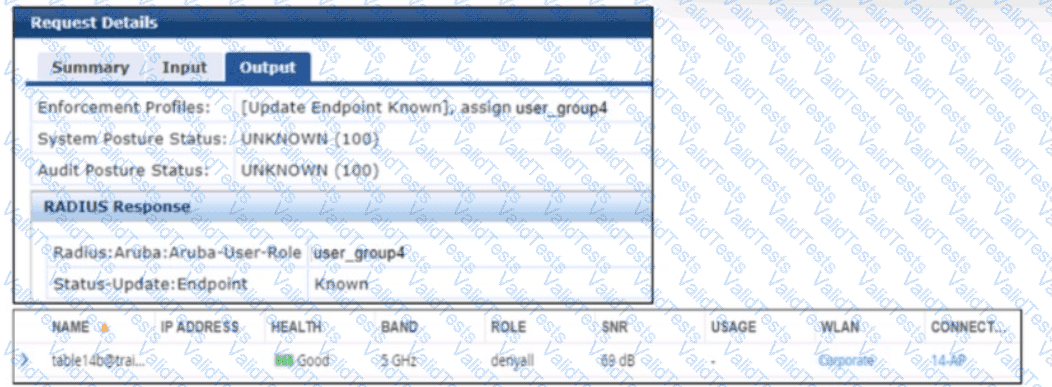
Refer to the exhibits.

Question # 36

A company has added a new user group. Users in the group try to connect to the WLAN and receive errors that the connection has no Internet access. The users cannot reach any resources. The first exhibit shows the record for one of the users who cannot connect. The second exhibit shows the role to which the AOS device assigned the user’s client.

What is a likely problem?

Options:

A.

The AOS device does not have the correct RADIUS dictionaries installed on it to understand the Aruba-User-Role VSA.

B.

The AOS device has a server derivation rule configured on it that has overridden the role sent by CPPM.

C.

The clients rejected the server authentication on their side because they do not have the root CA for CPPM’s RADIUS/EAP certificate.

D.

The role name that CPPM is sending does not match the role name configured on the AOS device.

Expert Solution
Questions # 37:

A customer has an AOS-10 network infrastructure. The customer is looking for a solution that can classify many different types of devices, including IoT devices. Which solution should you explain can provide these capabilities?

Options:

A.

HPE Aruba Networking EdgeConnect SD-WAN

B.

HPE Aruba Networking ClearPass OnGuard

C.

HPE Aruba Networking Central

D.

HPE Aruba Networking ClearPass Onboard

Expert Solution
Questions # 38:

You have been instructed to look in an AOS Security Dashboard’s client list. Your goal is to find clients that belong to the company and have connected to devices that might belong to hackers.

Which client fits this description?

Options:

A.

MAC address: d8:50:e6:f3:6d:a4; Client Classification: Authorized; AP Classification: Suspected Rogue

B.

MAC address: d8:50:e6:f3:6e:c5; Client Classification: Interfering; AP Classification: Neighbor

C.

MAC address: d8:50:e6:f3:6e:60; Client Classification: Interfering; AP Classification: Interfering

D.

MAC address: d8:50:e6:f3:70:ab; Client Classification: Interfering; AP Classification: Suspected Rogue

Expert Solution
Questions # 39:

Refer to the exhibit.

Device A is establishing an HTTPS session with the Arubapedia web sue using Chrome. The Arubapedia web server sends the certificate shown in the exhibit

What does the browser do as part of vacating the web server certificate?

Options:

A.

It uses the public key in the DigCen SHA2 Secure Server CA certificate to check the certificate's signature.

B.

It uses the public key in the DigCert root CA certificate to check the certificate signature

C.

It uses the private key in the DigiCert SHA2 Secure Server CA to check the certificate's signature.

D.

It uses the private key in the Arubapedia web site's certificate to check that certificate's signature

Expert Solution
Questions # 40:

Your HPE Aruba Networking Mobility Master-based solution has detected a rogue AP. Among other information, the AOS Detected Radios page lists this information for the AP:

SSID = PublicWiFi

BSSID = a8:bd:27:12:34:56

Match method = Plus one

Match method = Eth-Wired-Mac-Table

The security team asks you to explain why this AP is classified as a rogue. What should you explain?

Options:

A.

The AP has been detected using multiple MAC addresses. This indicates that the AP is spoofing its MAC address, which qualifies it as a suspected rogue.

B.

The AP is probably connected to your LAN because it has a BSSID that is close to a MAC address that has been detected in your LAN. Because it does not belong to the company, it is a suspected rogue.

C.

The AP is an AP that belongs to your solution. However, the AOS has detected that it is behaving suspiciously. It might have been compromised, so it is classified as a suspected rogue.

D.

The AP has a BSSID that is close to your authorized APs’ BSSIDs. This indicates that the AP might be spoofing the corporate SSID and attempting to lure clients to it, making the AP a suspected rogue.

Expert Solution
Viewing page 4 out of 6 pages
Viewing questions 31-40 out of questions