On the IS-IS IPv6 network shown in the figure, after the network becomes stable:
R1 can ping 2000:12::0, and
The display ipv6 neighbors command can be used to display the MAC address corresponding to 2000:12::0.

Is this statement TRUE or FALSE?
On the OSPFv3 network shown in the figure, OSPFv3 is enabled on the interfaces connecting R1, R2, and R3. The router ID of each router is 10.0.X.X, where X is the number of the router. If you check detailed information about an LSA on R3, the command output shows that the LSA is generated by R2 and describes the IPv6 prefix address associated with the Router-LSA.

A network device has established an OSPF neighbor relationship with another device. The figure shows the configuration of GE0/0/0 on the network device.

Which of the following commands would NOT affect the OSPF neighbor status of the interface?
The path that IP packets pass through on an MPLS network is called a label switched path (LSP). An LSP is a bidirectional path that specifies the transmission direction of data flows.
R1 and R2 use directly connected interfaces to establish an EBGP peer relationship. R1 imports 2000:: 1/128 to BGR By default, which of the following is the next hop of the route from R2 to 2000:: 1/128?

On the OSPFv3 network shown in the figure:
Area 1 is a stub area
Area 2 is a common area
Area 3 is an NSSA
The IPv6 address of Loopback0 on R6 is 2000::6/128.
The router ID of each router is 10.0.X.X, where X is the router number.
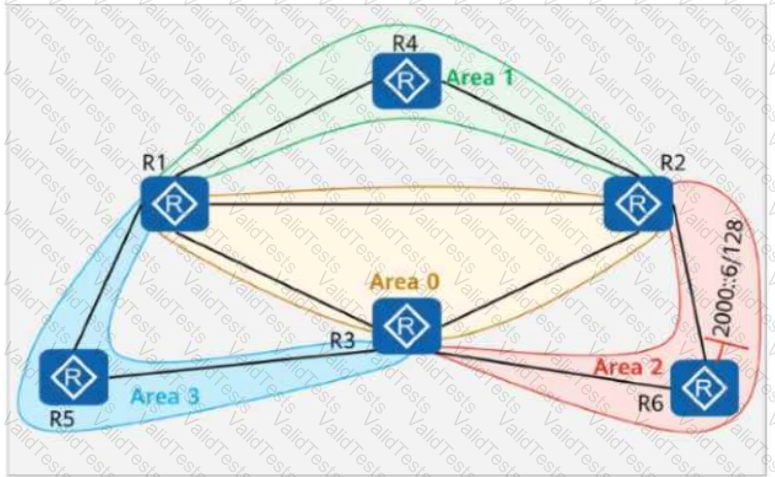
Which of the following statements are true?
On the OSPFv3 network shown in the figure, area 1 is a stub area, area 2 is a common area, and area 3 is an NSSA. Which of the following LSAs is displayed only in area 2?

On the network shown in the figure, IS-IS runs on R1, R2, R4, and R5, and the area ID is 49.0001. IS-IS runs on R3 and R6, and the area ID is 49.0002. The import-route isis level-2 into level-1 command is configured on R2 and R5. In AS 65000, R1, R3, R4, and R6 each establish iBGP peer relationships with R2 and R5. R2 and R5 are RR (Route Reflectors), and R1, R4, R3, and R6 are the iBGP peer relationship clients. The iBGP peer relationship ID is 10.0.0.X/32, where X is the number of the iBGP router. R1 and R4 import the external route 192.168.1.0/24 to BGP through the import-route command, and R3 and R6 import the external route 192.168.2.0/24 to BGP through the import-route command. Which of the following statements are true?

The figure shows the LSP information of R1 and R3 on an MPLS network. An administrator runs the ping -a 1.1.1.1 3.3.3.3 command on R1. Given this, which of the following statements is true?

On the IS-IS network shown in the figure, R1 imports a default route using the default-route-advertise always level-1 command. Which of the following statements are true?



