Which of the following is derived from a schedule model to meet the project execution plan and achieve management approval for use as a baseline?
The objective of a solution implemented was to increase the number of customer calls resolved per hour.
When using basic statistical sampling concepts, what does the business analyst (BA) need to consider?
A business analyst (BA) has been coordinating several meetings with stakeholders to reach consensus regarding the solution design to implement a global currency exchange system for an international bank. Consensus has not been reached yet, although BA has great communication skills and is trusted by all stakeholders. The stakeholders formally approved the business need initially.
Why is there disagreement?
A company finalized the implementation of a new, corporate-wide database. After nearly three months of operation, the solution is repeatedly producing invalid outputs. A business analyst (BA) has been asked to investigate the solution's problem. The BA has been able to find several instances where the outputs from the solution are below an acceptable level of quality.
Which of the following techniques should the BA use to identify the solution limitations?
The BA Is finalizing the definition of the requirements architecture by understanding how requirements relate to each other. A key component that must be apparent in all three diagrams is that none of the requirements be linked in different or conflicting ways. What relationship quality criterion does this represent?
A major manufacturer of popular beverages has appointed a local distributor to serve a specific territory. The demand for the beverages has a pronounced seasonal pattern. The distributor performs well overall, but is repeatedly unable to keep up with fulfilling many customer orders during peak demand periods. The distributor's current delivery capability is stretched to deliver 60 tons of merchandise per day whereas the season's peak demand periods need a daily delivery capability of up to 100 tons.
The distributor is under pressure to fully meet the year-round market demand in order to stay in business. The distributor's management wants to identify and consider more cost-effective options as resorting to adding more trucks and drivers would not be economically feasible.
A business analyst (BA) has spent several days observing and measuring the warehouse activities to understand the situation and to gain insights into possible solutions. The delivery workflow is a four-step process: (1) picking the orders and assembling them on trays, (2) bringing the trays to the loading bay, (3) loading the orders into trucks, and (4) delivering the orders to customers. As the following table illustrates, overall performance depends is dependent on five major resources: (1) the workers who pick the orders and load them into trucks, (2) the tallyers who check the orders, (3) the drivers, (4) the trucks, and (5) eight loading bays (LBs).
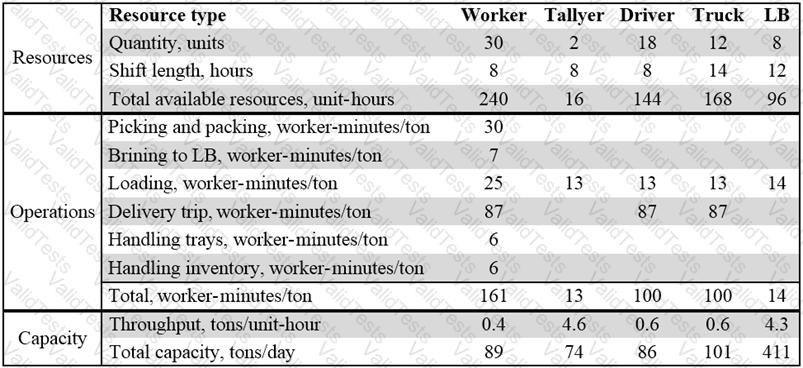
Preparing a customer order for loading takes about one hour. Upon the BA's observation, only 30% of trips have their orders available for loading when a truck arrives. This causes a waste of both the truck's and the driver's time.
What should the BA recommend to eliminate such waste?
An insurance company wants to increase sales by 15% and customer retention by 10% within 1 calendar year.
Various strategies to achieve this were considered and a restructure to the existing pricing model is selected to help achieve these goals.
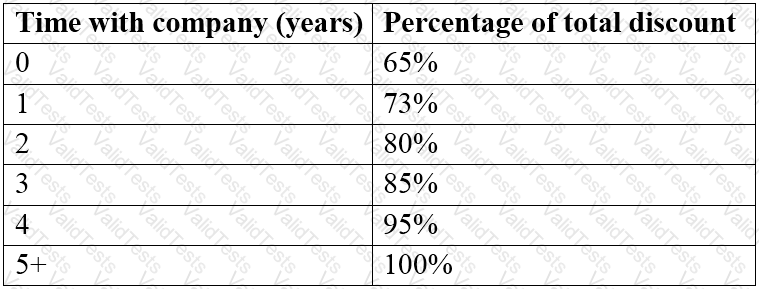
A business analyst (BA) works with stakeholders such as actuaries, product specialists, sales staff, risk managers, and underwriters who agree to applying varying levels of discounts to customers based on:
•Total annual premium the customer has with the company (Financial worth)
•Time with the insurance company (Loyalty)
Various financial models are considered but the stakeholders agree that an initial applicable discount is determined based on the customer's overall premium:
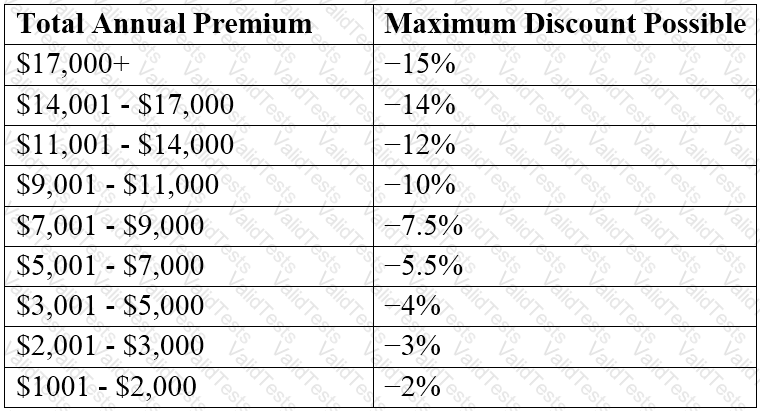
The percentage of the maximum possible discount available to the customer is adjusted based on time with the company:
Which technique would the BA use to validate the desired outcomes?
A business analyst (BA) wants to estimate the potential value delivered by a set of requirements and design options by targeting a small group of stakeholders to understand their perceived value and expectations. The BA is going to organize a discussion during which feedback is collected.
Which technique will be used?
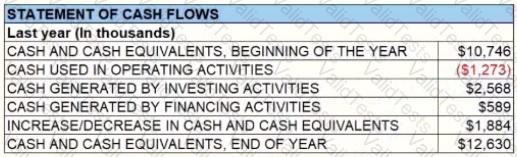
In order to align with the added value required from the parcel tracking solution, what would be an important requirements' category for the BA to give more focus?
A health insurance provider undertakes enhancements to its mobile application platform and finalizes the following capabilities as part of the scope of the next release:
I.Ability to integrate online maps and global positioning system (GPS) technology with the mobile application in real time to display location of service providers in the subscriber's vicinity that participate in the subscriber's plan network.
II.Ability for the subscriber to lookup the service providers by specifying either a postal code or a search area radius in miles.
III.Ability for the subscriber to initiate the download of fee information for one or more service providers in a single request.
Through requirements workshops the business analyst elicits the following detailed business requirements:
1.The company's mobile application platform must support real time integration with the following third party systems:
A ) GPS System
B ) Postal Code Validation
2.The service providers available for selection must participate in the subscriber's medical plan network as of the current system date.
3.The map display shall highlight the boundary of the search area with a dotted yellow line.
4.The extent and shape of the search area shall be determined based on one of the following user choices:
A ) Postal code – Subscriber location acquired from GPS shall be used to determine and populate the related postal code as the default postal code with options for the user to change the postal code.
B ) Radius for the search area around the subscriber's location, that will have default value of 5 miles. The radius can be changed by the subscriber with a maximum range of 50 miles.
5.Subscriber shall be able to select one of the options above and supply corresponding input.
6.System shall validate the user input and display appropriate error messages if invalid.
7.Based on the inputs and the plan of the subscriber, the system shall retrieve information for the participating service providers that are located within the designated search area.
8.System shall display a map including visual markers to indicate locations of the service providers in the top half of the device screen and a list of the same service providers in the bottom half of the device screen.
9.The list of service providers shall include the Name, Phone Number and Street Address.
10.If the subscriber specified the radius or retained the default postal code for the search area, the list shall additionally include the approximate driving distance in miles from the subscriber's last registered location and the list shall be sorted in the ascending order of the driving distance.
11.The subscriber shall be able to select a service provider either from the list or from the map and download a document that contains the name, contact telephone, email address, fax number and the fee schedule for the covered services applicable to the subscriber's plan.
What is the appropriate diagram type to describe the association between the subscriber, the medical plan and the participating service providers?


