A business unit of a transnational manufacturer wants to implement a robust process for addressing integrity- critical equipment deterioration incidents. Timely and complete resolution of such incidents is vital for the business unit’s continuous safe and profitable operation. Treating each incident involves many employees from different departments extensively collaborating and exchanging information. That information is spread across multiple systems having their access limited to particular user groups. With the current manual process, some incidents get forgotten and remain unresolved for years.
The project’s Sponsor is an Equipment Integrity and Reliability Advisor, who moved into this position from another business unit. That business unit implemented a proprietary application to integrate the information and to assist in tracking and managing the incidents. Having a positive experience with the application, the Sponsor is suggesting to customize it and reuse in the new business unit.
The business unit’s Enterprise Architect (EA), who is responsible for assessing solution options and presenting them to executive decision makers, has a few concerns with adopting the existing application. The application uses point-to-point interfaces with other data sources whereas the business unit’s target architecture relies on a data warehouse-based integration. Moreover, the two business units use different legacy systems, as well as different front-end implementation technologies. Additionally, the existing application is monolingual, while the business unit needs user interfaces and some data to be presented in two languages. With all of this, it may be easier to build a new application from scratch than to customize the existing one. To understand which option is better, the EA asks a business analyst (BA) to define business requirements.
Through the elicitation process, the BA identifies the following requirement: "Particular incident-related activities require approval by authorized personnel before beginning them, as well as confirmation of acceptance of their completion."
What kind of asset should the BA provide to fully specify the approval requirement?
An organization Is trying to streamline its current processes to improve performance and reduce costs. A business analyst (BA) conducted a process improvement workshop and identified the following issues as the top three items to be addressed:
1: There are multiple teams to define systems, functionality, and content in many instances, multiple teams are defining the same functionalities while other functionalities are not being defined at all leading to unclear understanding of business requirements
2: Product specification forms are published each year. A comparison tool is used to evaluate specification differences between yearly releases, but does not adequately identify changes between versions and needs to be improved.
3: Training consists of a new team member shadowing a seasoned team member. There are no written training materials or formal training sources therefore training is inconsistent and not meeting the needs of the organization.
Which stakeholders would the BA interview to determine the changes needed to the comparison tool?
A national branch of a global company is struggling to improve business processes of its Public and Government Affairs (PGA) department. To work with external stakeholders effectively, PGA employees need to collect, manage, and exchange a vast amount of information. Complex cases involve collaboration of many employees from different departments. The ability to share information and to coordinate corresponding activities is crucial for the company's growth plans. Their current tools and practices do not serve the purpose well. The existing system, which was deployed a couple of years ago, has only a few active users. The majority of PGA employees avoid using it because the system is hard to use and lacks needed functionality. Consequently, available information is mostly unstructured and stored either locally or on a shared network drive. Some of the information exists only in a paper form.
The branch's PGA head, who sponsors the project, wants to implement a configurable solution that two other branches successfully deployed several months ago. Both deployments were done by three solution consultants, who will be available to assist in the project. They will be responsible for tailoring the solution to PGA needs, as well as for training the PGA staff. With their help, the sponsor plans to complete the project in approximately three months.
The solution consultants reside in another country 7 hours ahead of the rest of the project team. They will be available part-time, but are planning two one-week long trips to the PGA central office to conduct initial training and to participate in the final deployment of the system into production. The consultants, in turn, expect a business analyst (BA) to assist in collecting necessary data and defining customization requirements.
The solution consultants have composed a set of as-is solution documents. A spreadsheet contains a catalog of brief definitions of all requirements with priorities assigned to them. A separate document explains data models and user interfaces. For the new and changed requirements, the BA wants to capture additional attributes such as the source, reason, complexity, and priority of change. Some of these requirements can be reused in other work.
How should information for these requirements be managed?
Company A is a nation-wide leader in commercial demolition. Having just celebrated its 100th year of operations, the company decided to begin doing work internationally. The current system used for reporting company finances is unable to keep pace with the potential demands of doing work in geographically dispersed locations. Therefore, the company decided to replace its client-based Profit & Loss (P&L) reporting system with a more robust, web-based system. This will ensure transparency across the organization and enable better decision making.
The business analyst (BA) at Company A has recently completed several rounds of elicitation to determine the requirements for the new, web-based system. Over 1250 requirements were elicited. An initial Requirements Traceability Matrix (RTM) has been drafted, and a subset of the RTM can be seen below:
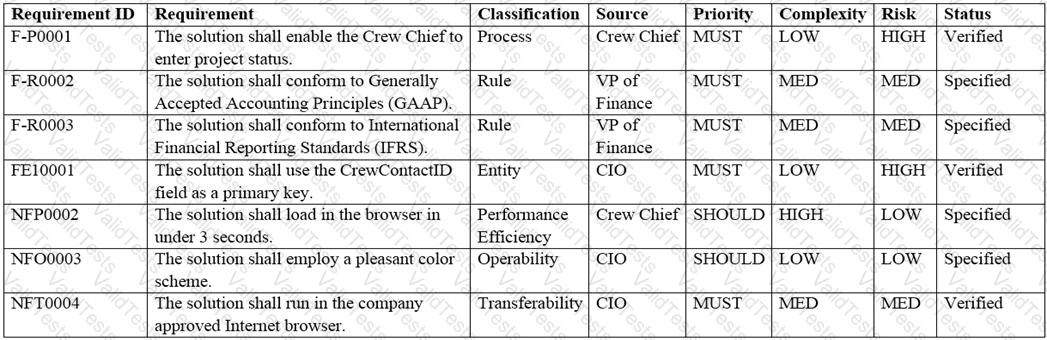
The BA will create a Data Model to meet which requirement?
The BA is analyzing the requirements that are represented in the Class Diagram. In addition to the diagram, the BA would like to include a separate document that has the information about the data elements to ensure a common understanding of the classes' attributes. What technique is used to define the data elements?
A major manufacturer of popular beverages has appointed a local distributor to serve a specific territory. The demand for the beverages has a pronounced seasonal pattern. The distributor performs well overall, but is repeatedly unable to keep up with fulfilling many customer orders during peak demand periods. The distributor's current delivery capability is stretched to deliver 60 tons of merchandise per day whereas the season's peak demand periods need a daily delivery capability of up to 100 tons.
The distributor is under pressure to fully meet the year-round market demand in order to stay in business. The distributor's management wants to identify and consider more cost-effective options as resorting to adding more trucks and drivers would not be economically feasible.
A business analyst (BA) has spent several days observing and measuring the warehouse activities to understand the situation and to gain insights into possible solutions. The delivery workflow is a four-step process: (1) picking the orders and assembling them on trays, (2) bringing the trays to the loading bay, (3) loading the orders into trucks, and (4) delivering the orders to customers. As the following table illustrates, overall performance depends is dependent on five major resources: (1) the workers who pick the orders and load them into trucks, (2) the tallyers who check the orders, (3) the drivers, (4) the trucks, and (5) eight loading bays (LBs).
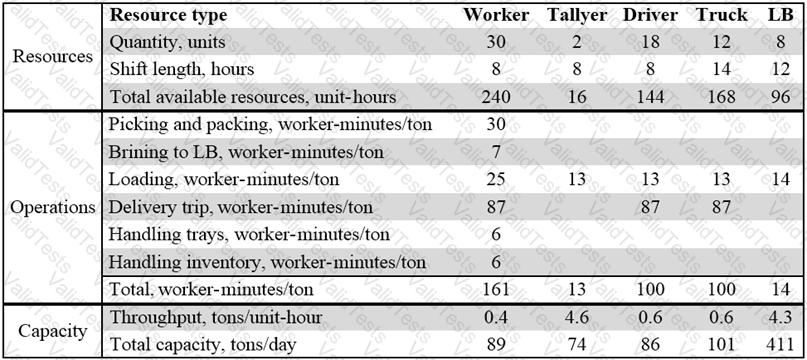
Each truck can only make two trips a day. The BA has noticed that only 30% of trips have their orders available for loading when a truck arrives. Otherwise the truck has to wait one extra hour until the orders are picked and brought to the loading bay.
If trucks are the only constraint, approximately how many hours are lost due to this downtime?
A business unit of a transnational manufacturer wants to implement a robust process for addressing integrity- critical equipment deterioration incidents. Timely and complete resolution of such incidents is vital for the business unit’s continuous safe and profitable operation. Treating each incident involves many employees from different departments extensively collaborating and exchanging information. That information is spread across multiple systems having their access limited to particular user groups. With the current manual process, some incidents get forgotten and remain unresolved for years.
The project’s Sponsor is an Equipment Integrity and Reliability Advisor, who moved into this position from
another business unit. That business unit implemented a proprietary application to integrate the information and to assist in tracking and managing the incidents. Having a positive experience with the application, the Sponsor is suggesting to customize it and reuse in the new business unit.
The business unit’s Enterprise Architect (EA), who is responsible for assessing solution options and presenting them to executive decision makers, has a few concerns with adopting the existing application. The application uses point-to-point interfaces with other data sources whereas the business unit’s target architecture relies on a data warehouse-based integration. Moreover, the two business units use different legacy systems, as well as different front-end implementation technologies. Additionally, the existing application is monolingual, while the business unit needs user interfaces and some data to be presented in two languages. With all of this, it may be easier to build a new application from scratch than to customize the existing one. To understand which option is better, the EA asks a business analyst (BA) to define business requirements.
With the team ready to consider design options, they are reviewing the following requirement: "Appropriate stakeholders shall be timely and reliably notified on incident-related events."
What quality criteria does this requirement fail to satisfy?
A software development company is in the process of creating a new product for their customer base. It has been several years since such a project has been initiated and the organization has created a new team to own and develop the product. The project team will be evaluated by the successful adoption of the product, which will be developed over the next 12 months.
The team's business analyst (BA) has analyzed the current state in partnership with the product owner and has been meeting with senior management to identify the goals that need to be attained. A broad view of the business has been analyzed in order to have an understanding of how the company is currently providing value to its customer base.
What has the BA evaluated to help determine value of the project?
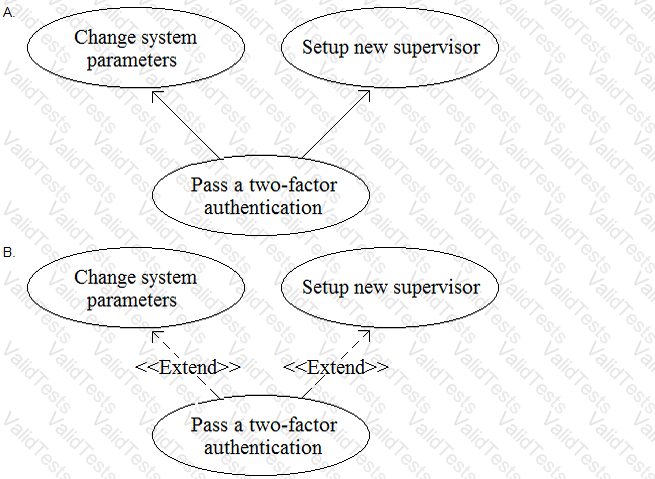
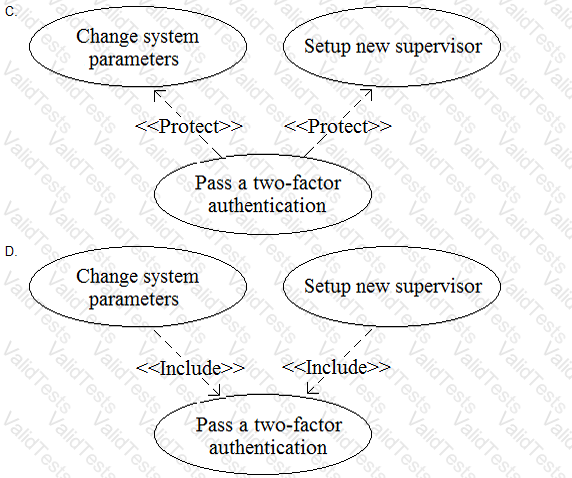
A business analyst (BA) is working on a payment system (PS) implementation. A set of systems which should interact with a new system has been identified. The business analyst defined that a user with role of "Supervisor" in the PS must pass a two-factor authentication before an execution of the functions: "Change system parameters" and "Set up new supervisor." A user must have the role of "Supervisor" to use the standard functions "Send mail notification" or "Send SMS notification".
The BA defined the following use cases:
•"Change system parameters"
•"Setup new supervisor"
•"Send mail notification"
•"Send SMS notification"
•"Send notification"
•"Pass a two-factor authentication"
The BA wants to create a Use Case diagram.
What standard relationship should be defined between "Change system parameters", "Setup new supervisor" and "Pass a two-factor authentication"?
The performance of a newly implemented document management system is falling significantly short of the measures defined as part of the project. However, the business is recognizing some level of value from the system. The business analyst (BA) considers the only option available to the company to increase performance and determines that the cost of implementing the option is ten times higher than the expected benefits. What should the BA recommend?


