A popular department store chain wants to make computer upgrades as well as conduct a major remodeling effort to increase revenue to all their 100 stores over the next 2 years. The remodeling will occur in two phases. The two phases are required at each store and can be completed in any order, but each phase must be fully completed before the next phase can begin. Phase 1 will take approximately 32 weeks and will not require a store to be temporarily closed. Phase 2 will take approximately 20 weeks and will require a store to be temporarily closed.
In order to keep inventory level and total revenue for the department store chain at an operational level, 75% of the stores must remain open to the public at all times. Against the board of director's advice, the Chief
Executive Officer (CEO) made a decision to start and complete the top 25 revenue-producing stores in the first year to get those stores remodeled and fully operational.
A business analyst (BA) has been brought in to help with planning the project and gathering requirements. Based on the CEO's executive decision, which risk tolerance attitude is the CEO exhibiting?
A software development company is in the process of creating a new product for their customer base. It has been several years since such a project has been initiated and the organization has created a new team to own and develop the product. The project team will be evaluated by the successful adoption of the product, which will be developed over the next 12 months.
The team's business analyst (BA) has analyzed the current state in partnership with the product owner and has been meeting with senior management to identify the goals that need to be attained. A broad view of the business has been analyzed in order to have an understanding of how the company is currently providing value to its customer base.
After the BA completed the initial analysis, the information is reviewed with leadership. At this point in the project, what will the BA be presenting?
A major manufacturer of popular beverages has appointed a local distributor to serve a specific territory. The demand for the beverages has a pronounced seasonal pattern. The distributor performs well overall, but is repeatedly unable to keep up with fulfilling many customer orders during peak demand periods. The distributor's current delivery capability is stretched to deliver 60 tons of merchandise per day whereas the season's peak demand periods need a daily delivery capability of up to 100 tons.
The distributor is under pressure to fully meet the year-round market demand in order to stay in business. The distributor's management wants to identify and consider more cost-effective options as resorting to adding more trucks and drivers would not be economically feasible.
A business analyst (BA) has spent several days observing and measuring the warehouse activities to understand the situation and to gain insights into possible solutions. The delivery workflow is a four-step process: (1) picking the orders and assembling them on trays, (2) bringing the trays to the loading bay, (3) loading the orders into trucks, and (4) delivering the orders to customers. As the following table illustrates, overall performance depends is dependent on five major resources: (1) the workers who pick the orders and load them into trucks, (2) the tallyers who check the orders, (3) the drivers, (4) the trucks, and (5) eight loading bays (LBs).
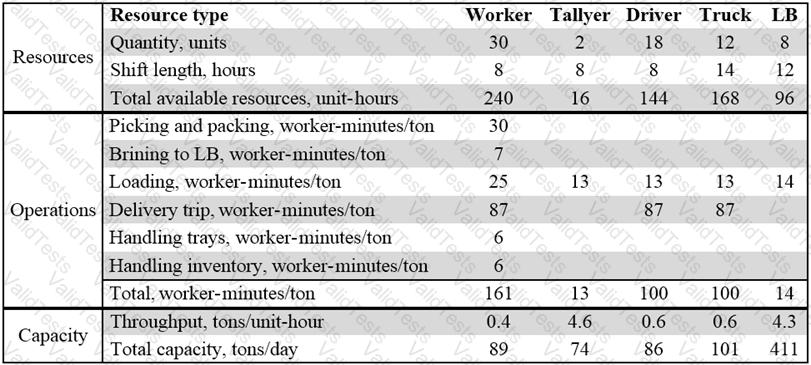
If the driver's average throughput is 0.6 tons/hour, how many hours per day would 15 drivers have to work to deliver 100 tons of merchandise?
The technology team at a financial institution has successfully constructed a software application to be deployed as part of a digital banking strategy. A business analyst (BA) has completed a review of the current state description and now needs to evaluate the solution and determine limiting factors for value realization.
What additional input is required to perform the assessment of enterprise limitations?
A financial institution engaged in mortgage lending has embarked on a business process improvement initiative to eliminate the activities that hinder growth to ultimately improve the success rate of its mortgage business. As a benchmark for identification, the institution is keen on improving any business process that has less than a 75% success rate. The institution has appointed a business analyst (BA) to review the business transactions for the processes of origination, payments, and closures, as well as identify opportunities for improvements and recommend solutions.
The BA has collected the following information over the last three months pertaining to these business processes:
•All the business processes are at their maximum capacity in terms of the current number of transactions.
•Each business process has a certain number of rejects and the reasons for rejection include documentation, verification, collateral, and funding. Funding rejects occur when the bank's customers have failed to make payment of their mortgage processing fee or mortgage closure payment.
The BA has also recommended the use of documentation checklists as a solution to eliminate the documentation rejects.

Assuming the BA's recommendation to be true, what will be the new success rate of the mortgage closure process?
An organization implements a solution to increase the efficiency of its internal processes. The business analyst (BA) felt that the success of the solution is tied to the organizational structure and confirmed that the solution conforms to the organizational hierarchy. After the solution rolled out, the solution was not widely adopted among stakeholders and some features were not being utilized.
Which aspect of the organizational structure did the BA fail to consider?
An organization is trying to streamline its current processes to improve performance and reduce costs. A business analyst (BA) conducted a process improvement workshop and identified the following issues as the top three items to be addressed:
1: There are multiple teams to define systems, functionality, and content, in many instances, multiple teams are defining the same Functionalities while other functionalities are not being defined at all. leading to unclear understanding of business requirements
2: Product specification forms are published each year. A comparison tool is used to evaluate specification differences between yearly releases; but does not adequately identify changes between versions and needs to be improved.
3: Training consists of a new team member shadowing a seasoned team member. There are no written training materials or formal training sources therefore training is inconsistent and not meeting the needs of the organization.
The BA learns that formal training programs are not often devised for teams as small and diverse as this team, but still believes it is a viable solution to the training need. What type of analysis would help the BA gain approval to proceed with creating this type of training program for this team?
A business analyst (BA) works for an organization that is moving from a waterfall methodology to an agile approach. This causes new challenges and opportunities for the BA.
Which business analysis planning and monitoring element is most impacted by the organization's change?
A business analyst (BA) is developing an approach for information management. The BA needs to identify and categorize which information is to be managed.
Which of the following techniques should the BA use to achieve this objective?
A health insurance provider undertakes enhancements to its mobile application platform and finalizes the following capabilities as part of the scope of the next release:
I.Ability to integrate online maps and global positioning system (GPS) technology with the mobile application in real time to display location of service providers in the subscriber's vicinity that participate in the subscriber's plan network.
II.Ability for the subscriber to lookup the service providers by specifying either a postal code or a search area radius in miles.
III.Ability for the subscriber to initiate the download of fee information for one or more service providers in a single request.
Through requirements workshops the business analyst elicits the following detailed business requirements:
1.The company's mobile application platform must support real time integration with the following third party systems:
A ) GPS System
B ) Postal Code Validation
2.The service providers available for selection must participate in the subscriber's medical plan network as of the current system date.
3.The map display shall highlight the boundary of the search area with a dotted yellow line.
4.The extent and shape of the search area shall be determined based on one of the following user choices:
A ) Postal code – Subscriber location acquired from GPS shall be used to determine and populate the related postal code as the default postal code with options for the user to change the postal code.
B ) Radius for the search area around the subscriber's location, that will have default value of 5 miles. The radius can be changed by the subscriber with a maximum range of 50 miles.
5.Subscriber shall be able to select one of the options above and supply corresponding input.
6.System shall validate the user input and display appropriate error messages if invalid.
7.Based on the inputs and the plan of the subscriber, the system shall retrieve information for the participating service providers that are located within the designated search area.
8.System shall display a map including visual markers to indicate locations of the service providers in the top half of the device screen and a list of the same service providers in the bottom half of the device screen.
9.The list of service providers shall include the Name, Phone Number and Street Address.
10.If the subscriber specified the radius or retained the default postal code for the search area, the list shall additionally include the approximate driving distance in miles from the subscriber's last registered location and the list shall be sorted in the ascending order of the driving distance.
11.The subscriber shall be able to select a service provider either from the list or from the map and download a document that contains the name, contact telephone, email address, fax number and the fee schedule for the covered services applicable to the subscriber's plan.
Which of the following characteristics is violated by requirement 5?


