Weekend Certification Special Limited Time 70% Discount Offer - Ends in 0d 00h 00m 00s - Coupon code: validbest

Pass the Juniper Associate JNCIA-SEC JN0-232 Questions and answers with ValidTests

Exam JN0-232 All Questions
Exam JN0-232 Premium Access

View all detail and faqs for the JN0-232 exam

Viewing page 1 out of 4 pages
Viewing questions 1-10 out of questions
Questions # 1:

You are asked to create a security policy that controls traffic allowed to pass between the Internet and private security zones. You must ensure that this policy is evaluated before all other policy types on your SRX Series device.

In this scenario, which type of security policy should you create?

Options:

A.

routing policy

B.

default policy

C.

zone policy

D.

global policy

Questions # 2:

Referring to the exhibit,

Question # 2

which action would you take to permit the traffic shown in the exhibit?

Options:

A.

Assign the ge-0/0/1.0 interface to a security zone.

B.

Assign the fxp0.0 interface to a security zone.

C.

Enable flow-mode processing for family mpls.

D.

Enable flow-mode processing for family inet.

Questions # 3:

Which two settings does the host-inbound-traffic zone configuration parameter control? (Choose two.)

Options:

A.

transit traffic

B.

protocols on the zone’s physical interfaces

C.

exception traffic

D.

protocols on the zone’s logical interfaces

Questions # 4:

A new packet arrives on an interface on your SRX Series Firewall that is assigned to the trust security zone.

In this scenario, how does the SRX Series Firewall determine the egress security zone?

Options:

A.

by performing a session lookup

B.

by examining the destination port

C.

by performing a route lookup

D.

by examining the ingress security zone properties

Questions # 5:

An SRX Series Firewall operates in which two modes? (Choose two.)

Options:

A.

flow mode

B.

packet mode

C.

route mode

D.

wireless mode

Questions # 6:

Which two statements about global security policies are correct? (Choose two.)

Options:

A.

The from-zone and to-zone contexts are not required for a global security policy.

B.

Global security policies require specific zone contexts.

C.

Global policies are processed before zone-based security policies.

D.

You can use both zone-based security policies and global security policies at the same time.

Questions # 7:

What is a purpose for creating multiple routing instances on an SRX Series Firewall device?

Options:

A.

to enable network monitoring through SNMP

B.

to maintain separation of routing information for security purposes

C.

to manage routing protocols and updates

D.

to simplify the configuration of network interfaces

Questions # 8:

You are asked to enable trace options to debug the packet flow.

In this scenario, which flag would you configure at the [edit security flow traceoptions] hierarchy?

Options:

A.

packet-dump

B.

general

C.

state

D.

basic-datapath

Questions # 9:

Which two statements are correct about Junos OS? (Choose two.)

Options:

A.

It is a network operating system.

B.

It is supported on physical and virtual devices.

C.

It is a network management system for Juniper devices.

D.

It is a network operating system for IoT devices.

Questions # 10:

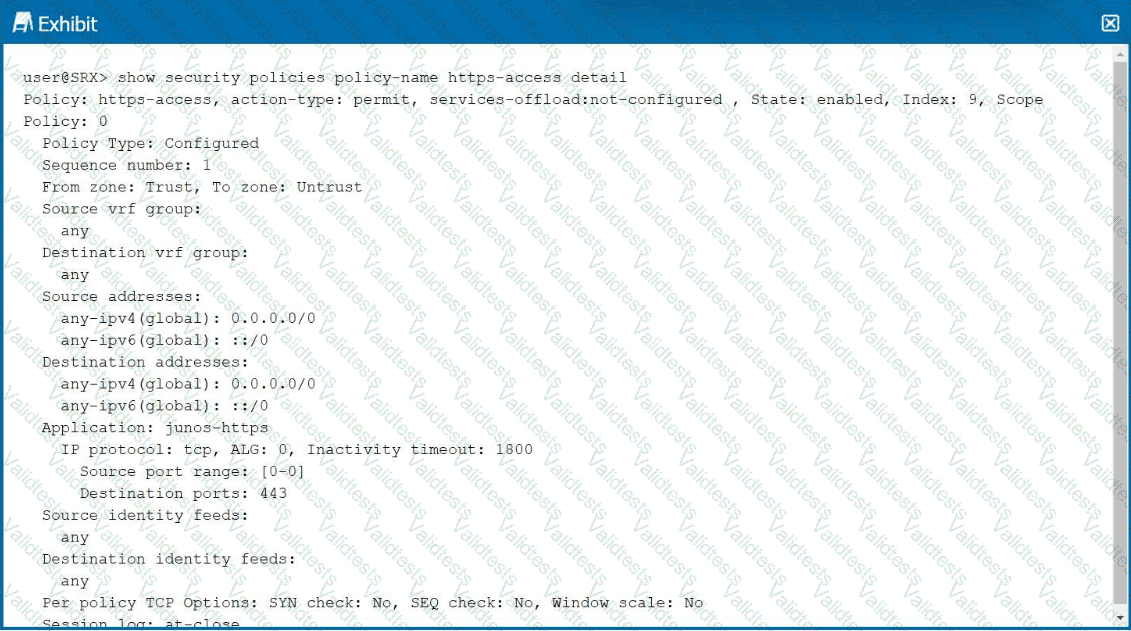
Click the Exhibit button.

Question # 10

Referring to the exhibit, which two statements are correct? (Choose two.)

Options:

A.

This security policy uses a non-default inactivity timeout.

B.

This security policy is the second security policy in the list.

C.

This security policy permits HTTPS traffic.

D.

This security policy is a zone-based security policy.

Viewing page 1 out of 4 pages
Viewing questions 1-10 out of questions