Weekend Certification Special Limited Time 70% Discount Offer - Ends in 0d 00h 00m 00s - Coupon code: validbest

Pass the Juniper Associate JNCIA-SEC JN0-232 Questions and answers with ValidTests

Exam JN0-232 All Questions
Exam JN0-232 Premium Access

View all detail and faqs for the JN0-232 exam

Viewing page 3 out of 4 pages
Viewing questions 21-30 out of questions
Questions # 21:

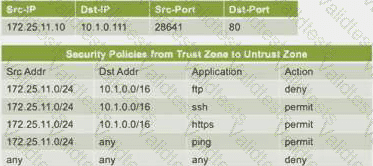
Referring to the exhibit, the top table shows the source and destination IP addresses and also the source and destination ports of the incoming packet.
Question # 21

The lower table represents the security policies from the trust zone to the untrust zone.

In this scenario, which two statements are correct? (Choose two.)

Options:

A.

The incoming packet is permitted by the HTTPS application.

B.

The incoming packet is permitted because it does not match any policy listed.

C.

The incoming packet is denied by the final security policy.

D.

The firewall processes security policies in a top-down manner.

Questions # 22:

Which two statements are correct about unified security policies? (Choose two.)

Options:

A.

Traffic that matches a unified policy will not be evaluated by traditional security policy.

B.

Dynamic applications in unified security policies analyze traffic based on Layer 4 information.

C.

Traffic that matches a traditional policy will not be evaluated by unified security policy.

D.

Dynamic applications in unified security policies analyze traffic based on Layer 7 information.

Questions # 23:

What happens if no match is found in both zone-based and global security policies?

Options:

A.

The traffic is discarded by the default security policy.

B.

The traffic is redirected to a predefined safe zone.

C.

The traffic is logged for further analysis.

D.

The traffic is allowed by default.

Questions # 24:

You want to confirm that your SRX Series Firewall is connected to the SBL server.

Which operational mode command would you use in this scenario?

Options:

A.

show security utm anti-virus status

B.

show security web filtering status

C.

show security utm content-filtering statistics

D.

show security utm anti-spam status

Questions # 25:

Which zone configuration is required to permit transit traffic?

Options:

A.

a system-defined null zone

B.

a system-defined Junos-host zone

C.

a user-defined security zone

D.

a user-defined functional zone

Questions # 26:

Which two statements are correct about security zones? (Choose two.)

Options:

A.

An interface can exist in multiple security zones.

B.

Interfaces in the same security zone must share the same routing instance.

C.

Interfaces in the same security zone must use separate routing instances.

D.

A security zone can contain multiple interfaces.

Questions # 27:

You are troubleshooting first path traffic not passing through an SRX Series Firewall. You have determined that the traffic is ingressing and egressing the correct interfaces using a route lookup.

In this scenario, what is the next step in troubleshooting why the device may be dropping the traffic?

Options:

A.

Verify that the interfaces are in the correct security zones.

B.

Verify the routing protocol being used.

C.

Verify that source NAT is occurring.

D.

Verify that the correct ALG is being used.

Questions # 28:

Which two statements are correct about unified security policies on SRX Series Firewalls? (Choose two.)

Options:

A.

Unified security policies match applications before processing policy statements.

B.

Unified security policies can be zone-based or global.

C.

Unified security policies use the application identification (AppID) engine.

D.

Unified security policies with multiple matches use the most restrictive match.

Questions # 29:

When traffic enters an interface, which two results does a route lookup determine? (Choose two.)

Options:

A.

egress interface

B.

egress security zone

C.

ingress interface

D.

DNS name

Questions # 30:

Which two characteristics of destination NAT and static NAT are correct? (Choose two.)

Options:

A.

Static NAT automatically creates a matching rule for the opposite direction.

B.

Destination NAT requires address range sizes that match the devices being translated.

C.

Static NAT uses Port Address Translation.

D.

Destination NAT supports port forwarding.

Viewing page 3 out of 4 pages
Viewing questions 21-30 out of questions