A 33-year-old primigravid woman presents to the office with gestational hypertension. Her pregnancy is at 37 weeks’ gestation. The ultrasound findings are as follows:
Head circumference: 5th percentile
Biparietal diameter: 10th percentile
Abdominal circumference: 5th percentile
Femur length: 25th percentile
Amniotic fluid volume: 5.0 cm
Umbilical Doppler: Reversed end-diastolic flow
Which one of the following is the best next step?
A 26-year-old woman, gravida 2, para 2, aborta 0, has just delivered a full-term newborn via spontaneous vaginal delivery after 4 hours of labor. Following oxytocin administration and placental expulsion, there continues to be a steady trickle of bright red blood from her vagina. On examination, the placenta is intact and the fundus feels firm. Her vital signs are within normal range.
Which one of the following is the most likely diagnosis?
An 85-year-old man is transferred from an acute care hospital to your long-term care (LTC) facility. He has a fever, fatigue, myalgia, and malaise. His test result is positive for influenza A virus. Two other residents and 1 LTC staff member have experienced the same symptoms. Which one of the following is the best next step to prevent further infections at the LTC facility?
A 35-year-old patient presents to your clinic for assessment of a chronic rash. With the patient’s consent, you take a photo of the rash and upload it to their electronic medical record. You explain that you would like to consult with a specialist. That evening, you post a description of the rash to your online physicians’ group, being careful to anonymize the details. You get a direct message from a physician who says they have extra training in dermatology and they ask you for a photo of the rash. Which one of the following is the best next step?
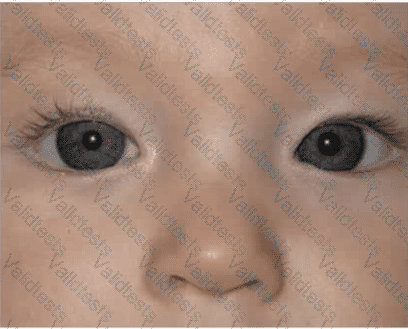
An 18-month-old boy is brought to the office by his guardians for a well-child visit. His guardians are concerned that his eyes do not look the same. On examination, his eyes appear as shown in the referenced photo.
Which one of the following best represents the patient ' s condition?
An 85-year-old woman who is your patient has advanced metastatic lung cancer. You are visiting her at her home for palliative care. She has previously indicated to you and her family that she hoped to die at home and that comfort is her priority. She is now weak to get out of bed and has had no oral intake for 2 days. She is confused most of the time, with brief lucid episodes. Despite attentive symptom management, her family reports that she is suffering and asks that you increase her medications to expedite her death. Which one of the following is the best next step?
A 29-year-old woman, gravida 1, para 0, aborta 0, presents to your clinic. Her pregnancy is at 22 weeks’ gestation. Her blood pressure is 158/96 mm Hg. Which one of the following antihypertensive medications is contraindicated for this patient?
You perform a literature search of journal articles on the effectiveness of a new antihypertensive for first-line treatment of people aged 35 to 50. You find reports of 4 good quality studies. Three of them show that statistically, the new drug is significantly more effective than the standard treatment, and one shows no difference. Before you conclude that the new antihypertensive is more effective in this group of patients, which one of the following concepts must be given consideration?
A 70-year-old woman presents to the Emergency Department with a 2-day history of dysuria and right flank pain. Upon arrival, she is quite unwell. Her vital signs are as follows: blood pressure 70/38 mm Hg, heart rate 130/min, respiratory rate 24/min, temperature 39.4 °C.
Due to difficulty obtaining peripheral access, a central line is inserted. There is a lot of ongoing bleeding around the line insertion site. Her blood work shows:
White blood cell count: 19.8 × 10⁹/L (4–10)
Hemoglobin: 101 g/L (123–157)
Platelets: 85 × 10⁹/L (130–400)
Blood film: schistocytes
INR: 1.9 (0.9–1.2)
Fibrinogen: < 1 g/L (2–4)
Which one of the following is the most likely cause of her ongoing bleeding?
A 79-year-old woman presents to the Emergency Department with sudden-onset severe chest and back pain that started 1 hour ago. She has a history of hypertension and looks unwell. Her vital signs are as follows: blood pressure 168/108 mm Hg, heart rate 110/min, respiratory rate 22/min, temperature 36.7°C. Findings of a physical examination of the chest and abdomen are normal. An urgent computed tomography (CT) scan of the chest and abdomen shows an aortic dissection extending from the descending thoracic aorta to the upper abdominal aorta. The branches of the abdominal aorta are patent. Following initial resuscitation, which one of the following is the best next step?


