Pre-Summer Special Limited Time 70% Discount Offer - Ends in 0d 00h 00m 00s - Coupon code: validbest

Pass the MuleSoft Certified Platform Architect MCPA-Level-1 Questions and answers with ValidTests

Exam MCPA-Level-1 All Questions
Exam MCPA-Level-1 Premium Access

View all detail and faqs for the MCPA-Level-1 exam

Viewing page 3 out of 5 pages
Viewing questions 21-30 out of questions
Questions # 21:

Which of the following sequence is correct?

Options:

A.

API Client implementes logic to call an API >> API Consumer requests access to API >> API Implementation routes the request to >> API

B.

API Consumer requests access to API >> API Client implementes logic to call an API >> API routes the request to >> API Implementation

C.

API Consumer implementes logic to call an API >> API Client requests access to API >> API Implementation routes the request to >> API

D.

API Client implementes logic to call an API >> API Consumer requests access to API >> API routes the request to >> API Implementation

Expert Solution
Questions # 22:

When should idempotency be taken into account?

Options:

A.

When making requests to update currently locked entities

B.

When storing the results of s previous request for use in response to subsequent requests

C.

When sending concurrent update requests for the same entity

D.

When preventing duplicate processing from multiple sent requests

Expert Solution
Questions # 23:

Mule applications that implement a number of REST APIs are deployed to their own subnet that is inaccessible from outside the organization.

External business-partners need to access these APIs, which are only allowed to be invoked from a separate subnet dedicated to partners - called Partner-subnet. This subnet is accessible from the public internet, which allows these external partners to reach it.

Anypoint Platform and Mule runtimes are already deployed in Partner-subnet. These Mule runtimes can already access the APIs.

What is the most resource-efficient solution to comply with these requirements, while having the least impact on other applications that are currently using the APIs?

Options:

A.

Implement (or generate) an API proxy Mule application for each of the APIs, then deploy the API proxies to the Mule runtimes

B.

Redeploy the API implementations to the same servers running the Mule runtimes

C.

Add an additional endpoint to each API for partner-enablement consumption

D.

Duplicate the APIs as Mule applications, then deploy them to the Mule runtimes

Expert Solution
Questions # 24:

What is the most performant out-of-the-box solution in Anypoint Platform to track transaction state in an asynchronously executing long-running process implemented as a Mule application deployed to multiple CloudHub workers?

Options:

A.

Redis distributed cache

B.

java.util.WeakHashMap

C.

Persistent Object Store

D.

File-based storage

Expert Solution
Questions # 25:

When using CloudHub with the Shared Load Balancer, what is managed EXCLUSIVELY by the API implementation (the Mule application) and NOT by Anypoint Platform?

Options:

A.

The assignment of each HTTP request to a particular CloudHub worker

B.

The logging configuration that enables log entries to be visible in Runtime Manager

C.

The SSL certificates used by the API implementation to expose HTTPS endpoints

D.

The number of DNS entries allocated to the API implementation

Expert Solution
Questions # 26:

Which scenario is suited for MUnit tests instead of integration tests?

Options:

A.

For read-only interactions to any dependencies (such as other web APIs)

B.

When testing does not require knowledge of implementation details

C.

When no mocking is permissible

D.

For tests that are implemented using SoapUI

Expert Solution
Questions # 27:

Several times a week, an API implementation shows several thousand requests per minute in an Anypoint Monitoring dashboard, Between these bursts, the

dashboard shows between two and five requests per minute. The API implementation is running on Anypoint Runtime Fabric with two non-clustered replicas, reserved vCPU 1.0

and vCPU Limit 2.0.

An API consumer has complained about slow response time, and the dashboard shows the 99 percentile is greater than 120 seconds at the time of the complaint. It also shows

greater than 90% CPU usage during these time periods.

In manual tests in the QA environment, the API consumer has consistently reproduced the slow response time and high CPU usage, and there were no other API requests at

this time. In a brainstorming session, the engineering team has created several proposals to reduce the response time for requests.

Which proposal should be pursued first?

Options:

A.

Increase the vCPU resources of the API implementation

B.

Modify the API client to split the problematic request into smaller, less-demanding requests

C.

Increase the number of replicas of the API implementation

D.

Throttle the APT client to reduce the number of requests per minute

Expert Solution
Questions # 28:

Which statement is true about identity management and client management on Anypoint Platform?

Options:

A.

If an external identity provider is configured, the SAML 2.0 bearer tokens issued by the identity provider cannot be used for invocations of the Anypoint Platform web APIs

B.

If an external client provider is configured, it must be configured at the Anypoint Platform organization level and cannot be assigned to individual business groups and environments

C.

Anypoint Platform supports configuring one external identity provider

D.

Both client management and identity management require an identity provider

Expert Solution
Questions # 29:

A Platinum customer uses the U.S. control plane and deploys applications to CloudHub in Singapore with a default log configuration.

The compliance officer asks where the logs and monitoring data reside?

Options:

A.

Logs are held in:Singapore and monitoring data is held in the United States

B.

Logs and monitoring data are held in the United States

C.

Logs are held in the United States and monitoring data is held in Singapore

D.

Logs and monitoring data are held in Singapore

Expert Solution
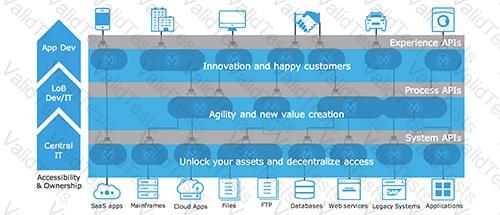
Questions # 30:

Select the correct Owner-Layer combinations from below options

Options:

A.

1. App Developers owns and focuses on Experience Layer APIs

2. Central IT owns and focuses on Process Layer APIs

3. LOB IT owns and focuses on System Layer APIs

B.

1. Central IT owns and focuses on Experience Layer APIs

2. LOB IT owns and focuses on Process Layer APIs

3. App Developers owns and focuses on System Layer APIs

C.

1. App Developers owns and focuses on Experience Layer APIs

2. LOB IT owns and focuses on Process Layer APIs

3. Central IT owns and focuses on System Layer APIs

Expert Solution
Viewing page 3 out of 5 pages
Viewing questions 21-30 out of questions