An organization is implementing a Quote of the Day API that caches today's quote.
What scenario can use the GoudHub Object Store via the Object Store connector to persist the cache's state?
An organization is deploying their new implementation of the OrderStatus System API to multiple workers in CloudHub. This API fronts the organization's on-premises Order Management System, which is accessed by the API implementation over an IPsec tunnel.
What type of error typically does NOT result in a service outage of the OrderStatus System API?
What best explains the use of auto-discovery in API implementations?
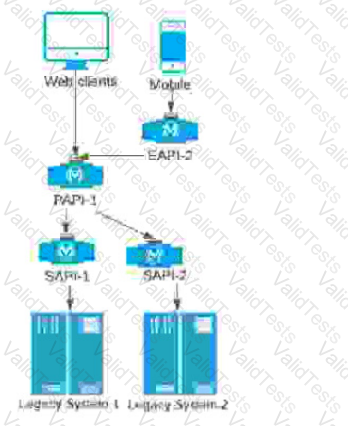
A company stores financial transaction data in two legacy systems. For each legacy system, a separate, dedicated System API (SAPI) exposes data for that legacy system. A Process API (PAPI) merges the data retrieved from ail of the System APIs into a common format. Several API clients call the PAPI through its public domain name.
The company now wants to expose a subset of financial data to a newly developed mobile application that uses a different Bounded Context Data Model. The company wants to follow MuleSoft's best practices for building out an effective application network.
Following MuleSoft's best practices, how can the company expose financial data needed by the mobile application in a way that minimizes the impact on the currently running API clients, API implementations, and support asset reuse?
Add two new Experience APIs (EAPI-i and EAPI-2}.
Add Mobile PAPI-2 to expose the Intended subset of financial data as requested.
Both PAPIs access the Legacy Systems via SAPI-1 and SAP]-2.
Add two new Experience APIs (EAPI-i and EAPI-2}.
Add Mobile PAPI-2 to expose the Intended subset of financial data as requested.
Both PAPIs access the Legacy Systems via SAPI-1 and SAP]-2.
Create a new mobile Experince API (EAPI) chat exposes that subset of PAPI endpoints.
Add transformtion login to the mobile Experince API implementation to make mobile data compatible with the required PAPIs.
Develop and deploy is new PAPI implementation with data transformation and ... login to support this required endpoints of both mobile and web clients.
Deploy an API Proxy with an endpoint from API Manager that redirect the existing PAPI endpoints to the new PAPI.
Due to a limitation in the backend system, a system API can only handle up to 500 requests per second. What is the best type of API policy to apply to the system API to avoid overloading the backend system?
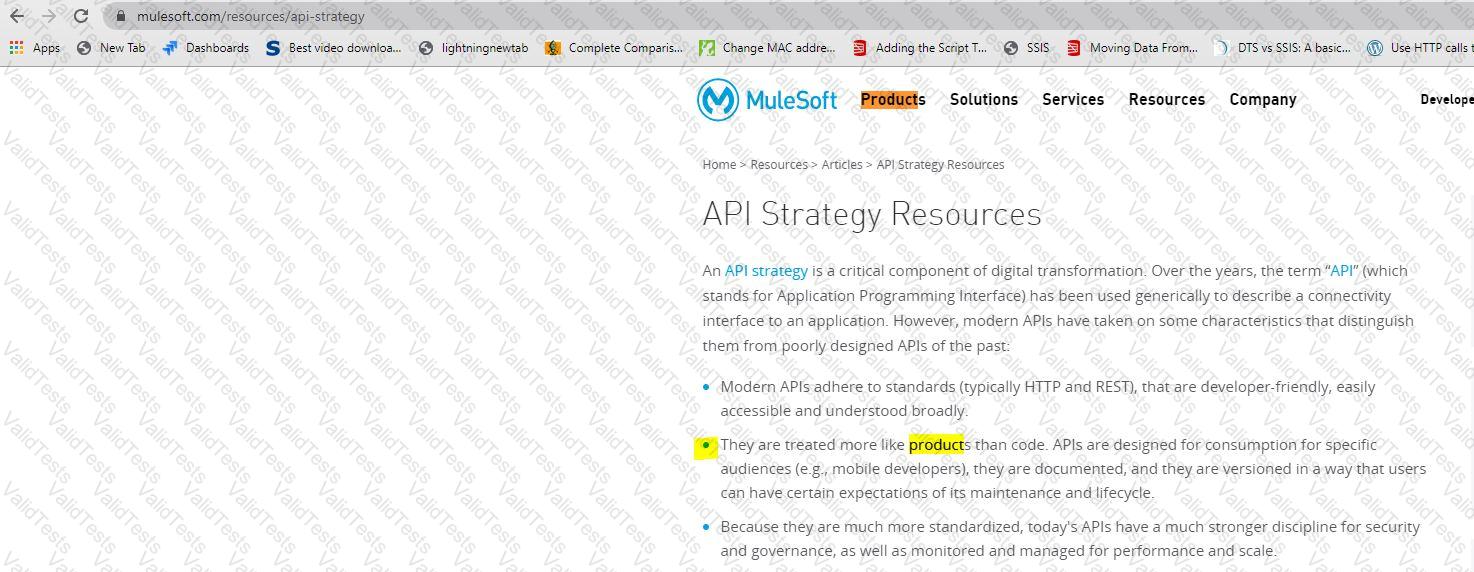
An organization makes a strategic decision to move towards an IT operating model that emphasizes consumption of reusable IT assets using modern APIs (as defined by MuleSoft).
What best describes each modern API in relation to this new IT operating model?
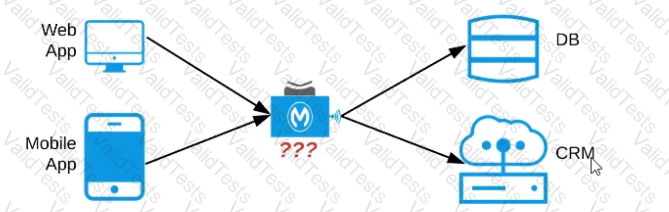
Refer to the exhibit. An organization needs to enable access to their customer data from both a mobile app and a web application, which each need access to common fields as well as certain unique fields.
The data is available partially in a database and partially in a 3rd-party CRM system.
What APIs should be created to best fit these design requirements?
A) A Process API that contains the data required by both the web and mobile apps, allowing these applications to invoke it directly and access the data they need thereby providing the flexibility to add more fields in the future without needing API changes
B) One set of APIs (Experience API, Process API, and System API) for the web app, and another set for the mobile app
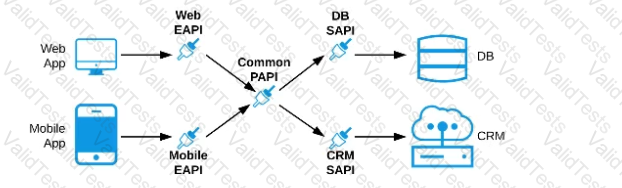
C) Separate Experience APIs for the mobile and web app, but a common Process API that invokes separate System APIs created for the database and CRM system
D) A common Experience API used by both the web and mobile apps, but separate Process APIs for the web and mobile apps that interact with the database and the CRM System
An API implementation is deployed to CloudHub.
What conditions can be alerted on using the default Anypoint Platform functionality, where the alert conditions depend on the API invocations to an API implementation?
A company deploys Mule applications with default configurations through Runtime Manager to customer-hosted Mule runtimes. Each Mule application is an API
implementation that exposes RESTful interfaces to API clients. The Mule runtimes are managed by the MuleSoft-hosted control plane. The payload is never used by any Logger
components.
When an API client sends an HTTP request to a customer-hosted Mule application, which metadata or data (payload) is pushed to the MuleSoft-hosted control plane?
A company requires Mule applications deployed to CloudHub to be isolated between non-production and production environments. This is so Mule applications deployed to non-production environments can only access backend systems running in their customer-hosted non-production environment, and so Mule applications deployed to production environments can only access backend systems running in their customer-hosted production environment. How does MuleSoft recommend modifying Mule applications, configuring environments, or changing infrastructure to support this type of per-environment isolation between Mule applications and backend systems?