View all detail and faqs for the ISO-9001-Lead-Auditor exam
In the context of a third-party audit, match the activity with the party responsible in relation to the audit process.

Scenario 1: AL-TAX is a company located in California which provides financial and accounting services. The company manages the finances of 17 companies and now is seeking to expand their business even more The CEO of AL-TAX, Liam Durham, claims that the company seeks to provide top-notch services to their clients Recently, there were a number of new companies interested in the services provided by AL-TAX.
In order to fulfill the requirements of new clients and further improve quality, Liam discussed with other top management members the idea of implementing a quality management system (QMS) based on ISO 9001. During the discussion, one of the members of the top management claimed that the size of the company was not large enough to implement a QMS. In addition, another member claimed that a QMS is not applicable for the industry in which AL TAX operates. However, as the majority of the members voted for implementing the QMS. Liam initiated the project.
Initially, Liam hired an experienced consultant to help AL-TAX with the implementation of the QMS. They started by planning and developing processes and methods for the establishment of a QMS based on ISO 9001. Furthermore, they ensured that the quality policy is appropriate to the purpose and context of AL TAX and communicated to all employees. In addition, they also tried to follow a process that enables the company to ensure that its processes are adequately resourced and managed, and that improvement opportunities are determined.
During the implementation process, Liam and the consultant focused on determining the factors that could hinder their processes from achieving the planned results and implemented some preventive actions in order to avoid potential nonconformities Six months after the implementation of the QMS. AL-TAX conducted an internal audit. The results of the internal audit revealed that the QMS was not fulfilling all requirements of ISO 9001. A serious issue was that the QMS was not fulfilling the requirements of clause 5.1.2 Customer focus and had also not ensured clear and open communication channels with suppliers.
Throughout the next three years, the company worked on improving its QMS through the PDCA cycle in the respective areas. To assess the effectiveness of the intended actions while causing minimal disruptions, they tested changes that need to be made on a smaller scale. After taking necessary actions, AL-TAX decided to apply for certification against ISO 9001.
Based on the scenario above, answer the following question:
The CEO of AL-TAX hired an experienced consultant to help with the implementation of the QMS. Is this required from ISO 9001?
Scenario 2:
Bell is a Canadian food manufacturing company that operates globally. Their main products include nuts, dried fruits, and confections. Bell has always prioritized product quality and has maintained a good reputation for many years. However, the company's production error rate increased significantly, leading to more customer complaints.
To increase efficiency and customer satisfaction, Bell implemented a Quality Management System (QMS) based on ISO 9001. The top management established a QMS implementation team comprising five middle managers from various departments, including Leslie, the quality manager.
Leslie was responsible for assigning responsibilities and authorities for QMS-related roles. He also suggested including a top management representative in the QMS team, but top management declined due to other priorities.
The team defined the QMS scope as:
"The scope of the QMS includes all activities related to food processing."
Leslie established a quality policy and presented it to the team for review before top management approval. Top management also proposed a new strategy for handling customer complaints, requiring biweekly customer surveys to monitor customer perceptions.
Which statement related to the last paragraph of scenario 2 is correct?
You are conducting a third-party audit to ISO 9001 and the next item on your audit plan is 'internal auditing'.
When reviewing a sample of audit records up to 5 years previously, you find that many contain non-conformance reports and no actions have been taken. You interview the Quality Manager.
You: "I have noted that many of the older files contain non-conformances that have not had any corrective action taken."
Quality Manager: "Because the business is always changing, the departmental managers tell me that the non-conformances are no longer applicable. I made a decision that any non-conformance over 3 years old is automatically closed"
You: "Do you obtain any confirmation beforehand from the appropriate departments that the non-conformances are no longer applicable."
Quality Manager: " No, because they are so old I consider that they are no longer appropriate. Please remember that we take a risk-based approach which means we audit where and when it is considered important to do so.
Select one course of action you would now take from the options.
XYZ Corporation is an organisation that employs 100 people. As the audit team leader, you are conducting a certification audit at Stage 1. When reviewing the quality management system (QMS)
documentation, you find that quality objectives have been set for every employee in the organisation except top management. The Quality Manager complains that this has created a lot of resistance
to the QMS, and the Chief Executive is asking questions about how much it will cost. He asks for your opinion on whether this is the correct method of setting objectives.
How would you respond with the following options? Select three.
Which action indicates that an organization is meeting the requirements of ISO 9001 regarding nonconforming outputs?
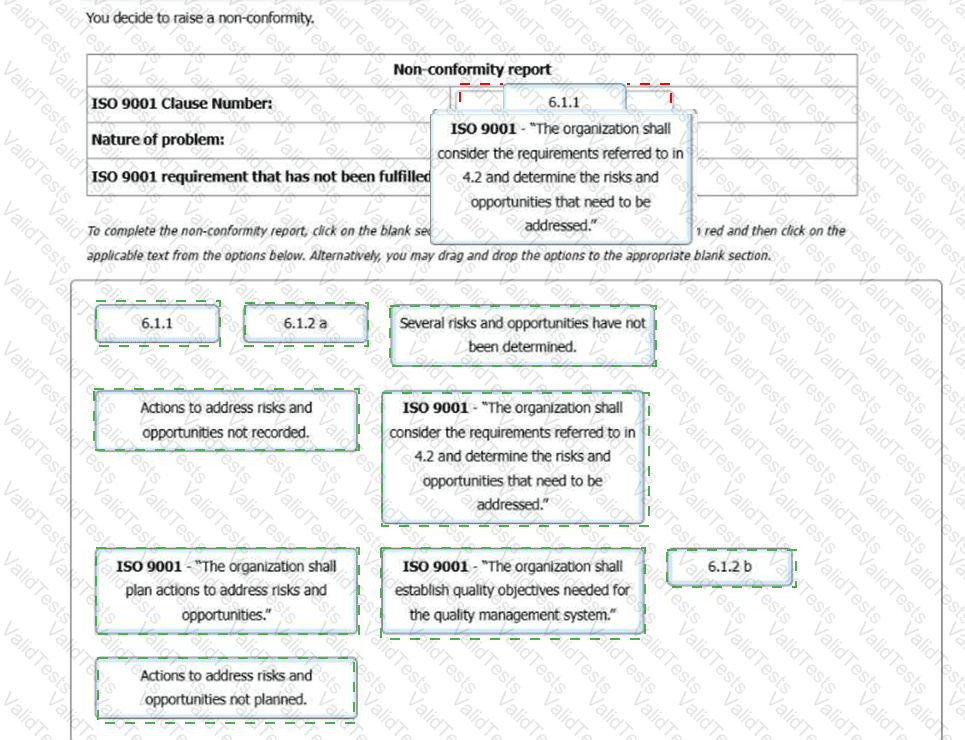
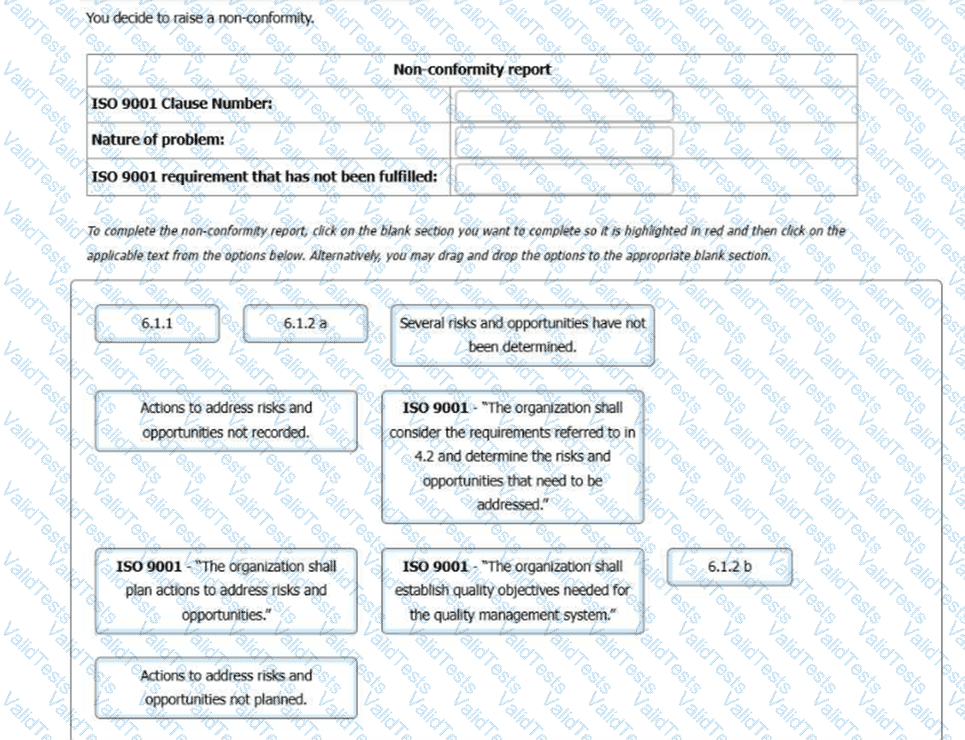
You are carrying out an audit at an organisation seeking certification to ISO 9001 for the first time. The organisation offers health and safety training to
customers.
You are interviewing the Quality Systems Manager (QSM).
You: "What risks and opportunities have the business identified?"
QSM: "I'1l show you. This was discussed with the Managing Director at the latest management review."
Narrative: The QSM shows you the latest management review record and points to the following table:

You: "How is the business planning to address these risks and opportunities?"
QSM: "The MD said that they already knew about them so it was not necessary."
Whistlekleen is a national dry cleaning and laundry company with 50 shops. You are conducting a surveillance audit of the Head Office and are sampling customer complaints. 80% of complaints originate from five shops in the same region. Most of these complaints
relate to customer laundry not being cleaned as customers require. The Quality Manager tells you that these are the oldest shops in the company. The cleaning equipment needs replacing but the company cannot afford it now. You learn that the shop managers were
told to dismiss most of the complaints because of the poor quality of the laundered materials.
On raising the matter with senior management, you are told that there are plans to replace the equipment in these shops over the next five years.
You raised a nonconformity against clause 8.5.1 of ISO 9001.
Based on the scenario, select the three options which best describe the evidence for raising such a nonconformity.
You are a member of the audit team of a second-party audit of an organisation with 625 employees. The audit procedure recommends using sampling criteria which requires the review of the documented competence for 25 personnel. The audit team leader developed an audit plan allocating one hour to audit the Human Resources department (from 11:30 am to 12:30 pm). She told you that she could not allocate any additional time.
What would you do?
You, as auditor, are in dialogue with the quality lead and managing director of a small business that supplies specialist laboratory equipment and furniture.
You: "I'd like to look at how you manage change in the organisation. What changes have you made as a
business, say, over the last 12 months?"
Auditee: "We have made some strategic changes, the main one being that we no longer manufacture our
own products in house."
You: "That sounds like quite a significant change. What has been the impact of that?"
Auditee: "We now mainly sell other manufacturers' products, under their brand names, and have outsourced
manufacture of our own brand products to one of our suppliers. Unfortunately, we had to make six members
of our staff redundant. This represents about 20% of our workforce, so this has been quite a challenging
time."
You: "I'm sure. What were the reasons for making the change?"
Auditee: "Our manufacturing section was a small operation, and we struggled to cope with fluctuations in
demand. During busy periods, we found it hard to meet lead times, and in quiet periods we had staff with
little to do. This was having an impact on customer satisfaction and meant we had to charge premium prices
that made our product uncompetitive."
You: "How did you go about the change?"
The auditor asks to speak to the purchasing manager about the selection of the subcontractor to
manufacture the company's own brand products.
You: "How did you choose a supplier to manufacture your products?"
Auditee: "We have had a long-term relationship with a supplier ABC Ltd - we gave them our design
drawings, got them to complete a supplier questionnaire and run a couple of trial batches for us. We were
happy with the result and we have used them ever since."
ISO 9001:2015, clause 8.4.1 outlines situations when controls need to be applied to externally provided processes, products and services. Which one of the following situations is applicable to this scenario?