
View all detail and faqs for the ISO-9001-Lead-Auditor exam
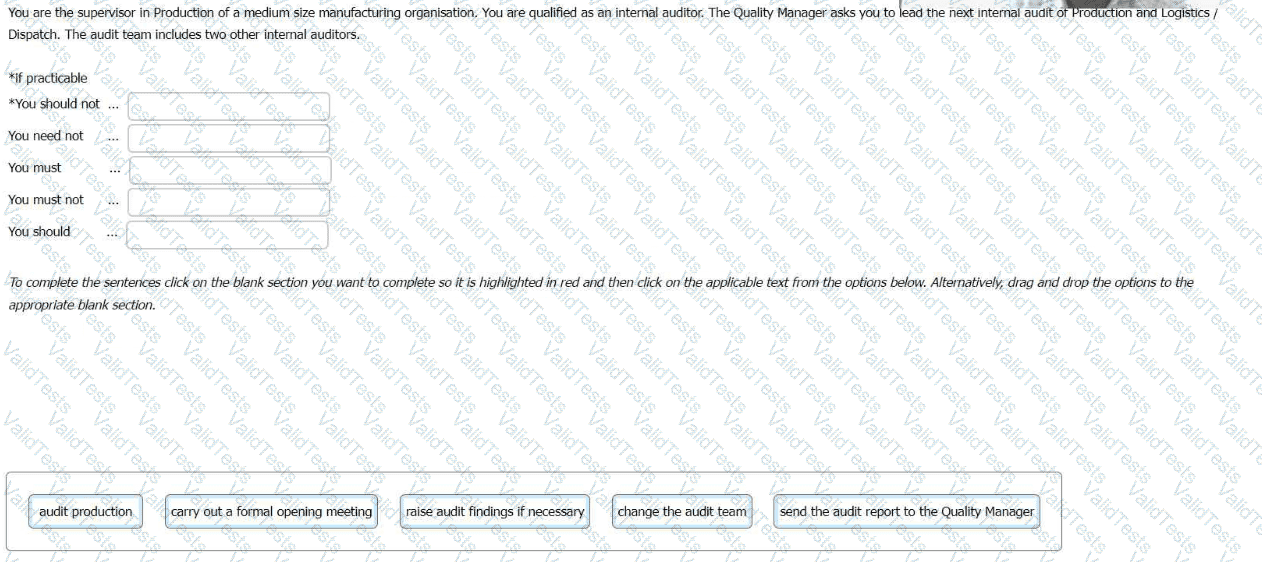
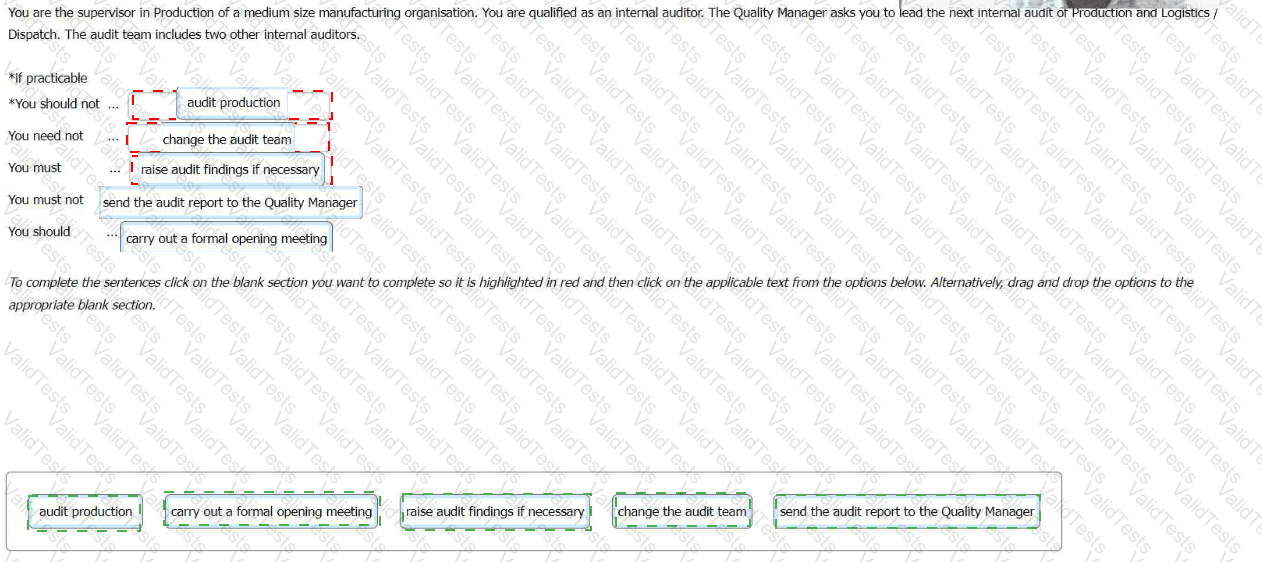
You are the supervisor in Production of a medium size manufacturing organisation. You are qualified as an internal auditor. The Quality Manager asks you to lead the next internal audit of Production and Logistics Dispatch. The audit team includes two other internal auditors.
Which two of the following may be changed once a Stage 2 certification audit has commenced?
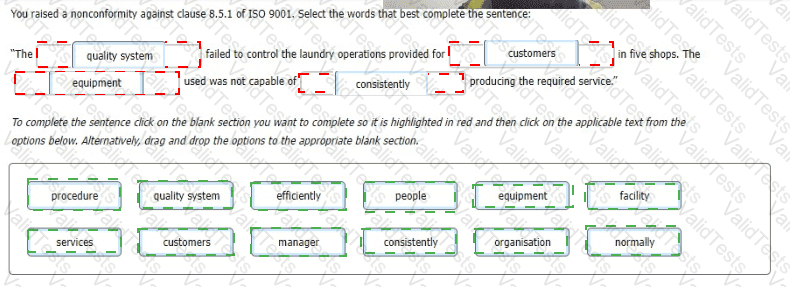
Whistlekleen is a national dry cleaning and laundry company with 50 shops. You are conducting a surveillance audit of the Head Office and are sampling customer
complaints. You find that 80% of complaints originate from five shops in the same region. Most of these complaints relate to damage to customer laundry. The Quality
Manager tells you that these are the oldest shops in the company. The cleaning equipment needs replacing but the company cannot afford it at the moment. You learn
that the shop managers were told to dismiss most of the claims on the basis of the poor quality of the laundered materials.
On raising the matter with senior management, you are told that there are plans to replace the equipment in these shops over the next five years.
A Health Trust has contracted with Servitup, a catering services organisation which has been certified to ISO 9001 for 1 year. It provides services to ten, small rural
hospitals in remote locations involving purchase and storage of dry goods and fresh produce, preparing meals and loading heated trolleys for ward service by hospital
staff. An auditor is conducting the first sole surveillance audit at one site with the Deputy Catering Manager (DCM).
At the closing meeting attended solely by the DCM, the auditor informs him that he has found numerous gaps in the QMS processes which lead him to consider
recommending suspension of the organisation's certification. He is particularly concerned with the evidence that patient health is being adversely affected by produce
stored beyond its safe consumption date, poor kitchen hygiene and undercooked meals. The DCM says that he cannot make any decisions about these issues in the
absence of the Catering Manager due to illness but will write everything down and report to the Catering Manager.
Which two actions should you take in the context of the audit?
What is a list of actions that should be performed during the audit with their respective timeline?
An audit team of three people is conducting a Stage 2 audit to ISO 9001 of an engineering organisation which manufactures sacrificial anodes for the
oil and gas industry in marine environments. These are aluminium products designed to prevent corrosion of submerged steel structures. As one of
the auditors, you find that the organisation has shipped anodes for Project DK in the Gulf of Mexico before the galvanic efficiency test results for the
anodes have been fully analysed and reported as required by the customer. The Quality Manager explains that the Managing Director authorised the
release of the anodes to avoid late delivery as penalties would be imposed. The customer was not informed since the tests rarely fall below the
required efficiency. You raise a nonconformity against clause 8.6 of ISO 9001.
During the audit team meeting in preparation for the Closing meeting, the second auditor disagreed with the clause of ISO 9001 selected for the
above nonconformity. He thinks it should be clause 9.1.1.
Choose three options for how the audit team leader should best respond to the situation:
Scenario 7: POLKA is a car manufacturing company based in Stockholm, Sweden. The company has around 14,000 employees working in different sectors which help with the design, painting, assembling, and test drives of the final product. The company is widely known for its qualitative products and affordable prices. In order to retain their reputation, POLKA implemented a quality management system (QMS) based on ISO 9001.
Before applying for certification, the company decided to conduct an internal audit to check whether there are any nonconformities in their QMS and if the requirements of ISO 9001 are being fulfilled. The top management appointed Sean, the internal auditor, as the team leader of the internal audit team. Sean required from the top management to have unrestricted access to the employees and executives of POLKA and to the documented information. Furthermore, Sean required to establish a team with a large number of auditors, considering the size and the complexity of the organization. The top management of POLKA agreed with Sean's requirements.
The top management, in cooperation with Sean, assigned 10 more employees to the audit team. Following that. Sean planned the audit activities and assigned the roles and responsibilities to each auditor. They began by interviewing employees of different manufacturing departments to check whether they are aware of the process of the QMS implementation. While conducting these activities, one of the auditors asked Sean for permission to audit the department in which he worked on a daily basis, as he was very familiar with the processes of the department.
Along the way, the teams findings showed that the staff were trained, documented information was updated, and the QMS fulfilled the requirements of ISO 9001. The internal audit took three weeks to complete, and on the last week the audit team held a final meeting
The team shared their results and together drafted the audit report This report was submitted to the top management of the company. The report was maintained as documented information, and was available to the relevant interested parties.
Based on the scenario above, answer the following question:
Ten employees of POLKA were part of the audit team that conducted the internal audit. Is this acceptable?
What is the responsibility of the audit committee during an internal audit?
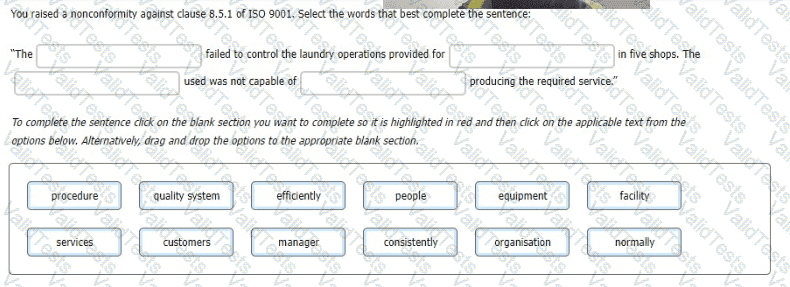
Whistiekleen is a national dry cleaning and laundry organisation with 50 shops. You are conducting a surveillance audit of the Head Office and are sampling customer complaints. You find that 80% of complaints originate from five shops in the same region. Most of these complaints relate to damage to customer laundry. The Quality Manager tells you that these are the oldest shops in the organisation. The deaning equipment needs replacing but the organisation cannot afford it now. You learn that the shop managers were told to dismiss most of the claims based on the poor quality of the laundered materials.
On raising the matter with senior management, you are told that there are plans to replace the equipment in these shops over the next five years.
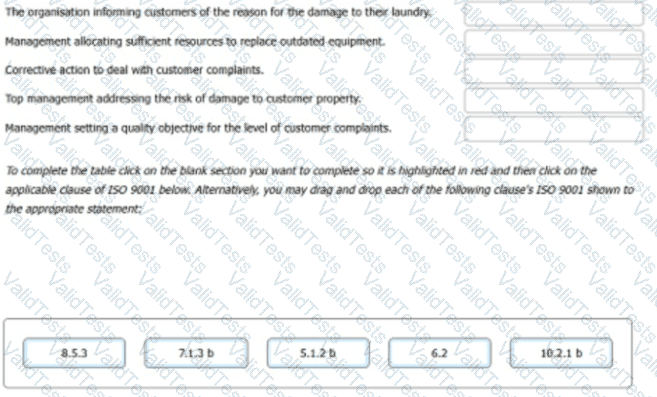
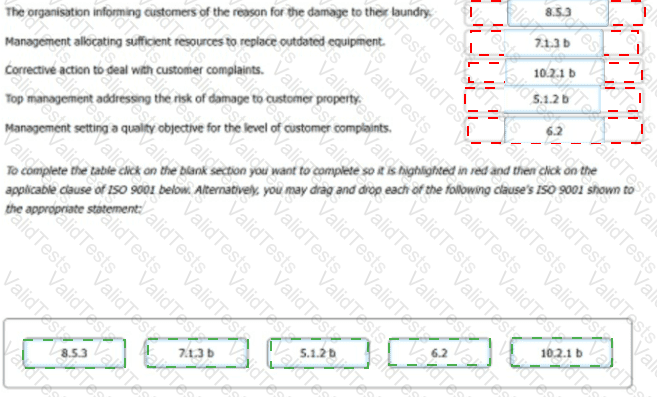
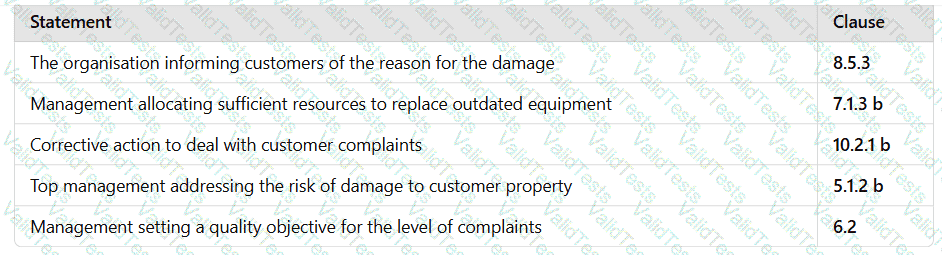
Match the ISO 9001 Clauses to the statements.
During a third-party audit of a pharmaceutical organisation (CD9000) site of seven COVID-19 testing laboratories in various terminals at
a major international airport, you interview the CD 9000's General Manager (GM), who was accompanied by Jack, the legal compliance
expert. Jack is acting as the guide in the absence of the Technical Manager due to him contracting COVID-19.
You: "What external and internal issues have been identified that could affect CD9000 and its quality management system?"
GM: "Jack guided us on this. We identified issues like probable competition of another laboratory organisation in the airport, legal
requirements on COVID-19 continuously changing, the shortage of competent laboratory analysists, the epidemic declining soon,
shortage of chemicals for the analysis. It was quite a good experience."
You: "Did you document these issues?"
GM: "No. Jack said that ISO 9001 does not require us to document these issues."
You: "How did you determine the risks associated with the issues and did you plan actions to address them?"
GM: "I am not sure. The Technical Manager is responsible for this process. Jack may be able to answer this question in his absence."
Select two options for how you would respond to the General Manager's suggestion:

 A screenshot of a computer AI-generated content may be incorrect.