View all detail and faqs for the ISO-IEC-27001-Lead-Auditor exam
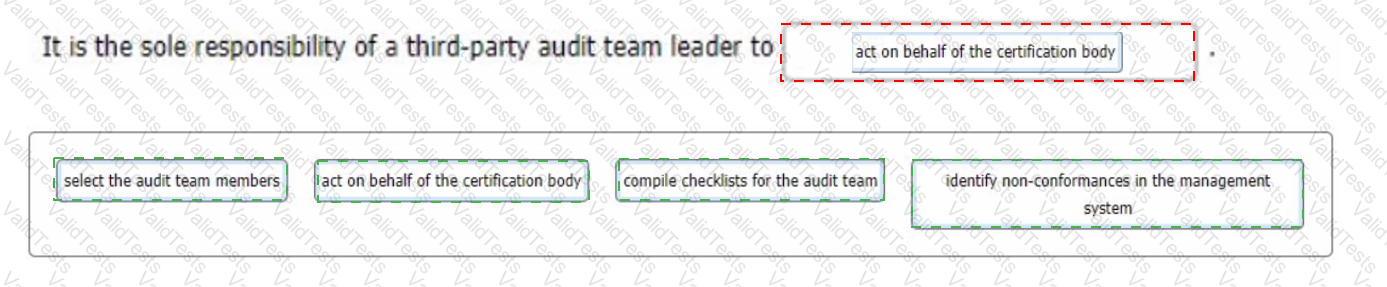
Select the words that best complete the sentence:
To complete the sentence with the best word(s), click on the blank section you want to complete so that it is highlighted in red, and then click on the applicable text from the options below. Alternatively, you may drag and drop the option to the appropriate blank section.
You are performing an ISMS audit at a residential nursing home (ABC) that provides healthcare services. The next step in your audit plan is to verify the information security of ABC's healthcare mobile app development, support, and lifecycle process. During the audit, you learned the organization outsourced the mobile app development to a professional software development company with CMMI Level 5, ITSM (ISO/IEC 20000-1), BCMS (ISO 22301) and ISMS (ISO/IEC 27001) certified.
The IT Manager presented the software security management procedure and summarised the process as following:
The mobile app development shall adopt "security-by-design" and "security-by-default" principles, as a minimum. The following security
functions for personal data protection shall be available:
Access control.
Personal data encryption, i.e., Advanced Encryption Standard (AES) algorithm, key lengths: 256 bits; and
Personal data pseudonymization.
Vulnerability checked and no security backdoor
You sample the latest Mobile App Test report, details as follows:
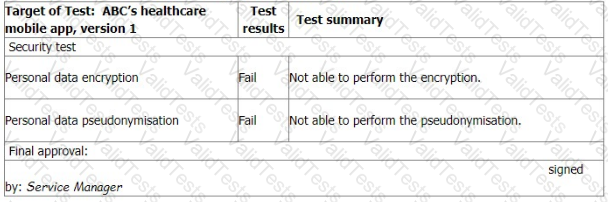
You ask the IT Manager why the organisation still uses the mobile app while personal data encryption and pseudonymization tests failed. Also, whether the Service Manager is authorised to approve the test.
The IT Manager explains the test results should be approved by him according to the software security management procedure.
The reason why the encryption and pseudonymisation functions failed is that these functions heavily slowed down the system and service performance. An extra 150% of resources are needed to cover this. The Service Manager agreed that access control is good enough and acceptable. That's why the Service Manager signed the approval.
You are preparing the audit findings. Select the correct option.
Which two of the following options for information are not required for audit planning of a certification audit?
Which one of the following options best describes the main purpose of a Stage 1 third-party audit?
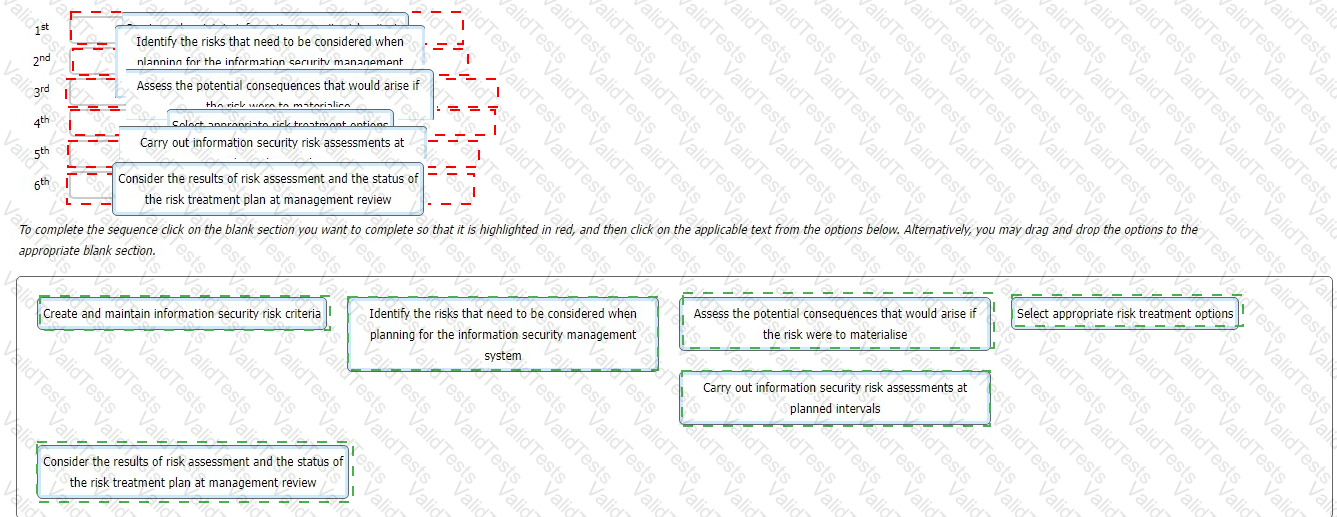
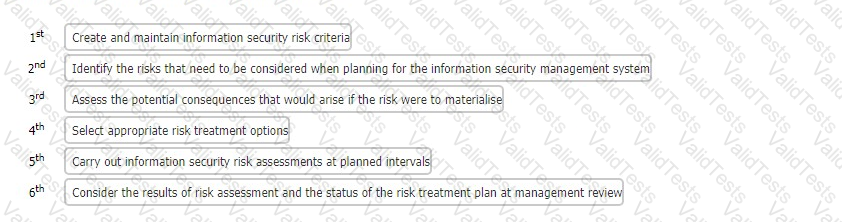
You are an experienced ISMS audit team leader providing instruction to a class of auditors in training. The subject of today's lesson is the management of information security risk in accordance with the requirements of ISO/IEC 27001:2022.
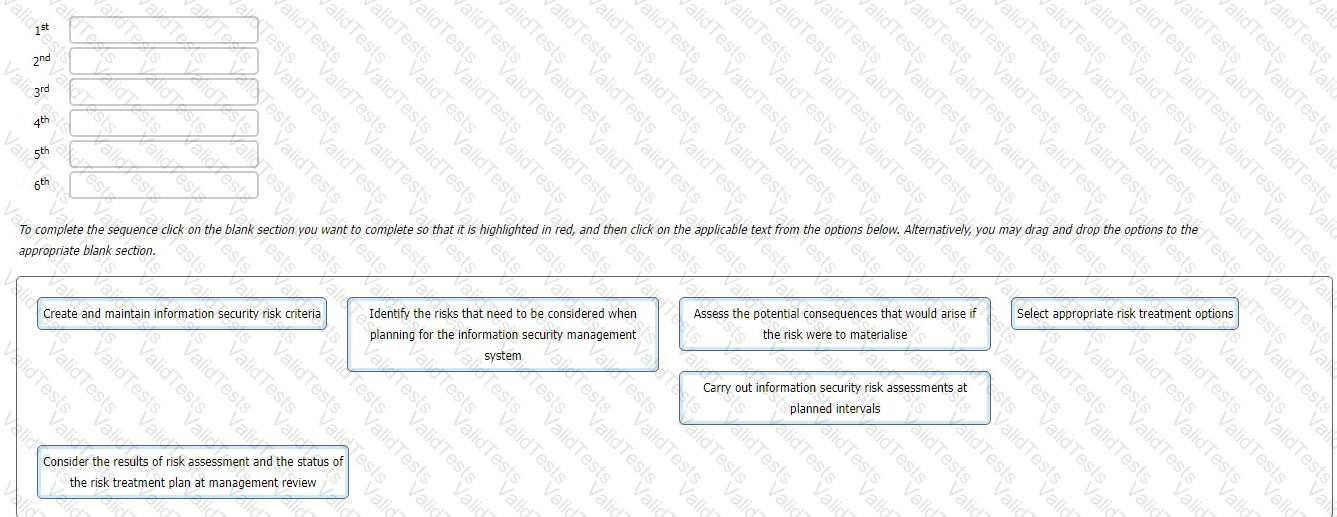
You provide the class with a series of activities. You then ask the class to sort these activities into the order in which they appear in the standard.
What is the correct sequence they should report back to you?
As the ISMS audit team leader, you are conducting a second-party audit of an international logistics company on behalf of an online retailer. During the audit, one of your team members reports a nonconformity relating to control 5.18 (Access rights) of Appendix A of ISO/IEC 27001:2022. She found evidence that removing the server access protocols of 20 people who left in the last 3 months took up to 1 week whereas the policy required removing access within 24 hours of their departure.
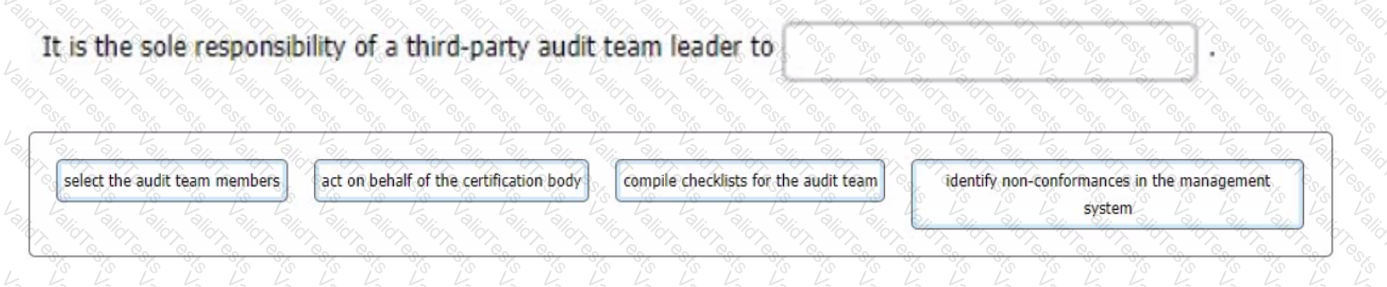
Complete the sentence with the best word(s), dick on the blank section you want to complete so that it is highlighted in red, and then click on the applicable text from the options below. Alternatively, you may drag and drop the option to the appropriate blank section.

What is meant by the term 'Corrective Action'? Select one
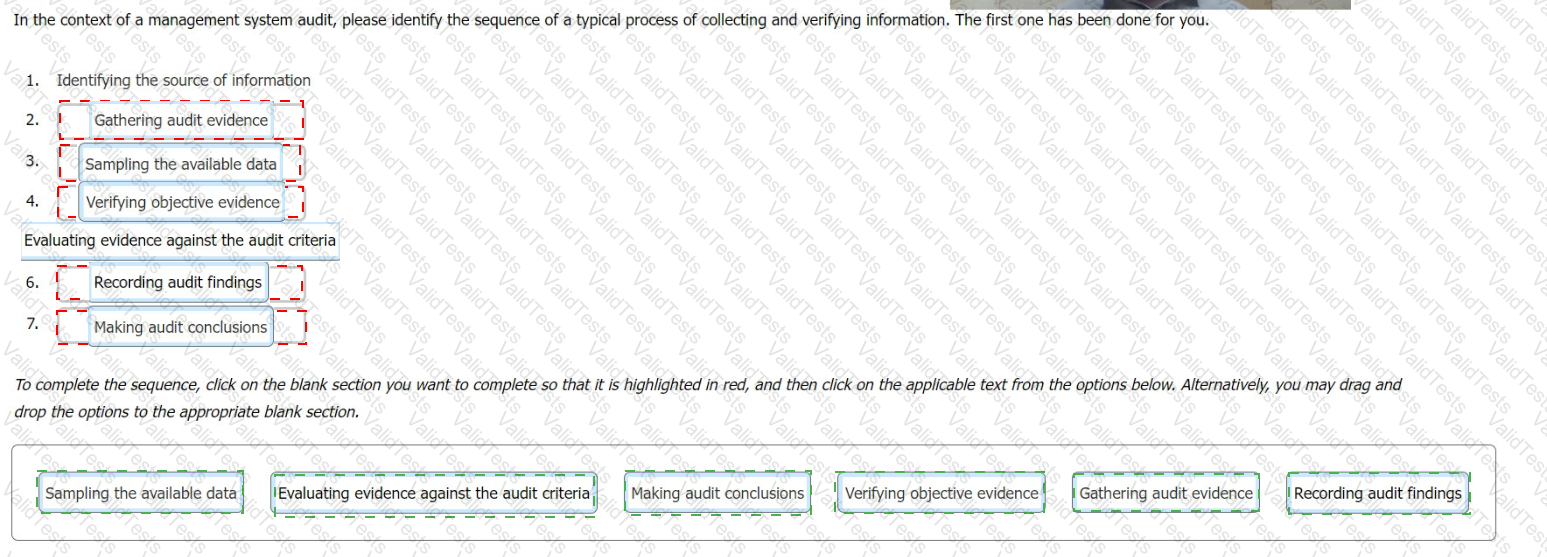
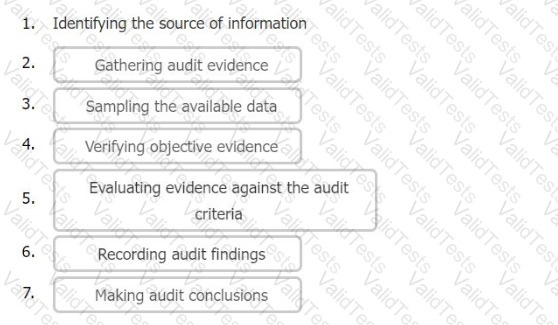
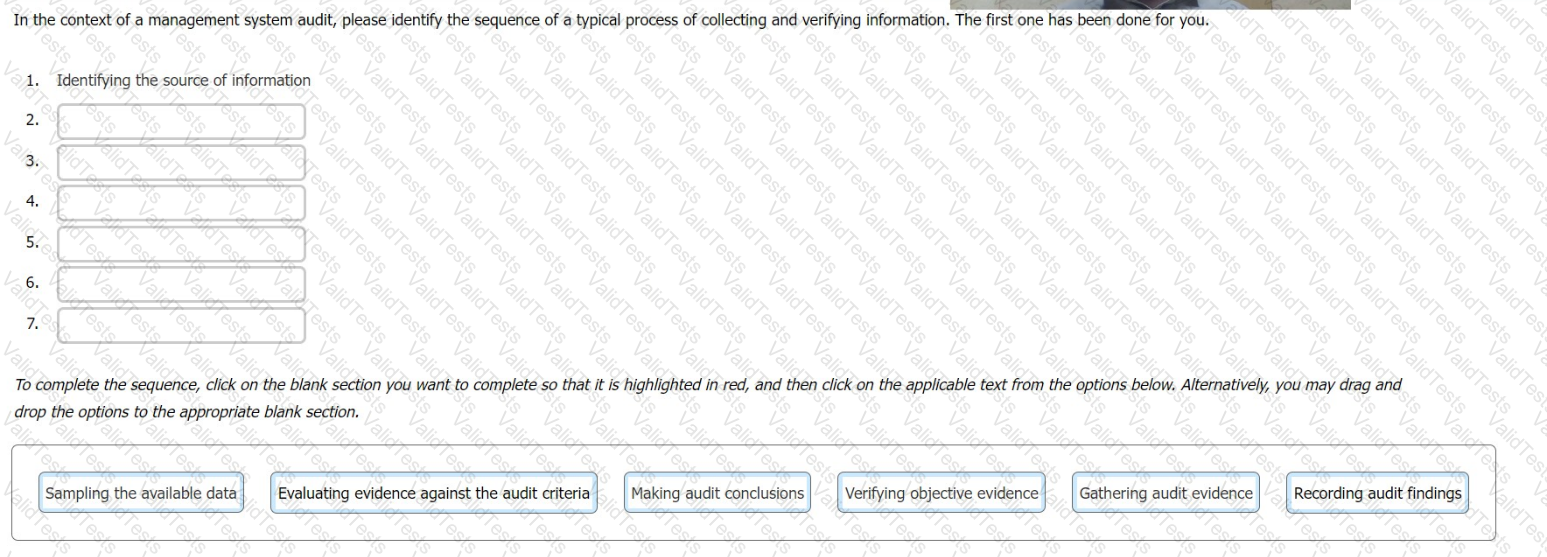
In the context of a management system audit, please identify the sequence of a typical process of collecting and verifying information. The first one has been done for you.
Scenario 6: Sinvestment is an insurance company that offers home, commercial, and life insurance. The company was founded in North Carolina, but have recently expanded in other locations, including Europe and Africa.
Sinvestment is committed to complying with laws and regulations applicable to their industry and preventing any information security incident. They have implemented an ISMS based on ISO/IEC 27001 and have applied for ISO/IEC 27001 certification.
Two auditors were assigned by the certification body to conduct the audit. After signing a confidentiality agreement with Sinvestment. they started the audit activities. First, they reviewed the documentation required by the standard, including the declaration of the ISMS scope, information security policies, and internal audits reports. The review process was not easy because, although Sinvestment stated that they had a documentation procedure in place, not all documents had the same format.
Then, the audit team conducted several interviews with Sinvestment's top management to understand their role in the ISMS implementation. All activities of the stage 1 audit were performed remotely, except the review of documented information, which took place on-site, as requested by Sinvestment.
During this stage, the auditors found out that there was no documentation related to information security training and awareness program. When asked, Sinvestment's representatives stated that the company has provided information security training sessions to all employees. Stage 1 audit gave the audit team a general understanding of Sinvestment's operations and ISMS.
The stage 2 audit was conducted three weeks after stage 1 audit. The audit team observed that the marketing department (which was not included in the audit scope) had no procedures in place to control employees’ access rights. Since controlling employees' access rights is one of the ISO/IEC 27001 requirements and was included in the information security policy of the company, the issue was included in the audit report. In addition, during stage 2 audit, the audit team observed that Sinvestment did not record logs of user activities. The procedures of the company stated that "Logs recording user activities should be retained and regularly reviewed," yet the company did not present any evidence of the implementation of such procedure.
During all audit activities, the auditors used observation, interviews, documented information review, analysis, and technical verification to collect information and evidence. All the audit findings during stages 1 and 2 were analyzed and the audit team decided to issue a positive recommendation for certification.
According to scenario 6, the marketing department employees were not following the access control policy. Which option is correct in this case?
You are an experienced ISMS audit team leader providing guidance to an ISMS auditor in training. They have been asked to carry out an assessment of external providers and have prepared a checklist containing the following activities. They have asked you to review their checklist to confirm that the actions they are proposing are appropriate.
The audit they have been invited to participate in is a third-party surveillance audit of a data centre . The data centre agent is part of a wider telecommunication group. Each data centre within the group operates its own ISMS and holds its own certificate.
Select three options that relate to ISO/IEC 27001:2022's requirements regarding external providers.