View all detail and faqs for the ISO-IEC-27001-Lead-Auditor exam
Question:
Which option below is correct about the audit plan?
Scenario 6: Sinvestment is an insurance company that offers home, commercial, and life insurance. The company was founded in North Carolina, but have recently expanded in other locations, including Europe and Africa.
Sinvestment is committed to complying with laws and regulations applicable to their industry and preventing any information security incident. They have implemented an ISMS based on ISO/IEC 27001 and have applied for ISO/IEC 27001 certification.
Two auditors were assigned by the certification body to conduct the audit. After signing a confidentiality agreement with Sinvestment. they started the audit activities. First, they reviewed the documentation required by the standard, including the declaration of the ISMS scope, information security policies, and internal audits reports. The review process was not easy because, although Sinvestment stated that they had a documentation procedure in place, not all documents had the same format.
Then, the audit team conducted several interviews with Sinvestment's top management to understand their role in the ISMS implementation. All activities of the stage 1 audit were performed remotely, except the review of documented information, which took place on-site, as requested by Sinvestment.
During this stage, the auditors found out that there was no documentation related to information security training and awareness program. When asked, Sinvestment's representatives stated that the company has provided information security training sessions to all employees. Stage 1 audit gave the audit team a general understanding of Sinvestment's operations and ISMS.
The stage 2 audit was conducted three weeks after stage 1 audit. The audit team observed that the marketing department (which was not included in the audit scope) had no procedures in place to control employees’ access rights. Since controlling employees' access rights is one of the ISO/IEC 27001 requirements and was included in the information security policy of the company, the issue was included in the audit report. In addition, during stage 2 audit, the audit team observed that Sinvestment did not record logs of user activities. The procedures of the company stated that "Logs recording user activities should be retained and regularly reviewed," yet the company did not present any evidence of the implementation of such procedure.
During all audit activities, the auditors used observation, interviews, documented information review, analysis, and technical verification to collect information and evidence. All the audit findings during stages 1 and 2 were analyzed and the audit team decided to issue a positive recommendation for certification.
During stage 1 audit, the audit team found out that Sinvestment did not have records on information security training and awareness. What Sinvestment do in this case? Refer to scenario 6.
Scenario:
Northstorm is an online retail shop offering unique vintage and modern accessories. It initially entered a small market but gradually grew thanks to the development of the overall e-commerce landscape. Northstorm works exclusively online and ensures efficient payment processing, inventory management, marketing tools, and shipment orders. It uses prioritized ordering to receive, restock, and ship its most popular products.
Northstorm has traditionally managed its IT operations by hosting its website and maintaining full control over its infrastructure, including hardware, software, and data administration. However, this approach hindered its growth due to the lack of responsive infrastructure. Seeking to enhance its e-commerce and payment systems, Northstorm opted to expand its in-house data centers, completing the expansion in two phases over three months. Initially, the company upgraded its core servers, point-of-sale, ordering, billing, database, and backup systems. The second phase involved improving mail, payment, and network functionalities. Additionally, during this phase, Northstorm adopted an international standard for personally identifiable information (PII) controllers and PII processors regarding PII processing to ensure its data handling practices were secure and compliant with global regulations.
Despite the expansion, Northstorm's upgraded data centers failed to meet its evolving business demands. This inadequacy led to several new challenges, including issues with order prioritization. Customers reported not receiving priority orders, and the company struggled with responsiveness. This was largely due to the main server's inability to process orders from YouDecide, an application designed to prioritize orders and simulate customer interactions. The application, reliant on advanced algorithms, was incompatible with the new operating system (OS) installed during the upgrade.
Faced with urgent compatibility issues, Northstorm quickly patched the application without proper validation, leading to the installation of a compromised version. This security lapse resulted in the main server being affected and the company's website going offline for a week. Recognizing the need for a more reliable solution, the company decided to outsource its website hosting to an e-commerce provider. The company signed a confidentiality agreement concerning product ownership and conducted a thorough review of user access rights to enhance security before transitioning.
Question:
Which of the following is a preventive control based on Scenario 1?
You are performing an ISMS initial certification audit at a residential nursing home that provides healthcare services. The next step in your audit plan is to conduct the closing meeting. During the final audit team meeting, as an audit team leader, you agree to report 2 minor nonconformities and 1 opportunity for improvement as below:
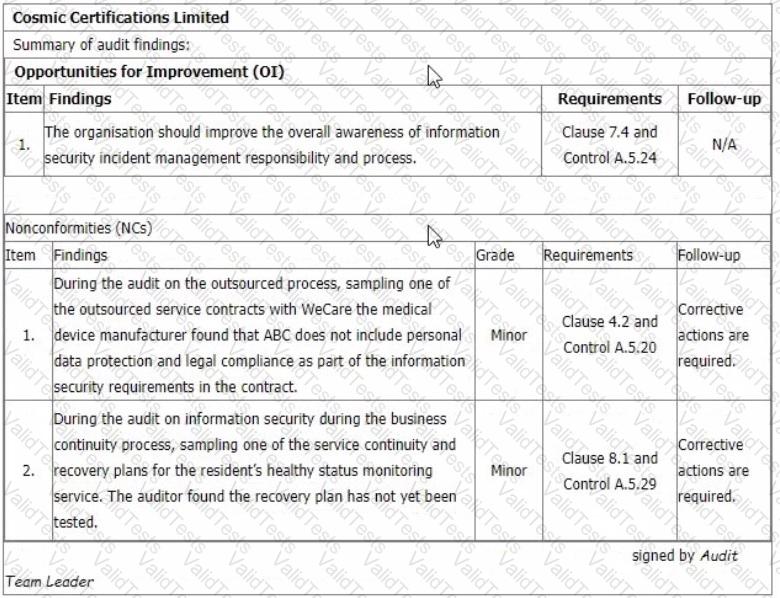
During the closing meeting, the Management System Representative (MSR) updates you with the information that ABC is going to merge with WeCare medical devices manufacture within the next 3 months. ABC will be the organisation's name after the merger. He asks if it is possible to include WeCare medical devices manufacture location in the follow-up audit so that the certification will include it. He says that WeCare is certified to ISO/IEC 27001:2022.
Select one option for the correct response to the request of the MSR.
You are performing an ISMS audit at a residential nursing home that provides healthcare services. The next step in your audit plan is to verify the information security incident management process. The IT Security Manager presents the information
security incident management procedure (Document reference ID: ISMS_L2_16, version 4) and explains that the process is
based on ISO/IEC 27035-1:2016.
You review the document and notice a statement "any information security weakness, event, and incident should be reported
to the Point of Contact (PoC) within 1 hour after identification". When interviewing staff, you found that there were differences
in the understanding of the meaning of "weakness, event, and incident".
The IT Security Manager explained that an online "information security handling" training seminar was conducted 6 months
ago. All of the interviewed persons participated in and passed the reporting exercise and course assessment.
You are preparing the audit findings. Select two options that are correct.
Which is the glue that ties the triad together
You are the audit team leader conducting a third-party audit of an online insurance company. During Stage 1, you found that the organization took a very cautious risk approach and included all the information security controls in ISO/IEC 27001:2022 Appendix A in their Statement of Applicability.
During the Stage 2 audit, your audit team found that there was no evidence of a risk treatment plan for the implementation of the three controls (5.3 Segregation of duties, 6.1 Screening, 7.12 Cabling security). You raise a nonconformity against clause 6.1.3.e of ISO 27001:2022.
At the closing meeting, the Technical Director issues an extract from an amended Statement of Applicability (as shown) and asks for the nonconformity to be withdrawn.
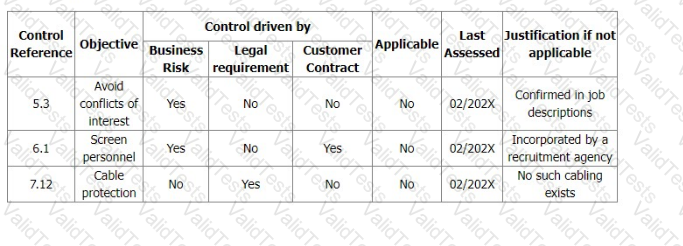
Select three options of the correct responses of an audit team leader to the request of the Technical Director.
You are an experienced ISMS internal auditor.
You have just completed a scheduled information security audit of your organisation when the IT Manager approaches you and asks for your assistance in the revision of the company's Statement of Applicability.
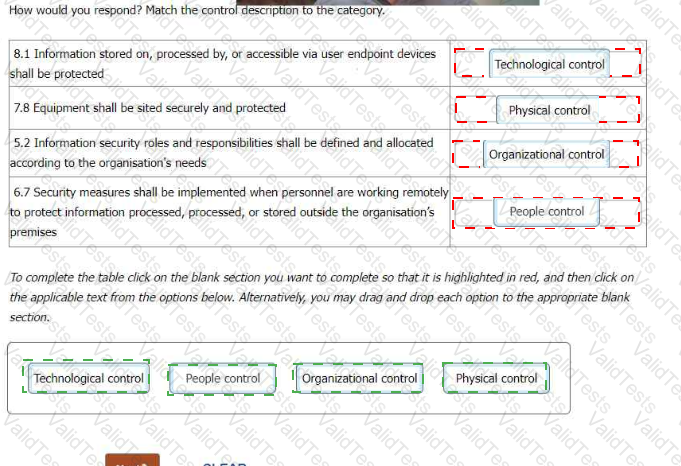
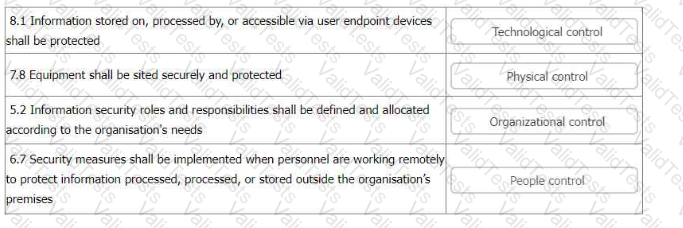
The IT Manager is attempting to update the ISO/IEC 27001:2013 based Statement of Applicability to a Statement aligned to the 4 control themes present in ISO/IEC 27001:2022 (Organizational controls, People Controls, Physical Controls, Technical Controls).
The IT Manager is happy with their reassignment of controls, with the following exceptions. He asks you which of the four control categories each of the following should appear under.
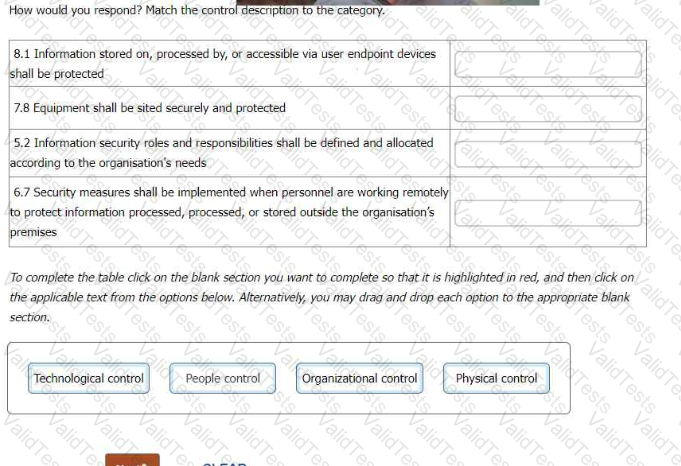
Scenario 7: Webvue. headquartered in Japan, is a technology company specializing in the development, support, and maintenance of computer software. Webvue provides solutions across various technology fields and business sectors. Its flagship service is CloudWebvue, a comprehensive cloud computing platform offering storage, networking, and virtual computing services. Designed for both businesses and individual users. CloudWebvue is known for its flexibility, scalability, and reliability.
Webvue has decided to only include CloudWebvue in its ISO/IEC 27001 certification scope. Thus, the stage 1 and 2 audits were performed simultaneously Webvue takes pride in its strictness regarding asset confidentiality They protect the information stored in CloudWebvue by using appropriate cryptographic controls. Every piece of information of any classification level, whether for internal use. restricted, or confidential, is first encrypted with a unique corresponding hash and then stored in the cloud
The audit team comprised five persons Keith. Sean. Layla, Sam. and Tina. Keith, the most experienced auditor on the IT and information security auditing team, was the audit team leader. His responsibilities included planning the audit and managing the audit team. Sean and Layla were experienced in project planning, business analysis, and IT systems (hardware and application) Their tasks included audit planning according to Webvue’s internal systems and processes Sam and Tina, on the other hand, who had recently completed their education, were responsible for completing the day-to-day tasks while developing their audit skills
While verifying conformity to control 8.24 Use of cryptography of ISO/IEC 27001 Annex A through interviews with the relevant staff, the audit team found out that the cryptographic keys have been initially generated based on random bit generator (RBG) and other best practices for the generation of the cryptographic keys. After checking Webvue's cryptography policy, they concluded that the information obtained by the interviews was true. However, the cryptographic keys are still in use because the policy does not address the use and lifetime of cryptographic keys.
As later agreed upon between Webvue and the certification body, the audit team opted to conduct a virtual audit specifically focused on verifying conformity to control 8.11 Data Masking of ISO/IEC 27001 within Webvue, aligning with the certification scope and audit objectives. They examined the processes involved in protecting data within CloudWebvue. focusing on how the company adhered to its policies and regulatory standards. As part of this process. Keith, the audit team leader, took screenshot copies of relevant documents and cryptographic key management procedures to document and analyze the effectiveness of Webvue's practices.
Webvue uses generated test data for testing purposes. However, as determined by both the interview with the manager of the QA Department and the procedures used by this department, sometimes live system data are used. In such scenarios, large amounts of data are generated while producing more accurate results. The test data is protected and controlled, as verified by the simulation of the encryption process performed by Webvue's personnel during the audit
While interviewing the manager of the QA Department, Keith observed that employees in the Security Training Department were not following proper procedures, even though this department fell outside the audit scope. Despite the exclusion in the audit scope, the non conformity in the Security Training Department has potential implications for the processes within the audit scope, specifically impacting data security and cryptographic practices in CloudWebvue. Therefore, Keith incorporated this finding into the audit report and accordingly informed the auditee.
Based on the scenario above, answer the following question:
Question:
Based on Scenario 7, was Keith’s choice regarding the incorporation of the Security Training Department in the audit report appropriate?
Scenario 2:
Clinic, founded in the 1990s, is a medical device company that specializes in treatments for heart-related conditions and complex surgical interventions. Based in Europe, it serves both patients and healthcare professionals. Clinic collects patient data to tailor treatments, monitor outcomes, and improve device functionality. To enhance data security and build trust, Clinic is implementing an information security management system (ISMS) based on ISO/IEC 27001. This initiative demonstrates Clinic's commitment to securely managing sensitive patient information and proprietary technologies.
Clinic established the scope of its ISMS by solely considering internal issues, interfaces, dependencies between internal and outsourced activities, and the expectations of interested parties. This scope was carefully documented and made accessible. In defining its ISMS, Clinic chose to focus specifically on key processes within critical departments such as Research and Development, Patient Data Management, and Customer Support.
Despite initial challenges, Clinic remained committed to its ISMS implementation, tailoring security controls to its unique needs. The project team excluded certain Annex A controls from ISO/IEC 27001 while incorporating additional sector-specific controls to enhance security. The team evaluated the applicability of these controls against internal and external factors, culminating in the development of a comprehensive Statement of Applicability (SoA) detailing the rationale behind control selection and implementation.
As preparations for certification progressed, Brian, appointed as the team leader, adopted a self-directed risk assessment methodology to identify and evaluate the company’s strategic issues and security practices. This proactive approach ensured that Clinic’s risk assessment aligned with its objectives and mission.
Question:
According to Scenario 2, was the scope of Clinic’s ISMS determined correctly?