View all detail and faqs for the ISO-IEC-27001-Lead-Auditor exam
Scenario 3
NightCore, a multinational technology enterprise headquartered in the United States, specializes in e-commerce, cloud computing, digital streaming, and artificial intelligence (AI). After having an information security management system (ISMS) implemented for over a year, NightCore contracted a certification body to perform an audit for ISO/IEC 27001 certification.
The certification body formed a team of five auditors, with Jack as a team leader. Jack is renowned for his extensive auditing experience in risk management, information security controls, and incident management. His skill set aligns well with the requirements of auditing principles and processes, enabling him to effectively comprehend the audit scope and apply relevant criteria effectively. Jack also demonstrates a solid understanding of NightCore’s organizational structure, purpose, and management practices and the statutory and regulatory requirements applicable to its activities.
The audit carried out by the audit team followed a rational method to reach reliable and reproducible conclusions systematically. The audit team recognized that only information capable of being verified to some extent should be considered valid evidence. In some rare instances during the audit where the verification of certain information posed challenges and where its degree of verifiability was low, the auditors exercised their professional judgment to assess the reliability and determine the level of reliance that could be placed on such evidence.
During the audit, the auditors documented their observations and inspection notes regarding the operational planning and control of NightCore’s ISMS operations. They also recorded observations of NightCore’s inventory of information and associated assets. Additionally, the auditors reviewed the configuration of firewalls implemented to secure connections to network services.
As the audit approached its final stages, NightCore’s commitment to upholding the highest levels of information security became evident. With ISO/IEC 27001 certification within reach, NightCore is well-positioned to achieve ISO/IEC 27001 certification, enhancing its reputation in the technology sector.
Question
According to Scenario 3, did the auditors appropriately handle information that could only be verified to some extent?
Question
Who establishes the audit scope and audit criteria?
Scenario 6: Cyber ACrypt is a cybersecurity company that provides endpoint protection by offering anti-malware and device security, asset life cycle management, and device encryption. To validate its ISMS against ISO/IEC 27001 and demonstrate its commitment to cybersecurity excellence, the company underwent a meticulous audit process led by John, the appointed audit team leader.
Upon accepting the audit mandate, John promptly organized a meeting to outline the audit plan and team roles This phase was crucial for aligning the team with the audit's objectives and scope However, the initial presentation to Cyber ACrypt’s staff revealed a significant gap in understanding the audit's scope and objectives, indicating potential readiness challenges within the company
As the stage 1 audit commenced, the team prepared for on-site activities. They reviewed Cyber ACrypt's documented information, including the information security policy and operational procedures ensuring each piece conformed to and was standardized in format with author identification, production date, version number, and approval date Additionally, the audit team ensured that each document contained the information required by the respective clause of the standard This phase revealed that a detailed audit of the documentation describing task execution was unnecessary, streamlining the process and focusing the team's efforts on critical areas During the phase of conducting on-site activities, the team evaluated management responsibility for the Cyber Acrypt's policies This thorough examination aimed to ascertain continual improvement and adherence to ISMS requirements Subsequently, in the document, the stage 1 audit outputs phase, the audit team meticulously documented their findings, underscoring their conclusions regarding the fulfillment of the stage 1 objectives. This documentation was vital for the audit team and Cyber ACrypt to understand the preliminary audit outcomes and areas requiring attention.
The audit team also decided to conduct interviews with key interested parties. This decision was motivated by the objective of collecting robust audit evidence to validate the management system’s compliance with ISO/IEC 27001 requirements. Engaging with interested parties across various levels of Cyber ACrypt provided the audit team with invaluable perspectives and an understanding of the ISMS's implementation and effectiveness.
The stage 1 audit report unveiled critical areas of concern. The Statement of Applicability (SoA) and the ISMS policy were found to be lacking in several respects, including insufficient risk assessment, inadequate access controls, and lack of regular policy reviews. This prompted Cyber ACrypt to take immediate action to address these shortcomings. Their prompt response and modifications to the strategic documents reflected a strong commitment to achieving compliance.
The technical expertise introduced to bridge the audit team's cybersecurity knowledge gap played a pivotal role in identifying shortcomings in the risk assessment methodology and reviewing network architecture. This included evaluating firewalls, intrusion detection and prevention systems, and other network security measures, as well as assessing how Cyber ACrypt detects, responds to, and recovers from external and internal threats. Under John's supervision, the technical expert communicated the audit findings to the representatives of Cyber ACrypt. However, the audit team observed that the expert s objectivity might have been compromised due to receiving consultancy fees from the auditee. Considering the behavior of the technical expert during the audit, the audit team leader decided to discuss this concern with the certification body.
Based on the scenario above, answer the following question:
Question:
According to Scenario 6, Cyber ACrypt modified the SoA and the ISMS policy after the Stage 1 audit report. How do you define this situation?
You see a blue color sticker on certain physical assets. What does this signify?
Question:
What type of sampling was used when the auditor used probability-based sampling for event log reviews?
PayBell, a finance corporation, is using an accounting software to track financial transactions. The software can be accessed from anywhere with an internet connection. It also enables PayBell's employees to easily collaborate with each other to ensure accurate financial reporting. What type of services is PayBell using?
You are performing an ISMS audit at a residential nursing home that provides healthcare services. The next step in your audit
plan is to verify the information security of the business continuity management process. During the audit, you learned that
the organisation activated one of the business continuity plans (BCPs) to make sure the nursing service continued during the
recent pandemic. You ask the Service Manager to explain how the organization manages information security during the
business continuity management process.
The Service Manager presented the nursing service continuity plan for a pandemic and summarised the process as follows:
Stop the admission of any NEW residents.
70% of administration staff and 30% of medical staff will work from home.
Regular staff self-testing, including submitting a negative test report 1 day BEFORE they come to the office.
Install ABC's healthcare mobile app, tracking their footprint and presenting a GREEN Health Status QR-Code for checking on the spot.
You ask the Service Manager how to prevent non-relevant family members or interested parties from accessing residents' personal data when staff work from home. The Service Manager cannot answer and suggests the IT Security Manager should help with that.
You would like to further investigate other areas to collect more audit evidence. Select three options that will not be in your audit trail.
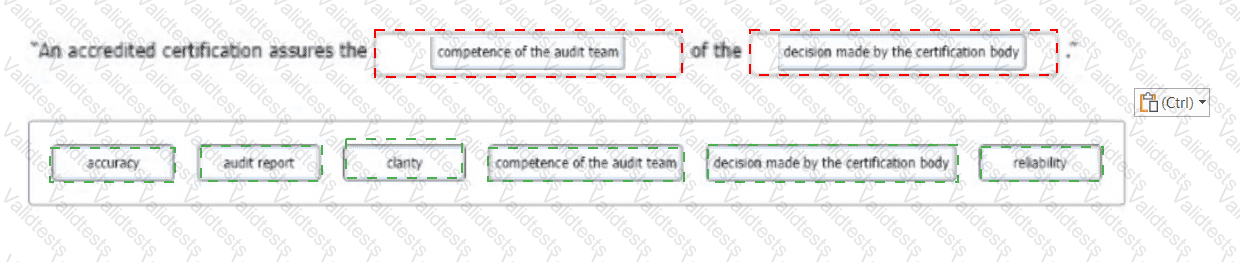
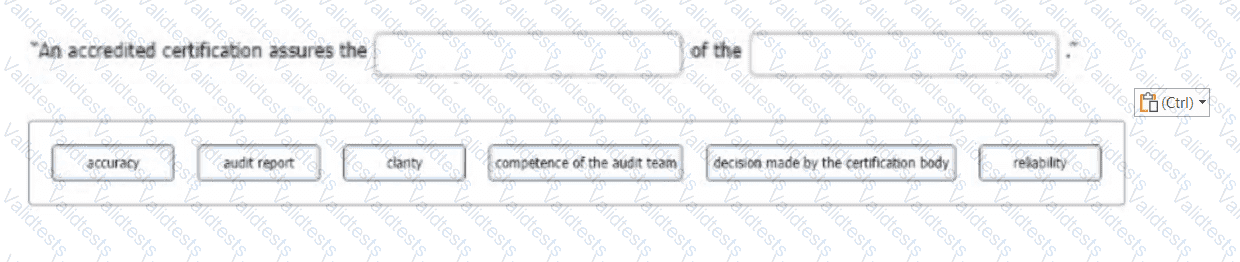
Select the words that best complete the sentence:
To complete the sentence with the word(s) click on the blank section you want to complete so that it is highlighted in red, and then click on the application text from the options below. Alternatively, you may drag and drop the option to the appropriate blank section.
Scenario 6
Sinvestment is an insurance provider that offers a wide range of coverage options, including home, commercial, and life insurance. Originally established in North California, the company has expanded its operations to other locations, including Europe and Africa. In addition to its growth, Sinvestment is committed to complying with laws and regulations applicable to its industry and preventing any information security incident. They have implemented an information security management system (ISMS) based on ISO/IEC 27001 and have applied for certification.
A team of auditors was assigned by the certification body to conduct the audit. After signing a confidentiality agreement with Sinvestment, they started the audit activities. For the activities of the stage 1 audit, it was decided that they would be performed on site, except the review of documented information, which took place remotely, as requested by Sinvestment.
The audit team started the stage 1 audit by reviewing the documentation required, including the declaration of the ISMS scope, information security policies, and internal audit reports. The evaluation of the documented information was based on the content and procedure for managing the documented information.
In addition, the auditors found out that the documentation related to information security training and awareness programs was incomplete and lacked essential details. When asked, Sinvestment’s top management stated that the company has provided information security training sessions to all employees.
The stage 2 audit was conducted three weeks after the stage 1 audit. The audit team observed that the marketing department (not included in the audit scope) had no procedures to control employees’ access rights. Since controlling employees' access rights is one of the ISO/IEC 27001 requirements and was included in the company's information security policy, the issue was included in the audit report.
Question
Was Sinvestment’s request for reviewing documented information remotely acceptable?
Scenario 9: Techmanic is a Belgian company founded in 1995 and currently operating in Brussels. It provides IT consultancy, software design, and hardware/software services, including deployment and maintenance. The company serves sectors like public services, finance, telecom, energy, healthcare, and education. As a customer-centered company, it prioritizes strong client relationships and leading security practices.
Techmanic has been ISO/IEC 27001 certified for a year and regards this certification with pride. During the certification audit, the auditor found some inconsistencies in its ISMS implementation. Since the observed situations did not affect the capability of its ISMS to achieve the intended results, Techmanic was certified after auditors followed up on the root cause analysis and corrective actions remotely During that year, the company added hosting to its list of services and requested to expand its certification scope to include that area The auditor in charge approved the request and notified Techmanic that the extension audit would be conducted during the surveillance audit
Techmanic underwent a surveillance audit to verify its iSMS's continued effectiveness and compliance with ISO/IEC 27001. The surveillance audit aimed to ensure that Techmanic’s security practices, including the recent addition of hosting services, aligned seamlessly with the rigorous requirements of the certification
The auditor strategically utilized the findings from previous surveillance audit reports in the recertification activity with the purpose of replacing the need for additional recertification audits, specifically in the IT consultancy sector. Recognizing the value of continual improvement and learning from past assessments. Techmanic implemented a practice of reviewing previous surveillance audit reports. This proactive approach not only facilitated identifying and resolving potential nonconformities but also aimed to streamline the recertification process in the IT consultancy sector.
During the surveillance audit, several nonconformities were found. The ISMS continued to fulfill the ISO/IEC 27001*s requirements, but Techmanic failed to resolve the nonconformities related to the hosting services, as reported by its internal auditor. In addition, the internal audit report had several inconsistencies, which questioned the independence of the internal auditor during the audit of hosting services. Based on this, the extension certification was not granted. As a result. Techmanic requested a transfer to another certification body. In the meantime, the company released a statement to its clients stating that the ISO/IEC 27001 certification covers the IT services, as well as the hosting services.
Based on the scenario above, answer the following question:
Question:
What action should be taken regarding Techmanic’s certification?