View all detail and faqs for the ISO-IEC-27001-Lead-Auditor exam
After analyzing the audit conclusions, Company X decided to accept the risk related to one of the detected nonconformities. They claimed that no corrective action was necessary; however, their decision was not documented. Is this acceptable?
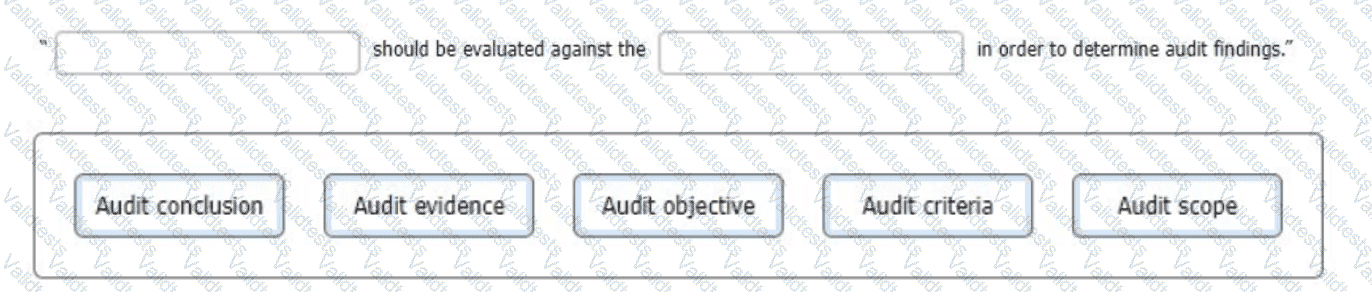
In regard to generating an audit finding, select the words that best complete the following sentence.
To complete the sentence with the best word(s), click on the blank section you want to complete so that it Is highlighted in red, and then click on the applicable text from the options below. Alternatively, you may drag and drop the option to the appropriate blank section.
Which two of the following statements are true?
Question
A security analyst is performing a penetration test on an organization’s internal network. A vulnerability scanning tool detects a high-risk vulnerability in a critical server, suggesting it could allow remote code execution. However, the penetration tester is unable to exploit the vulnerability successfully due to unknown system configurations and patch levels.
Should the company immediately consider this vulnerability as a confirmed security risk?
Scenario 4: Branding is a marketing company that works with some of the most famous companies in the US. To reduce internal costs. Branding has outsourced the software development and IT helpdesk operations to Techvology for over two years. Techvology. equipped with the necessary expertise, manages Branding's software, network, and hardware needs. Branding has implemented an information security management system (ISMS) and is certified against ISO/IEC 27001, demonstrating its commitment to maintaining high standards of information security. It actively conducts audits on Techvology to ensure that the security of its outsourced operations complies with ISO/IEC 27001 certification requirements.
During the last audit. Branding's audit team defined the processes to be audited and the audit schedule. They adopted an evidence based approach, particularly in light of two information security incidents reported by Techvology in the past year The focus was on evaluating how these incidents were addressed and ensuring compliance with the terms of the outsourcing agreement
The audit began with a comprehensive review of Techvology's methods for monitoring the quality of outsourced operations, assessing whether the services provided met Branding's expectations and agreed-upon standards The auditors also verified whether Techvology complied with the contractual requirements established between the two entities This involved thoroughly examining the terms and conditions in the outsourcing agreement to guarantee that all aspects, including information security measures, are being adhered to.
Furthermore, the audit included a critical evaluation of the governance processes Techvology uses to manage its outsourced operations and other organizations. This step is crucial for Branding to verify that proper controls and oversight mechanisms are in place to mitigate potential risks associated with the outsourcing arrangement.
The auditors conducted interviews with various levels of Techvology's personnel and analyzed the incident resolution records. In addition, Techvology provided the records that served as evidence that they conducted awareness sessions for the staff regarding incident management. Based on the information gathered, they predicted that both information security incidents were caused by incompetent personnel. Therefore, auditors requested to see the personnel files of the employees involved in the incidents to review evidence of their competence, such as relevant experience, certificates, and records of attended trainings.
Branding's auditors performed a critical evaluation of the validity of the evidence obtained and remained alert for evidence that could contradict or question the reliability of the documented information received. During the audit at Techvology, the auditors upheld this approach by critically assessing the incident resolution records and conducting thorough interviews with employees at different levels and functions. They did not merely take the word of Techvology's representatives for facts; instead, they sought concrete evidence to support the representatives' claims about the incident management processes.
Based on the scenario above, answer the following question:
Question:
Which auditing principle is explained in the last paragraph of Scenario 4?
Which statement below best describes the relationship between information security aspects?
You are an ISMS audit team leader tasked with conducting a follow-up audit at a client's data centre. Following two days on-site you conclude that of the original 12 minor and 1 major nonconformities that prompted the follow-up audit, only 1 minor nonconformity still remains outstanding.
Select four options for the actions you could take.
ISMS (1)---------------helps determine (2)--------------,
You are the person responsible for managing the audit programme and deciding the size and composition of the audit team for a specific audit. Select the two factors that should be considered.
The audit scope and criteria
Scenario 1
Fintive is a distinguished security provider specializing in online payments and protection solutions. Founded in 1999 by Thomas Fin in San Jose, California, Fintive offers services to companies operating online that seek to improve their information security, prevent fraud, and protect user information such as personally identifiable information (PII).
Fintive bases its decision-making and operational processes on previous cases, gathering customer data, classifying them according to the case, and analyzing them.
Initially, Fintive required a large number of employees to be able to conduct such complex analyses. However, as technology advanced, the company recognized an opportunity to implement a modern tool — a chatbot — to achieve pattern analyses aimed at preventing fraud in real time. This tool would also assist in improving customer service.
The initial idea was communicated to the software development team, who supported the initiative and were assigned to work on the project. They began integrating the chatbot into the existing system and set an objective regarding the chatbot, which was to answer 85% of all chat queries.
After successfully integrating the chatbot, the company released it for customer use. However, the chatbot exhibited several issues. Due to insufficient testing and a lack of sample data provided during the training phase — when it was supposed to learn the query pattern — the chatbot failed to effectively address user queries. Additionally, it sent random files to users when it encountered invalid inputs, such as unusual patterns of dots and special characters.
Consequently, the chatbot could not effectively answer customer queries, overwhelming traditional customer support and preventing them from assisting customers with their requests.
Recognizing the potential risks, Fintive decided to implement a set of new controls. The measures included enabling comprehensive audit logging, configuring automated alert systems to flag unusual activities, performing periodic access reviews, and monitoring system behavior for anomalies. The objective was to identify unauthorized access, errors, or suspicious activities in a timely manner, ensuring that any potential issues could be quickly recognized and investigated before causing significant harm.
Question
Based on Scenario 1, what type of control did Fintive implement in response to the identified issues?