
View all detail and faqs for the ISO-IEC-27001-Lead-Auditor exam
The audit team leader prepares the audit plan for an initial certification stage 2 audit to ISO/IEC 27001:2022.
Which one of the following statements is true?
You are an ISMS audit team leader preparing to chair a closing meeting following a third-party surveillance audit. You are drafting a closing meeting agenda setting out the topics you wish to discuss with your auditee.
Which one of the following would be appropriate for inclusion?
Which two of the following statements are true?
The audit team leader decided to involve a technical expert as part of the audit team, so they could fill the potential gaps of the audit team members' knowledge. What should the audit team leader consider in this case?
Which statement below best describes the relationship between information security aspects?
During an audit, the audit team leader reached timely conclusions based on logical reasoning and analysis. What professional behaviour was displayed by the audit team leader?
Scenario 8: Tessa. Malik, and Michael are an audit team of independent and qualified experts in the field of security, compliance, and business planning and strategies. They are assigned to conduct a certification audit in Clastus, a large web design company. They have previously shown excellent work ethics, including impartiality and objectiveness, while conducting audits. This time, Clastus is positive that they will be one step ahead if they get certified against ISO/IEC 27001.
Tessa, the audit team leader, has expertise in auditing and a very successful background in IT-related issues, compliance, and governance. Malik has an organizational planning and risk management background. His expertise relies on the level of synthesis and analysis of an organization's security controls and its risk tolerance in accurately characterizing the risk level within an organization On the other hand, Michael is an expert in the practical security of controls assessment by following rigorous standardized programs.
After performing the required auditing activities, Tessa initiated an audit team meeting They analyzed one of Michael s findings to decide on the issue objectively and accurately. The issue Michael had encountered was a minor nonconformity in the organization's daily operations, which he believed was caused by one of the organization's IT technicians As such, Tessa met with the top management and told them who was responsible for the nonconformity after they inquired about the names of the persons responsible
To facilitate clarity and understanding, Tessa conducted the closing meeting on the last day of the audit. During this meeting, she presented the identified nonconformities to the Clastus management. However, Tessa received advice to avoid providing unnecessary evidence in the audit report for the Clastus certification audit, ensuring that the report remains concise and focused on the critical findings.
Based on the evidence examined, the audit team drafted the audit conclusions and decided that two areas of the organization must be audited before the certification can be granted. These decisions were later presented to the auditee, who did not accept the findings and proposed to provide additional information. Despite the auditee's comments, the auditors, having already decided on the certification recommendation, did not accept the additional information. The auditee's top management insisted that the audit conclusions did not represent reality, but the audit team remained firm in their decision.
Based on the scenario above, answer the following question:
Question:
Based on the decision of the audit team, what is the next step that Clastus should take?
You are performing an ISMS audit at a residential nursing home (ABC) that provides healthcare services. The next
step in your audit plan is to verify the information security of ABC's healthcare mobile app development, support,
and lifecycle process. During the audit, you learned the organization outsourced the mobile app development to a
professional software development company with CMMI Level 5, ITSM (ISO/IEC 20000-1), BCMS (ISO 22301) and
ISMS (ISO/IEC 27001) certified.
The IT Manager presented the software security management procedure and summarised the process as following:
The mobile app development shall adopt "security-by-design" and "security-by-default" principles, as a minimum.
The following security functions for personal data protection shall be available:
Access control.
Personal data encryption, i.e., Advanced Encryption Standard (AES) algorithm, key lengths: 256 bits; and
Personal data pseudonymization.
Vulnerability checked and no security backdoor
You sample the latest Mobile App Test report, details as follows:
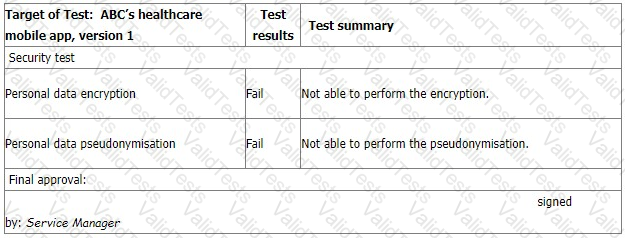
The IT Manager explains the test results should be approved by him according to the software security management procedure. The reason why the encryption and pseudonymisation functions failed is that these functions heavily slowed down the system and service performance. An extra 150% of resources are needed to cover this. The Service Manager agreed that access control is good enough and acceptable. That's why the Service Manager signed the approval.
You are preparing the audit findings. Select the correct option.
Which two of the following phrases would apply to "act" in relation to the Plan-Do-Check-Act cycle for a business process?
Question:
Which situation presented below represents a threat?

