You have been a successful program manager for many years in your State Department of Agriculture. During this time, you managed large programs, and some had major risks to mitigate especially in the information systems area as new software would be released that was commercially available, and you knew it would then enhance the benefits to your customers if you acquired it. You were the first in the Department to get your PfMP, and it led to a promotion to become the first portfolio manager. After a year in this position, you find managing risks and issues to be totally different because:
The Portfolio Management Office plays an integral role in Portfolio Management and offers support to the portfolio manager throughout the portfolio life cycle. What is the role of the PMO with respect to the portfolio performance metrics?
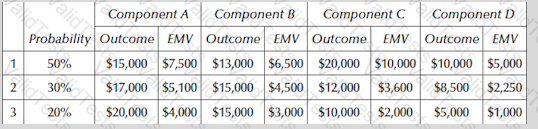
Assume you are putting together for the Portfolio Review Board several options for consideration of potential components and current components. You are using an approach with different probabilities to determine outcomes and EMV. Which of the following would you recommend realizing Components A and B are new, while C and D are in progress:
In a portfolio, data is an abundant asset, and managing the information aiming for a a better decision making is critical. For this you use a variety of Quantitative and Qualitative analysis methods. These methods are performed in 4 of the portfolio management processes and serve a slightly different purpose in each and every one of them. Considering that you are currently performing risk assessment and handling risk responses, how can you make use of the quantitative and qualitative analysis?
A portfolio manager needs to continuously balance the need and requirements with the available resources and needs to maintain a balanced portfolio and portfolio resources in order to optimize delivery. Capability and Capacity analysis is performed in 4 of the portfolio management processes and it serves a slightly different purpose in each and every one of them. When it relates to developing the performance management plan, what is the purpose of using this analysis?
Assume you are the portfolio manager for a telecommunications company. Your company was about to launch a new and easy to use smart phone with more features than any existing phones on the market at a lower price. However, although the phone was due to market in five days, the Federal Communications Commission issued today a regulation that would make your new phone not available for use in airplanes. Thus additional work must be done, and your executives are wondering whether a new phone should be developed for this new feature. You are ensuring that if a new phone is developed, or if the almost completed product is not to be marketed, there is still alignment to the organization's strategy. As you complete an analysis of alternatives, you also should ensure results of the analysis are reflected in the:
Efficiency is highly regarded when managing a portfolio and spans all activities i.e. risk management, communication management, etc. A portfolio is considered efficient if it
A recent development in the market gave your competitors a leading edge. Your company's CEO and executive members want to focus on new developments and gain the market leadership once again. You wanted to show the new structure to the Portfolio stakeholders and strategies have changed. As a portfolio manager, your best course of action is to perform a


