View all detail and faqs for the MuleSoft-Platform-Architect-I exam
A large organization with an experienced central IT department is getting started using MuleSoft. There is a project to connect a siloed back-end system to a new
Customer Relationship Management (CRM) system. The Center for Enablement is coaching them to use API-led connectivity.
What action would support the creation of an application network using API-led connectivity?
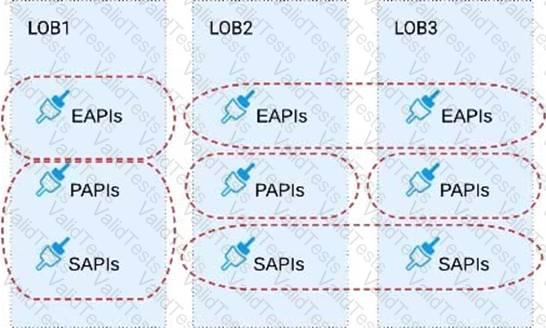
Refer to the exhibit.
Three business processes need to be implemented, and the implementations need to communicate with several different SaaS applications.
These processes are owned by separate (siloed) LOBs and are mainly independent of each other, but do share a few business entities. Each LOB has one development team and their own budget
In this organizational context, what is the most effective approach to choose the API data models for the APIs that will implement these business processes with minimal redundancy of the data models?
A) Build several Bounded Context Data Models that align with coherent parts of the business processes and the definitions of associated business entities
B) Build distinct data models for each API to follow established micro-services and Agile API-centric practices
C) Build all API data models using XML schema to drive consistency and reuse across the organization
D) Build one centralized Canonical Data Model (Enterprise Data Model) that unifies all the data types from all three business processes, ensuring the data model is consistent and non-redundant
Which of the following sequence is correct?
Due to a limitation in the backend system, a system API can only handle up to 500 requests per second. What is the best type of API policy to apply to the system API to avoid overloading the backend system?
What is true about API implementations when dealing with legal regulations that require all data processing to be performed within a certain jurisdiction (such as in the USA or the EU)?
A System API is designed to retrieve data from a backend system that has scalability challenges. What API policy can best safeguard the backend system?
Refer to the exhibit.
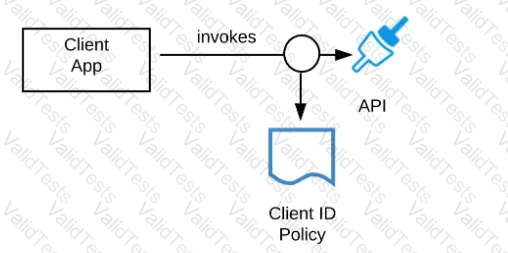
A developer is building a client application to invoke an API deployed to the STAGING environment that is governed by a client ID enforcement policy.
What is required to successfully invoke the API?
True or False. We should always make sure that the APIs being designed and developed are self-servable even if it needs more man-day effort and resources.
An eCommerce company is adding a new Product Details feature to their website, A customer will launch the product catalog page, a new Product Details link will
appear by product where they can click to retrieve the product detail description. Product detail data is updated with product update releases, once or twice a year, Presently
the database response time has been very slow due to high volume.
What action retrieves the product details with the lowest response time, fault tolerant, and consistent data?
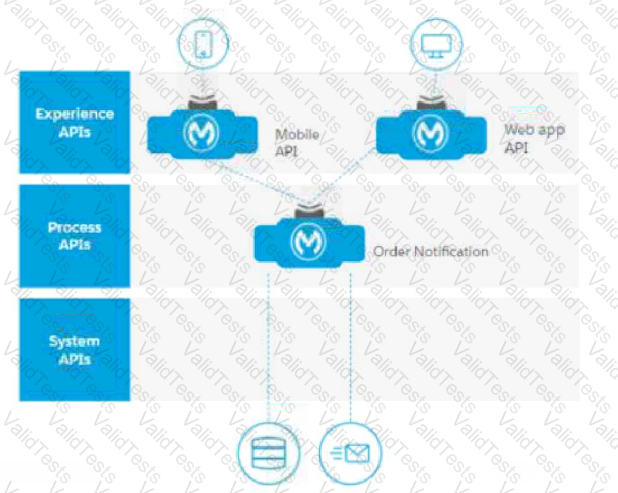
The Line of Business (LoB) of an eCommerce company is requesting a process that sends automated notifications via email every time a new order is processed through the
customer's mobile application or through the internal company's web application. In the future, multiple notification channels may be added: for example, text messages and
push notifications.
What is the most effective API-led connectivity approach for the scenario described above?
Create one Experience API for the web application and one for the mobile application.
Create a Process API to orchestrate and retrieve the email template from = database.
Create a System API that sends the email using the Anypoint Connector for Email.
Create one Experience API for the web application and one for the mobile application.
Create a Process API to orchestrate and retrieve the email template from
Create one Experience API for the web application and one for the mobile application,
Create a Process API to orchestrate, retrieve the email template from a database, and send the email using the Anypoint Connector for Email.
Create Experience APIs for both the web application and mobile application.
Create a Process API ta orchestrate, retrieve the email template from e database, and send the email using the Anypoint Connector for Email.
\
Create Experience APIs for both the web application and mobile application.
(Create 3 Process API to orchestrate and retrieve the email template from 2 databese.
Create a System API that sends the email using the Anypoint Connector for Email.