Pre-Summer Special Limited Time 70% Discount Offer - Ends in 0d 00h 00m 00s - Coupon code: validbest

Pass the Salesforce MuleSoft MuleSoft-Platform-Architect-I Questions and answers with ValidTests

Exam MuleSoft-Platform-Architect-I All Questions
Exam MuleSoft-Platform-Architect-I Premium Access

View all detail and faqs for the MuleSoft-Platform-Architect-I exam

Viewing page 3 out of 5 pages
Viewing questions 21-30 out of questions
Questions # 21:

Which two statements are true about the technology architecture of an Anypoint Virtual Private Cloud (VPC)?

Choose 2 answers

Options:

A.

Ports 8081 and 8082 are used

B.

CIDR blacks are used

C.

Anypoint VPC is responsible for load balancing the applications

D.

Round-robin load balancing is used to distribute client requests across different applications

E.

By default, HTTP requests can be made from the public internet to workers at port 6091

Expert Solution
Questions # 22:

An API implementation is being designed that must invoke an Order API, which is known to repeatedly experience downtime.

For this reason, a fallback API is to be called when the Order API is unavailable.

What approach to designing the invocation of the fallback API provides the best resilience?

Options:

A.

Search Anypoint Exchange for a suitable existing fallback API, and then implement invocations to this fallback API in addition to the Order API

B.

Create a separate entry for the Order API in API Manager, and then invoke this API as a fallback API if the primary Order API is unavailable

C.

Redirect client requests through an HTTP 307 Temporary Redirect status code to the fallback API whenever the Order API is unavailable

D.

Set an option in the HTTP Requester component that invokes the Order API to instead invoke a fallback API whenever an HTTP 4xx or 5xx response status code is returned from the Order API

Expert Solution
Questions # 23:

A company is using an on-prem cluster in the data center as a runtime plane and MuleSoft-hosted control plane.

How can the company monitor the detailed performance metrics on the Mule applications deployed to the cluster from the control plane?

Options:

A.

The settings of the Monitoring section in the control plane must be updated to enable detailed logging on the metrics to be captured

B.

Monitoring Agent must be installed on each node in the cluster

C.

Due to the potential performance impact on the runtime nodes, the Monitoring agent should be installed on a separate server

D.

There is no action needed as the on-prem runtime automatically sends the performance data to the control plane

Expert Solution
Questions # 24:

A company uses a hybrid Anypoint Platform deployment model that combines the EU control plane with customer-hosted Mule runtimes. After successfully testing a Mule API implementation in the Staging environment, the Mule API implementation is set with environment-specific properties and must be promoted to the Production environment. What is a way that MuleSoft recommends to configure the Mule API implementation and automate its promotion to the Production environment?

Options:

A.

Bundle properties files for each environment into the Mule API implementation's deployable archive, then promote the Mule API implementation to the Production environment using Anypoint CLI or the Anypoint Platform REST APIsB.

B.

Modify the Mule API implementation's properties in the API Manager Properties tab, then promote the Mule API implementation to the Production environment using API Manager

C.

Modify the Mule API implementation's properties in Anypoint Exchange, then promote the Mule API implementation to the Production environment using Runtime Manager

D.

Use an API policy to change properties in the Mule API implementation deployed to the Staging environment and another API policy to deploy the Mule API implementation to the Production environment

Expert Solution
Questions # 25:

Mule applications that implement a number of REST APIs are deployed to their own subnet that is inaccessible from outside the organization.

External business-partners need to access these APIs, which are only allowed to be invoked from a separate subnet dedicated to partners - called Partner-subnet. This subnet is accessible from the public internet, which allows these external partners to reach it.

Anypoint Platform and Mule runtimes are already deployed in Partner-subnet. These Mule runtimes can already access the APIs.

What is the most resource-efficient solution to comply with these requirements, while having the least impact on other applications that are currently using the APIs?

Options:

A.

Implement (or generate) an API proxy Mule application for each of the APIs, then deploy the API proxies to the Mule runtimes

B.

Redeploy the API implementations to the same servers running the Mule runtimes

C.

Add an additional endpoint to each API for partner-enablement consumption

D.

Duplicate the APIs as Mule applications, then deploy them to the Mule runtimes

Expert Solution
Questions # 26:

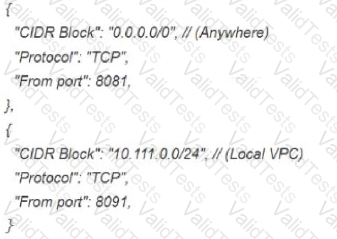
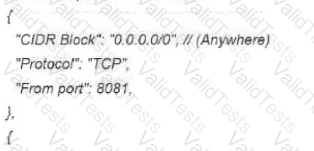
4 Production environment is running on a dedicated Virtual Private Cloud (VPC) on CloudHub 1,0, and the security team guidelines clearly state no traffic on HTTP.

Which two options support these security guidelines?

Choose 2 answers

Options:

A.

Configure the HTTPS protocol in HTTP listener in the Mule application

B.

Create a custom policy to apply to outgoing and incoming HTTP requests to control access to a configured API endpoint

C.

Remove the entry from the VPC firewall rule
D.

Configure the IP Blocklist policy to control access to a configured API endpoint from either a single IP address or a range of IP addresses.

E.

Add the entry in the VPC firewall rule.
Expert Solution
Questions # 27:

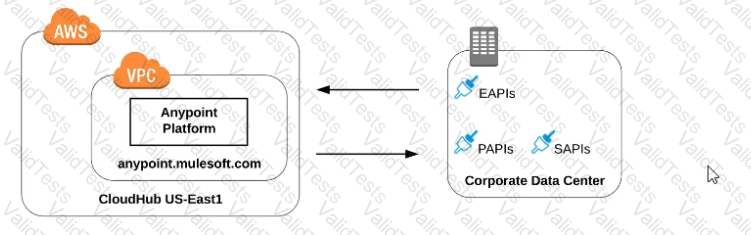
Refer to the exhibit.

Question # 27

what is true when using customer-hosted Mule runtimes with the MuleSoft-hosted Anypoint Platform control plane (hybrid deployment)?

Options:

A.

Anypoint Runtime Manager initiates a network connection to a Mule runtime in order to deploy Mule applications

B.

The MuleSoft-hosted Shared Load Balancer can be used to load balance API invocations to the Mule runtimes

C.

API implementations can run successfully in customer-hosted Mule runtimes, even when they are unable to communicate with the control plane

D.

Anypoint Runtime Manager automatically ensures HA in the control plane by creating a new Mule runtime instance in case of a node failure

Expert Solution
Questions # 28:

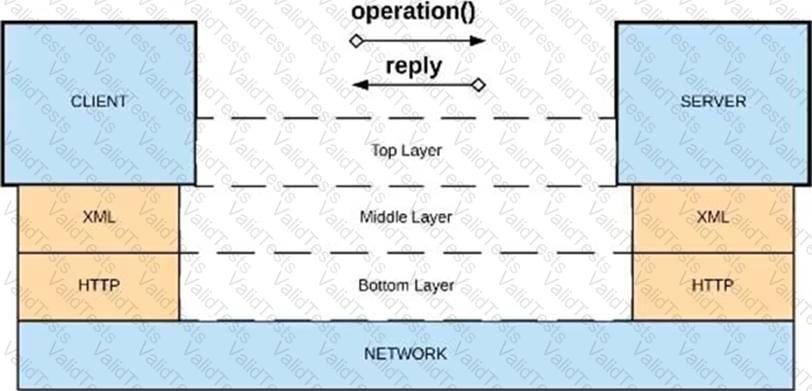
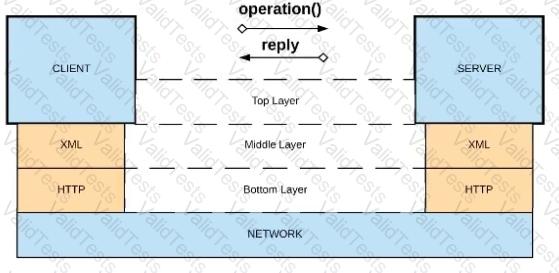
Refer to the exhibit.

What is a valid API in the sense of API-led connectivity and application networks?

A) Java RMI over TCP

B) Java RMI over TCP
Question # 28

C) CORBA over HOP

D) XML over UDP

Options:

A.

Option A

B.

Option B

C.

Option C

D.

Option D

Expert Solution
Questions # 29:

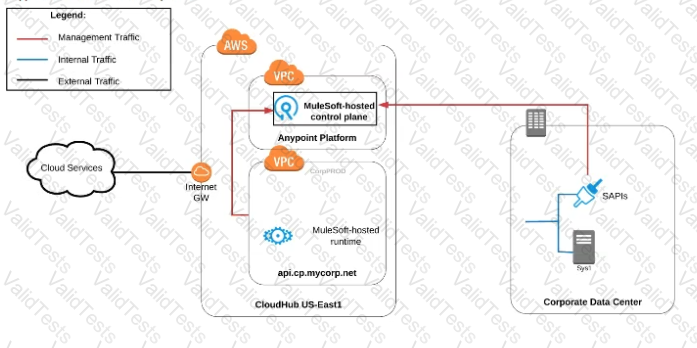
An organization uses various cloud-based SaaS systems and multiple on-premises systems. The on-premises systems are an important part of the organization's application network and can only be accessed from within the organization's intranet.

What is the best way to configure and use Anypoint Platform to support integrations with both the cloud-based SaaS systems and on-premises systems?

A) Use CloudHub-deployed Mule runtimes in an Anypoint VPC managed by Anypoint Platform Private Cloud Edition control plane

B) Use CloudHub-deployed Mule runtimes in the shared worker cloud managed by the MuleSoft-hosted Anypoint Platform control plane

C) Use an on-premises installation of Mule runtimes that are completely isolated with NO external network access, managed by the Anypoint Platform Private Cloud Edition control plane

D) Use a combination of Cloud Hub-deployed and manually provisioned on-premises Mule runtimes managed by the MuleSoft-hosted Anypoint Platform control plane
Question # 29

Options:

A.

Option A

B.

Option B

C.

Option C

D.

Option D

Expert Solution
Questions # 30:

What correctly characterizes unit tests of Mule applications?

Options:

A.

They test the validity of input and output of source and target systems

B.

They must be run in a unit testing environment with dedicated Mule runtimes for the environment

C.

They must be triggered by an external client tool or event source

D.

They are typically written using MUnit to run in an embedded Mule runtime that does not require external connectivity

Expert Solution
Viewing page 3 out of 5 pages
Viewing questions 21-30 out of questions