Pre-Summer Special Limited Time 70% Discount Offer - Ends in 0d 00h 00m 00s - Coupon code: validbest

Pass the Salesforce MuleSoft MuleSoft-Platform-Architect-I Questions and answers with ValidTests

Exam MuleSoft-Platform-Architect-I All Questions
Exam MuleSoft-Platform-Architect-I Premium Access

View all detail and faqs for the MuleSoft-Platform-Architect-I exam

Viewing page 4 out of 5 pages
Viewing questions 31-40 out of questions
Questions # 31:

4A developer for a transportation organization is implementing exactly one processing functionality in a Reservation Mule application to process and store passenger

records. This Reservation application will be deployed to multiple CloudHub workers/replicas. It is possible that several external systems could send duplicate passenger records

to the Reservation application.

An appropriate storage mechanism must be selected to help the Reservation application process each passenger record exactly once as much as possible. The selected storage

mechanism must be shared by all the CloudHub workers/replicas in order to synchronize the state information to assist attempting exactly once processing of each passenger

record by the deployed Reservation Mule application.

Which type of simple storage mechanism in Anypoint Platform allows the Reservation Mule application to update and share data between the CloudHub workers/replicas exactly

once, with minimal development effort?

Options:

A.

Persistent Object Store

B.

Runtime Fabric Object Store

C.

Non-persistent Object Store

D.

In-memory Mule Object Store

Expert Solution
Questions # 32:

An operations team is analyzing the effort needed to set up monitoring of their application network. They are looking at which API invocation metrics can be used to identify and predict trouble without having to write custom scripts or install additional analytics software or tools.

Which type of metrics can satisfy this goal of directly identifying and predicting failures?

Options:

A.

The number and types of API policy violations per day

B.

The effectiveness of the application network based on the level of reuse

C.

The number and types of past API invocations across the application network

D.

The ROI from each APT invocation

Expert Solution
Questions # 33:

When using CloudHub with the Shared Load Balancer, what is managed EXCLUSIVELY by the API implementation (the Mule application) and NOT by Anypoint Platform?

Options:

A.

The assignment of each HTTP request to a particular CloudHub worker

B.

The logging configuration that enables log entries to be visible in Runtime Manager

C.

The SSL certificates used by the API implementation to expose HTTPS endpoints

D.

The number of DNS entries allocated to the API implementation

Expert Solution
Questions # 34:

Which statement is true about Spike Control policy and Rate Limiting policy?

Options:

A.

All requests are rejected after the limit is reached in Rate Limiting policy, whereas the requests are queued in Spike Control policy after the limit is reached

B.

In a clustered environment, the Rate Limiting.and Spike Control policies are applied to each node in the cluster

C.

To protect Experience APIs by limiting resource consumption, Rate Limiting policy must be applied

D.

In order to apply Rate Limiting and Spike Control policies, a contract to bind client application and API is needed for both

Expert Solution
Questions # 35:

A set of tests must be performed prior to deploying API implementations to a staging environment. Due to data security and access restrictions, untested APIs cannot be granted access to the backend systems, so instead mocked data must be used for these tests. The amount of available mocked data and its contents is sufficient to entirely test the API implementations with no active connections to the backend systems. What type of tests should be used to incorporate this mocked data?

Options:

A.

Integration tests

B.

Performance tests

C.

Functional tests (Blackbox)

D.

Unit tests (Whitebox)

Expert Solution
Questions # 36:

In an organization, the InfoSec team is investigating Anypoint Platform related data traffic.

From where does most of the data available to Anypoint Platform for monitoring and alerting originate?

Options:

A.

From the Mule runtime or the API implementation, depending on the deployment model

B.

From various components of Anypoint Platform, such as the Shared Load Balancer, VPC, and Mule runtimes

C.

From the Mule runtime or the API Manager, depending on the type of data

D.

From the Mule runtime irrespective of the deployment model

Expert Solution
Questions # 37:

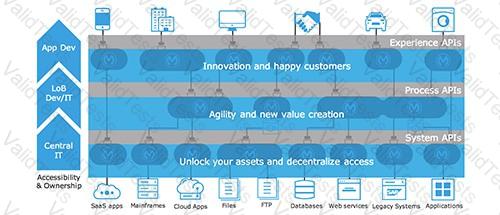
Select the correct Owner-Layer combinations from below options

Options:

A.

1. App Developers owns and focuses on Experience Layer APIs

2. Central IT owns and focuses on Process Layer APIs

3. LOB IT owns and focuses on System Layer APIs

B.

1. Central IT owns and focuses on Experience Layer APIs

2. LOB IT owns and focuses on Process Layer APIs

3. App Developers owns and focuses on System Layer APIs

C.

1. App Developers owns and focuses on Experience Layer APIs

2. LOB IT owns and focuses on Process Layer APIs

3. Central IT owns and focuses on System Layer APIs

Expert Solution
Questions # 38:

A company requires Mule applications deployed to CloudHub to be isolated between non-production and production environments. This is so Mule applications deployed to non-production environments can only access backend systems running in their customer-hosted non-production environment, and so Mule applications deployed to production environments can only access backend systems running in their customer-hosted production environment. How does MuleSoft recommend modifying Mule applications, configuring environments, or changing infrastructure to support this type of per-environment isolation between Mule applications and backend systems?

Options:

A.

Modify properties of Mule applications deployed to the production Anypoint Platform environments to prevent access from non-production Mule applications

B.

Configure firewall rules in the infrastructure inside each customer-hosted environment so that only IP addresses from the corresponding Anypoint Platform environments are allowed to communicate with corresponding backend systems

C.

Create non-production and production environments in different Anypoint Platform business groups

D.

Create separate Anypoint VPCs for non-production and production environments, then configure connections to the backend systems in the corresponding customer-hosted environments

Expert Solution
Questions # 39:

An API implementation is updated. When must the RAML definition of the API also be updated?

Options:

A.

When the API implementation changes the structure of the request or response messages

B.

When the API implementation changes from interacting with a legacy backend system deployed on-premises to a modern, cloud-based (SaaS) system

C.

When the API implementation is migrated from an older to a newer version of the Mule runtime

D.

When the API implementation is optimized to improve its average response time

Expert Solution
Questions # 40:

A system API has a guaranteed SLA of 100 ms per request. The system API is deployed to a primary environment as well as to a disaster recovery (DR) environment, with different DNS names in each environment. An upstream process API invokes the system API and the main goal of this process API is to respond to client requests in the least possible time. In what order should the system APIs be invoked, and what changes should be made in order to speed up the response time for requests from the process API?

Options:

A.

In parallel, invoke the system API deployed to the primary environment and the system API deployed to the DR environment, and ONLY use the first response

B.

In parallel, invoke the system API deployed to the primary environment and the system API deployed to the DR environment using a scatter-gather configured with a timeout, and then merge the responses

C.

Invoke the system API deployed to the primary environment, and if it fails, invoke the system API deployed to the DR environment

D.

Invoke ONLY the system API deployed to the primary environment, and add timeout and retry logic to avoid intermittent failures

Expert Solution
Viewing page 4 out of 5 pages
Viewing questions 31-40 out of questions