Pre-Summer Special Limited Time 70% Discount Offer - Ends in 0d 00h 00m 00s - Coupon code: validbest

Pass the Amazon Web Services AWS Certified Specialty SCS-C02 Questions and answers with ValidTests

Exam SCS-C02 All Questions
Exam SCS-C02 Premium Access

View all detail and faqs for the SCS-C02 exam

Viewing page 6 out of 15 pages
Viewing questions 51-60 out of questions
Questions # 51:

A company needs to follow security best practices to deploy resources from an AWS CloudFormation template. The CloudFormation template must be able to configure sensitive database credentials.

The company already uses AWS Key Management Service (AWS KMS) and AWS Secrets Manager.

Which solution will meet the requirements?

Options:

A.

Use a dynamic reference in the CloudFormation template to reference the database credentials in Secrets Manager.

B.

Use a parameter in the CloudFormation template to reference the database credentials. Encrypt the CloudFormation template by using AWS KMS.

C.

Use a SecureString parameter in the CloudFormation template to reference the database credentials in Secrets Manager.

D.

Use a SecureString parameter in the CloudFormation template to reference an encrypted value in AWS KMS

Expert Solution
Questions # 52:

A company uses AWS Organizations to manage several AWs accounts. The company processes a large volume of sensitive data. The company uses a serverless approach to microservices. The company stores all the data in either Amazon S3 or Amazon DynamoDB. The company reads the data by using either AWS lambda functions or container-based services that the company hosts on Amazon Elastic Kubernetes Service (Amazon EKS) on AWS Fargate.

The company must implement a solution to encrypt all the data at rest and enforce least privilege data access controls. The company creates an AWS Key Management Service (AWS KMS) customer managed key.

What should the company do next to meet these requirements?

Options:

A.

Create a key policy that allows the kms:Decrypt action only for Amazon S3 and DynamoDB. Create an SCP that denies the creation of S3 buckets and DynamoDB tables that are not encrypted with the key.

B.

Create an 1AM policy that denies the kms:Decrypt action for the key. Create a Lambda function than runs on a schedule to attach the policy to any new roles. Create an AWS Config rule to send alerts for resources that are not encrypted with the key.

C.

Create a key policy that allows the kms:Decrypt action only for Amazon S3, DynamoDB, Lambda, and Amazon EKS. Create an SCP that denies the creation of S3 buckets and DynamoDB tables that are not encrypted with the key.

D.

Create a key policy that allows the kms:Decrypt action only for Amazon S3, DynamoDB, Lambda, and Amazon EKS. Create an AWS Config rule to send alerts for resources that are not encrypted with the key.

Expert Solution
Questions # 53:

A company's policy requires that all API keys be encrypted and stored separately from source code in a centralized security account. This security account is managed by the company'ssecurity team However, an audit revealed that an API key is steed with the source code of an IAM Lambda function m an IAM CodeCommit repository in the DevOps account

How should the security learn securely store the API key?

Options:

A.

Create a CodeCommit repository in the security account using IAM Key Management Service (IAM KMS) tor encryption Require the development team to migrate the Lambda source code to this repository

B.

Store the API key in an Amazon S3 bucket in the security account using server-side encryption with Amazon S3 managed encryption keys (SSE-S3) to encrypt the key Create a resigned URL tor the S3 key. and specify the URL m a Lambda environmental variable in the IAM CloudFormation template Update the Lambda function code to retrieve the key using the URL and call the API

C.

Create a secret in IAM Secrets Manager in the security account to store the API key using IAM Key Management Service (IAM KMS) tor encryption Grant access to the IAM role used by the Lambda function so that the function can retrieve the key from Secrets Manager and call the API

D.

Create an encrypted environment variable for the Lambda function to store the API key using IAM Key Management Service (IAM KMS) tor encryption Grant access to the IAM role used by the Lambda function so that the function can decrypt the key at runtime

Expert Solution
Questions # 54:

A company wants to receive an email notification about critical findings in AWS Security Hub. The company does not have an existing architecture that supports this functionality.

Which solution will meet the requirement?

Options:

A.

Create an AWS Lambda function to identify critical Security Hub findings. Create an Amazon Simple Notification Service (Amazon SNS) topic as the target of the Lambda function. Subscribe an email endpoint to the SNS topic to receive published messages.

B.

Create an Amazon Kinesis Data Firehose delivery stream. Integrate the delivery stream with Amazon EventBridge. Create an EventBridge rule that has a filter to detect critical Security Hub findings. Configure the delivery stream to send the findings to an email address.

C.

Create an Amazon EventBridge rule to detect critical Security Hub findings. Create an Amazon Simple Notification Service (Amazon SNS) topic as the target of the EventBridge rule. Subscribe an email endpoint to the SNS topic to receive published messages.

D.

Create an Amazon EventBridge rule to detect critical Security Hub findings. Create an Amazon Simple Email Service (Amazon SES) topic as the target of the EventBridge rule. Use the Amazon SES API to format the message. Choose an email address to be the recipient of the message.

Expert Solution
Questions # 55:

A company is hosting a web application on Amazon EC2 instances behind an Application Load Balancer (ALB). The application has become the target of a DoS attack. Application logging shows that requests are coming from small number of client IP addresses, but the addresses change regularly.

The company needs to block the malicious traffic with a solution that requires the least amount of ongoing effort.

Which solution meets these requirements?

Options:

A.

Create an AWS WAF rate-based rule, and attach it to the ALB.

B.

Update the security group that is attached to the ALB to block the attacking IP addresses.

C.

Update the ALB subnet's network ACL to block the attacking client IP addresses.

D.

Create a AWS WAF rate-based rule, and attach it to the security group of the EC2 instances.

Expert Solution
Questions # 56:

A company that operates in a hybrid cloud environment must meet strict compliance requirements. The company wants to create a report that includes evidencefrom on-premises workloads alongside evidence from AWS resources. A security engineer must implement a solution to collect, review, and manage the evidence to demonstrate compliance with company policy.'

Which solution will meet these requirements?

Options:

A.

Create an assessment in AWS Audit Manager from a prebuilt framework or a custom framework. Upload manual evidence from the on-premises workloads. Add the evidence to the assessment. Generate an assessment report after Audit Manager collects the necessary evidence from the AWS resources.

B.

Install the Amazon CloudWatch agent on the on-premises workloads. Use AWS Config to deploy a conformance pack from a sample conformance pack template or a custom YAML template. Generate an assessment report after AWS Config identifies noncompliant workloads and resources.

C.

Set up the appropriate security standard in AWS Security Hub. Upload manual evidence from the on-premises workloads. Wait for Security Hub to collect the evidence from the AWS resources. Download the list of controls as a .csv file.

D.

Install the Amazon CloudWatch agent on the on-premises workloads. Create a CloudWatch dashboard to monitor the on-premises workloads and the AWS resources. Run a query on the workloads and resources. Download the results.

Expert Solution
Questions # 57:

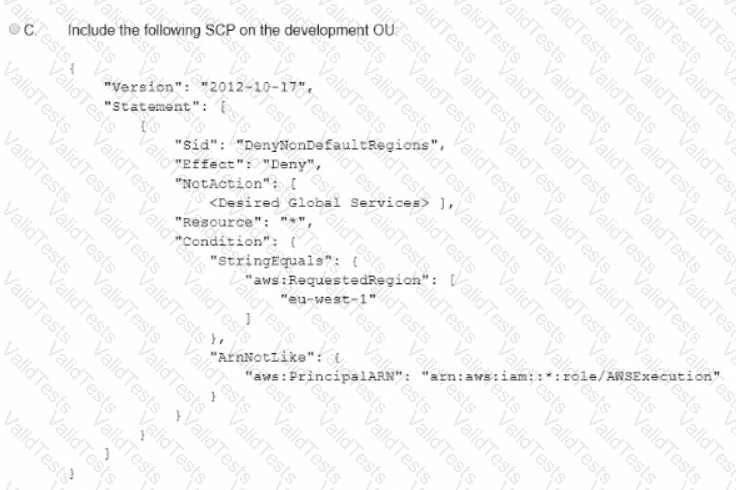
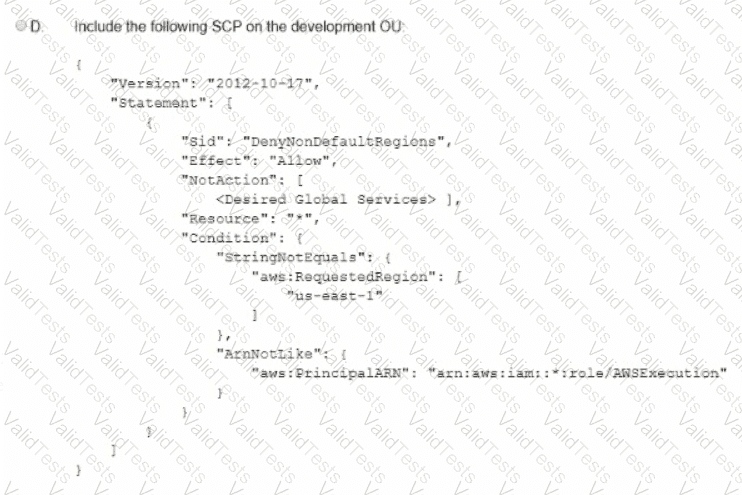
A company is using IAM Organizations. The company wants to restrict IAM usage to the eu-west-1 Region for all accounts under an OU that is named "development." The solution must persist restrictions to existing and new IAM accounts under the development OU.
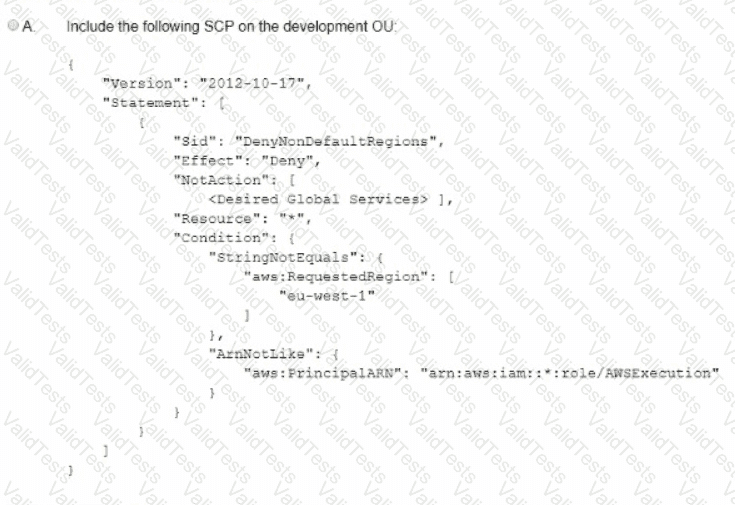
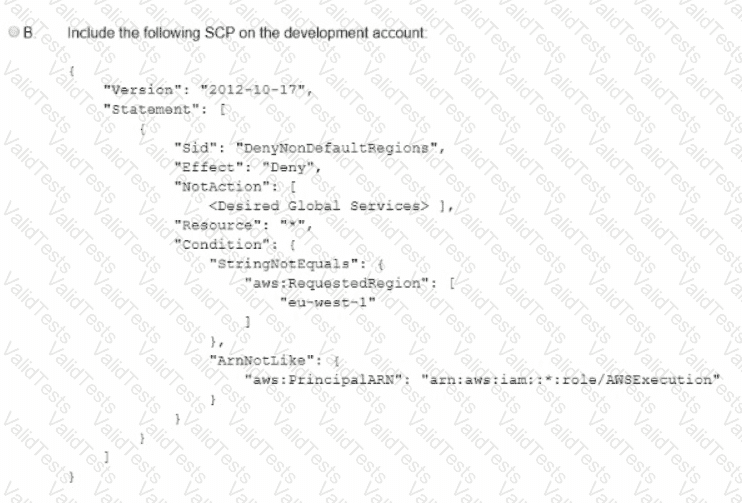
Question # 57

Question # 57

Question # 57

Question # 57

Options:

A.

Option A

B.

Option B

C.

Option C

D.

Option D

Expert Solution
Questions # 58:

A company uses Amazon Cognito for external user authentication for a web application. External users report that they can no longer log in to the application. What is the FIRST step that a security engineer should take to troubleshoot the problem?

Options:

A.

Review AWS CloudTrail togs to identify authentication errors that relate to Cognito users.

B.

Use AWS Identity and Access Management Access Analyzer to delete all unused 1AM roles and users

C.

Review any recent changes in Cognito configuration, 1AM policies, and role trust policies to identify issues.

D.

Write a script that uses CLI commands to reset all user passwords in the Cognito user pool.

Expert Solution
Questions # 59:

A company has a relational database workload that runs on Amazon Aurora MySQL. According to new compliance standards the company must rotate all database credentials every 30 days. The company needs a solution that maximizes security and minimizes development effort.

Which solution will meet these requirements?

Options:

A.

Store the database credentials in AWS Secrets Manager. Configure automatic credential rotation tor every 30 days.

B.

Store the database credentials in AWS Systems Manager Parameter Store. Create an AWS Lambda function to rotate the credentials every 30 days.

C.

Store the database credentials in an environment file or in a configuration file. Modify the credentials every 30 days.

D.

Store the database credentials in an environment file or in a configuration file. Create an AWS Lambda function to rotate the credentials every 30 days.

Expert Solution
Questions # 60:

A company has recently recovered from a security incident that required the restoration of Amazon EC2 instances from snapshots.

After performing a gap analysis of its disaster recovery procedures and backup strategies, the company is concerned that, next time, it will not be able to recover the EC2 instances if the AWS account was compromised and Amazon EBS snapshots were deleted.

All EBS snapshots are encrypted using an AWS KMS CMK.

Which solution would solve this problem?

Options:

A.

Create a new Amazon S3 bucket. Use EBS lifecycle policies to move EBS snapshots to the new S3 bucket. Move snapshots to Amazon S3 Glacier using lifecycle policies, and apply Glacier Vault Lock policies to prevent deletion.

B.

Use AWS Systems Manager to distribute a configuration that performs local backups of all attached disks to Amazon S3.

C.

Create a new AWS account with limited privileges. Allow the new account to access the AWS KMS key used to encrypt the EBS snapshots, and copy the encrypted snapshots to the new account on a recurring basis.

D.

Use AWS Backup to copy EBS snapshots to Amazon S3.

Expert Solution
Viewing page 6 out of 15 pages
Viewing questions 51-60 out of questions