Pre-Summer Special Limited Time 70% Discount Offer - Ends in 0d 00h 00m 00s - Coupon code: validbest

Pass the Amazon Web Services AWS Certified Specialty SCS-C02 Questions and answers with ValidTests

Exam SCS-C02 All Questions
Exam SCS-C02 Premium Access

View all detail and faqs for the SCS-C02 exam

Viewing page 9 out of 15 pages
Viewing questions 81-90 out of questions
Questions # 81:

A company hosts a web application on an Apache web server. The application runs on Amazon EC2 instances that are in an Auto Scaling group. The company configured the EC2 instances to send the Apache web server logs to an Amazon CloudWatch Logs group that the company has configured to expire after 1 year.

Recently, the company discovered in the Apache web server logs that a specific IP address is sending suspicious requests to the web application. A security engineer wants to analyze the past week of Apache web server logs to determine how many requests that the IP address sent and the corresponding URLs that the IP address requested.

What should the security engineer do to meet these requirements with the LEAST effort?

Options:

A.

Export the CloudWatch Logs group data to Amazon S3. Use Amazon Macie to query the logs for the specific IP address and the requested URLs.

B.

Configure a CloudWatch Logs subscription to stream the log group to an Am-azon OpenSearch Service cluster. Use OpenSearch Service to analyze the logs for the specific IP address and the requested URLs.

C.

Use CloudWatch Logs Insights and a custom query syntax to analyze the CloudWatch logs for the specific IP address and the requested URLs.

D.

Export the CloudWatch Logs group data to Amazon S3. Use AWS Glue to crawl the S3 bucket for only the log entries that contain the specific IP ad-dress. Use AWS Glue to view the results.

Expert Solution
Questions # 82:

A company is using AWS to run a long-running analysis process on data that is stored in Amazon S3 buckets. The process runs on a fleet of Amazon EC2 instances that are in an Auto Scaling group. The EC2 instances are deployed in a private subnet Of a VPC that does not have internet access. The EC2 instances and the S3 buckets are in the same AWS account

The EC2 instances access the S3 buckets through an S3 gateway endpoint that has the default access policy. Each EC2 instance is associated With an instance profile role that has a policy that explicitly allows the s3:GetObject action and the s3:PutObject action for only the required S3 buckets.

The company learns that one or more of the EC2 instances are compromised and are exfiltrating data to an S3 bucket that is outside the companys organization in AWS Organizations. A security engtneer must implement a solution to stop this exfiltration of data and to keep the EC2 processing job functional.

Which solution will meet these requirements?

Options:

A.

Update the policy on the S3 gateway endpoint to allow the S3 actions CY11y if the values of the aws:ResourceOrglD and aws:PrincipalOrglD condition keys match the companys values.

B.

Update the policy on the instance profile role to allow the S3 actions only if the value of the aws:ResourceOrglD condition key matches the company's value.

C.

Add a network ACL rule to the subnet of the EC2 instances to block outgoing connections on port 443.

D.

Apply an SCP on the AWS account to allow the $3 actions only if the values of the aws:ResourceOrglD and aws:PrincipalOrglD condition keys match the company's values.

Expert Solution
Questions # 83:

A company has an organization in AWS Organizations. The company wants to use AWS CloudFormation StackSets in the organization to deploy various AWS design patterns into environments. These patterns consist of Amazon EC2 instances, Elastic Load Balancing (ELB) load balancers, Amazon RDS databases, and Amazon Elastic Kubernetes Service (Amazon EKS) clusters or Amazon Elastic Container Service (Amazon ECS) clusters.

Currently, the company's developers can create their own CloudFormation stacks to increase the overall speed of delivery. A centralized CI/CD pipeline in a shared services AWS account deploys each CloudFormation stack.

The company's security team has already provided requirements for each service in accordance with internal standards. If there are any resources that do not comply with the internal standards, the security team must receive notification to take appropriate action. The security team must implement a notification solution that gives developers the ability to maintain the same overall delivery speed that they currently have.

Which solution will meet these requirements in the MOST operationally efficient way?

Options:

A.

Create an Amazon Simple Notification Service (Amazon SNS) topic. Subscribe the security team's email addresses to the SNS topic. Create a custom AWS Lambda function that will run the aws cloudformation validate-template AWS CLI command on all CloudFormation templates before the build stage in the CI/CD pipeline. Configure the CI/CD pipeline to publish a notification to the SNS topic if any issues are found.

B.

Create an Amazon Simple Notification Service (Amazon SNS) topic. Subscribe the security team's email addresses to the SNS topic. Create custom rules in CloudFormation Guard for each resource configuration. In the CllCD pipeline, before the build stage, configure a Docker image to run the cfn-guard command on the CloudFormation template. Configure the CI/CD pipeline to publish a notification to the SNS topic if any issues are found.

C.

Create an Amazon Simple Notification Service (Amazon SNS) topic and an Am-azon Simple Queue Service (Amazon SQS) queue. Subscribe the security team's email addresses to the SNS topic. Create an Amazon S3 bucket in the shared services AWS account. Include an event notification to publish to the SQS queue when new objects are added to the S3 bucket. Require the de-velopers to put their CloudFormation templates in the S3 bucket. Launch EC2 ins

D.

Create a centralized CloudFormation stack set that includes a standard set of resources that the developers can deploy in each AWS account. Configure each CloudFormation template to meet the security requirements. For any new resources or configurations, update the CloudFormation template and send the template to the security team for review. When the review is com-pleted, add the new CloudFormation stack to the repository for the devel-ope

Expert Solution
Questions # 84:

A company is using AWS Organizations to implement a multi-account strategy. The company does not have on-premises infrastructure. All workloads run on AWS. The company currently has eight member accounts. The company anticipates that it will have no more than 20 AWS accounts total at any time.

The company issues a new security policy that contains the following requirements:

• No AWS account should use a VPC within the AWS account for workloads.

• The company should use a centrally managed VPC that all AWS accounts can access to launch workloads in subnets.

• No AWS account should be able to modify another AWS account's application resources within the centrally managed VPC.

• The centrally managed VPC should reside in an existing AWS account that is named Account-A within an organization.

The company uses an AWS CloudFormation template to create a VPC that contains multiple subnets in Account-A. This template exports the subnet IDs through the CloudFormation Outputs section.

Which solution will complete the security setup to meet these requirements?

Options:

A.

Use a CloudFormation template in the member accounts to launch workloads. Configure the template to use the Fn::lmportValue function to obtain the subnet ID values.

B.

Use a transit gateway in the VPC within Account-A. Configure the member accounts to use the transit gateway to access the subnets in Account-A to launch workloads.

C.

Use AWS Resource Access Manager (AWS RAM) to share Account-A's VPC subnets with the remaining member accounts. Configure the member accounts to use the shared subnets to launch workloads.

D.

Create a peering connection between Account-A and the remaining member accounts. Configure the member accounts to use the subnets in Account-A through the VPC peering connection to launch workloads.

Expert Solution
Questions # 85:

A company is implementing a customized notification solution to detect repeated unauthorized authentication attempts to bastion hosts. The company's security engineer needs to implement a solution that will provide notification when 5 failed attempts occur within a 5-minute period. The solution must use native AWS services and must notify only the designated system administrator who is assigned to the specific bastion host.

Which solution will meet these requirements?

Options:

A.

Use the Amazon CloudWatch agent to collect operating system logs. Use Amazon EventBridge to configure an alarm based on a metric filter for failed login attempts. Send an alert to Amazon Simple Notification Service (Amazon SNS) when the defined threshold for the alarm is exceeded. Use Amazon EC2 instance tags to determine which SNS topics receive notifications.

B.

Use AWS Systems Manager Agent to collect operating system logs. Use the Systems Manager Run Command AWS-ConfigureCloudWatch document to configure an Amazon EventBridge event based on a metric filter for failed login attempts. Send an alert to Amazon Simple Notification Service (Amazon SNS) when the defined threshold for the alarm is exceeded. Use SNS messaging filters to control who receives notifications.

C.

Use the Amazon CloudWatch agent to collect operating system logs Create a CloudWatch alarm based on a metric filter for failed login attempts. Send an alert to Amazon Simple Notification Service (Amazon SNS) when the defined threshold for the alarm is exceeded. Use SNS messaging filters to control who receives notifications.

D.

Use AWS Systems Manager Agent to collect operating system logs. Use the Systems Manager Run Command AWS-ConfigureCloudWatch document to configure an Amazon CloudWatch alarm based on a metric filter for failed login attempts. Send an alert to Amazon Simple Notification Service (Amazon SNS) when the defined threshold for the alarm is exceeded. Use EC2 instance tags to determine which SNS topics receive notifications.

Expert Solution
Questions # 86:

A security engineer must use AWS Key Management Service (AWS KMS) to design a key management solution for a set of Amazon Elastic Block Store (Amazon

EBS) volumes that contain sensitive data. The solution needs to ensure that the key material automatically expires in 90 days.

Which solution meets these criteria?

Options:

A.

A customer managed CMK that uses customer provided key material

B.

A customer managed CMK that uses AWS provided key material

C.

An AWS managed CMK

D.

Operation system-native encryption that uses GnuPG

Expert Solution
Questions # 87:

A company's Security Team received an email notification from the Amazon EC2 Abuse team that one or more of the company's Amazon EC2 instances may have been compromised

Which combination of actions should the Security team take to respond to (be current modem? (Select TWO.)

Options:

A.

Open a support case with the IAM Security team and ask them to remove the malicious code from the affected instance

B.

Respond to the notification and list the actions that have been taken to address the incident

C.

Delete all IAM users and resources in the account

D.

Detach the internet gateway from the VPC remove aft rules that contain 0.0.0.0V0 from the security groups, and create a NACL rule to deny all traffic Inbound from the internet

E.

Delete the identified compromised instances and delete any associated resources that the Security team did not create.

Expert Solution
Questions # 88:

A Security Engineer has been tasked with enabling IAM Security Hub to monitor Amazon EC2 instances fix CVE in a single IAM account The Engineer has already enabled IAM Security Hub and Amazon Inspector m the IAM Management Console and has installed me Amazon Inspector agent on an EC2 instances that need to be monitored.

Which additional steps should the Security Engineer lake 10 meet this requirement?

Options:

A.

Configure the Amazon inspector agent to use the CVE rule package

B.

Configure the Amazon Inspector agent to use the CVE rule package Configure Security Hub to ingest from IAM inspector by writing a custom resource policy

C.

Configure the Security Hub agent to use the CVE rule package Configure IAM Inspector lo ingest from Security Hub by writing a custom resource policy

D.

Configure the Amazon Inspector agent to use the CVE rule package Install an additional Integration library Allow the Amazon Inspector agent to communicate with Security Hub

Expert Solution
Questions # 89:

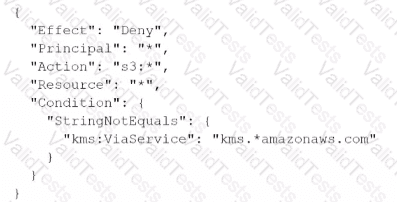
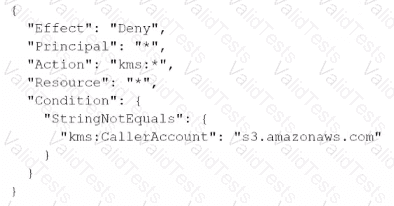
A company stores sensitive documents in Amazon S3 by using server-side encryption with an IAM Key Management Service (IAM KMS) CMK. A new requirement mandates that the CMK that is used for these documents can be used only for S3 actions.

Which statement should the company add to the key policy to meet this requirement?

A)
Question # 89

B)

Question # 89

Options:

A.

Option A

B.

Option B

Expert Solution
Questions # 90:

A security engineer for a large company is managing a data processing application used by 1.500 subsidiary companies. The parent and subsidiary companies all use AWS. The application uses TCP port 443 and runs on Amazon EC2 behind a Network Load Balancer (NLB). For compliance reasons, the application should only be accessible to the subsidianes and should not be available on the public internet. To meet the compliance requirements for restricted access, the engineer has received the public and private CIDR block ranges for each subsidiary.

What solution should the engineer use to implement the appropriate access restrictions for the application?

Options:

A.

Create a NACL to allow access on TCP port 443 (rom the 1.500 subsidiary CIDR block ranges Associate the NACL to both the NLB and EC2 instances.

B.

Create an AWS security group to allow access on TCP port 443 from the 1,500 subsidiary CIDR block ranges Associate the security group to the NLB Create a second security group (or EC2 instances with access on TCP port 443 from the NLB security group.

C.

Create an AWS PrivateLink endpoint service in the parent company account attached to the NLB. Create an AWS security group for the instances to allow access on TCP port 443 from the AWS PrivateLink endpoint Use AWS PrivateLink interface endpoints in the 1.500 subsidiary AWS accounts to connect to the data processing application.

D.

Create an AWS security group to allow access on TCP port 443 from the 1.500 subsidiary CIDR block ranges. Associate the security group with EC2 instances.

Expert Solution
Viewing page 9 out of 15 pages
Viewing questions 81-90 out of questions