BBA is a wholly owned subsidiary of AAB BBA operates in country B where the currency is the B$.
The following is an extract from BBA's financial statements at 31 December 20X1:

The following Information is relevant:
" The bonds were trading at $110 per $100 on 31 December 20X1. "Operating profit of BBA for the year ended 31 December 20X1 was S15 million
• The P/E ratio is 8
* Corporate income tax rate is 20%.
The tax authorities m country B Implemented thin capitalisation rules based on the level of gearing of the subsidiary, calculated as book value o( debt lo book value of equity The cut-off point for gearing used by the tax authorities for a company to be thinly capitalised is 75%.
Which of the following statements is correct as at 31 December 20X1?
A company has:
• 10 million $1 ordinary shares in issue
• A current share price of $5.00 a share
• A WACC of 15%
The company holds $10 million in cash. No interest is earned on this cash.
It will invest this in a project with an expected NPV of $4 million.
In a semi-strong efficient stock market, which of the following is the most likely share price immediately after the announcement of the new investment?
Company T is a listed company in the retail sector.
Its current profit before interest and taxation is $5 million.
This level of profit is forecast to be maintainable in future.
Company T has a 10% corporate bond in issue with a nominal value of $10 million.
This currently trades at 90% of its nominal value.
Corporate tax is paid at 20%.
The following information is available:
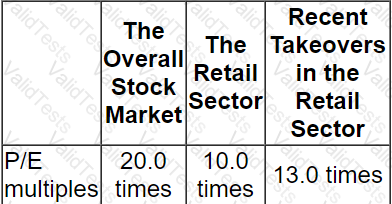
Which of the following is a reasonable expectation of the equity value in the event of an attempted takeover?
Company A plans to acquire Company B.
Both firms operate as wholesalers in the fashion industry, supplying a wide range of ladies' clothing shops.
Company A sources mainly from the UK, Company B imports most of its supplies from low-income overseas countries.
Significant synergies are expected in management costs and warehousing, and in economies of bulk purchasing.
Which of the following is likely to be the single most important issue facing Company A in post-merger integration?
The primary objective of a public sector entity is to ensure value for money is generated.
Value for money is defined as performing an activity so as to simultaneously achieve economy, efficiency and effectiveness
Efficiency is defined as:
A company is considering the issue of a convertible bond compared to a straight bond issue (non-convertible bond).
Director A is concerned that issuing a convertible bond will upset the shareholders for the following reasons:
• it will dilute their control
• the interest payments will be higher therefore reducing liquidity
• it will increase the gearing ratio therefore increasing financial risk
Director B disagrees, and is preparing a board paper to promote the issue of the convertible bond rather than a non-convertible.
Advise the Director B which THREE of the following statements should be included in his board paper to promote the issue of the convertible bond?
An unlisted company wishes to obtain an estimated value for its shares in anticipation of a private sale of a large parcel of shares.
Relevant data for the unlisted company:
• It has a residual dividend policy.
• It has earnings that are highly sensitive to underlying economic conditions.
• It is a small business in a large industry where there are listed companies but there are none with a similar capital structure.
The company intends to base valuations on the cost of equity of a proxy company after adjusting for any differences in capital structure where appropriate.
Which of the following methods is likely to give the most accurate equity value for this unlisted company?
Which THREE of the following non-financial objectives would be most appropriate for a listed company in the food retailing industry?
Company ABC is planning to bid for company DDD, an unlisted company in an unrelated industry sector to ABC.
The directors of ABC are considering a number of different valuation methods for DDD before making a bid.
Which of the following is the MOST appropriate method for ABC to use to value DDD?
Companies A, B, C and D:
• are based in a country that uses the K$ as its currency.
• have an objective to grow operating profit year on year.
• have the same total levels of revenue and cost.
• trade with companies or individuals in the eurozone. All import and export trade with companies or individuals in the eurozone is priced in EUR.
Typical import/export trade for each company in a year are as follows:
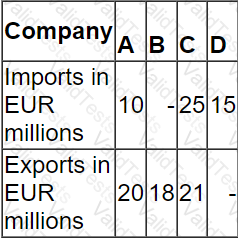
Which company's growth objective is most sensitive to a movement in the EUR/K$ exchange rate?


