A company has:
• A price/earnings (P/E) ratio of 10.
• Earnings of $10 million.
• A market equity value of $100 million.
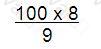
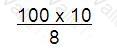
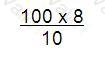
The directors forecast that the company's P/E ratio will fall to 8 and earnings fall to $9 million.
Which of the following calculations gives the best estimate of new company equity value in $ million following such a change?
A)

B)
C)
D)
A project requires an initial outlay of $2 million which can be financed with either a bank loan or finance lease.
The company will be responsible for annual maintenance under either option.
The tax regime is:
• Tax depreciation allowances can be claimed on purchased assets.
• If leased using a finance lease, tax relief can be claimed on the interest element of the lease payments and also on the accounting depreciation charge.
The trainee management accountant has begun evaluating the lease versus buy decision and has produced the following data. He is not confident that all this information is relevant to this decision.
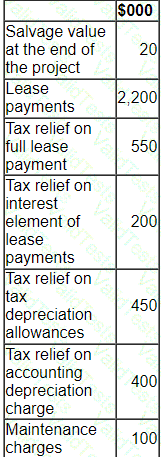
Using only the relevant data, which of the following is correct?
A manufacturing company is based in Country L whose currency is the L$.
One of the company's products is exported to Country M, a rapidly growing economy, whose currency is the M$.
In the most recent financial year:
• 100,000 units of the product were sold to customers in country M
• The unit selling price was M$12
The spot rate today is L$1 = M$5
The company has an objective of growth in total sales value in L$ of 10% a year.
If the L$ strengthens by 5% next year against the M$, what volume of sales of this product is needed next year to achieve the objective?
A company needs to raise $20 million to finance a project.
It has decided on a rights issue at a discount of 20% to its current market share price.
There are currently 20 million shares in issue with a nominal value of $1 and a market price of $5 per share.
Calculate the terms of the rights issue.
Extracts from a company's profit forecast for the next financial year as follows:
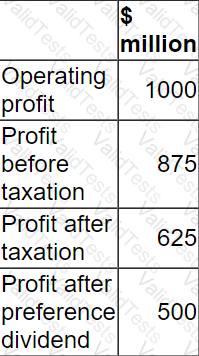
Since preparing the forecast, the company has decided to return surplus cash to shareholders by a share repurchase arrangement.
The share repurchase would result in the company purchasing 20% of the 1,250 million ordinary shares currently in issue and canceling them.
Assuming the share repurchase went ahead, the impact on the company's forecast earnings per share will be an increase of:
Company A has made an offer to take over all the shares in Company B on the following terms:
• For every 20 shares currently held, Company B's shareholders will receive $100 bond with a coupon rate of 3%
• The bond will be repaid in 10 years' time at its par value of $100.
• The current yield on 10 year bonds of similar risk is 6%.
What is the effective offer price per share being made to Company B's shareholders?
A listed company in a high growth industry, where innovation is a key driver of success has always operated a residual dividend policy, resulting in volatility in dividends due to periodic significant investments in research and development.
The company has recently come under pressure from some investors to change its dividend policy so that shareholders receive a consistent growing dividend. In addition, they suggested that the company should use more debt finance.
If the suggested change is made to the financial policies, which THREE of the following statements are true?
Company AB was established 6 years ago by two individuals who each own 50% of the shares.
Each individual heads a separate division within the company, which now has annual turnover of GBP10 million and employs 40 people.
Some of the employees are very highly paid as they are important contributors to the company's profitability.
The owners of the company wish to realise the full value of their investment within the next 12 months.
Which TWO of the following options are most likely to be acceptable exit strategies to the two owners of the company?
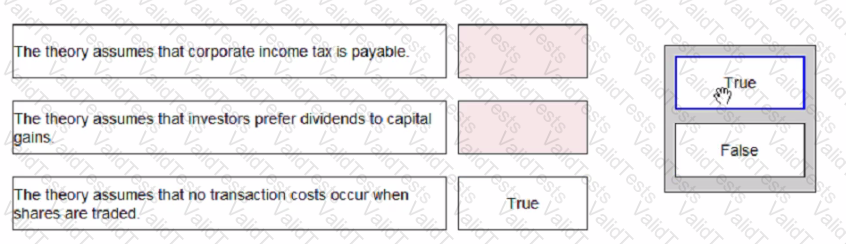
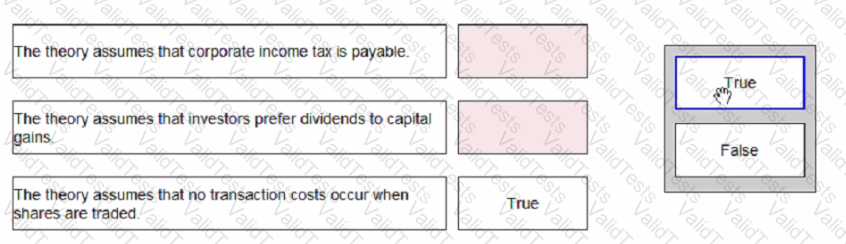
Select whether the following statements are true or false with regard to Modigliani and Miller's dividend policy theory.
The following information relates to Company ZZA's current capital structure:

Company ZZA is considering a change in the capital structure that will increase gearing to 35:65 (Debt Equity).
The risk-free rate is 4% and the return on the market portfolio is expected to be 12%.
The rate of corporate tax is 25%
Using the Capital Asset Pricing Model, calculate the cost of equity resulting from the proposed change to the capital structure.