On 1 January:
• Company X has a value of $50 million
• Company Y has a value of $20 million
• Both companies are wholly equity financed
Company X plans to take over Company Y by means of a share exchange. Following the acquisition the post-tax cashflow of Company X for the foreseeable future is estimated to be $8 million each year. The post-acquisition cost of equity is expected to be 10%.
What is the best estimate of the value of the synergy that would arise from the acquisition?
An unlisted company which is owned and managed by its original founders has accumulated excess cash following many years of profitable trading.
The Board of Directors is comprised of the four original founders who each hold 25% of the equity share capital.
Which THREE of the following will be significant considerations when deciding on the company's dividend policy?
Company A is based in Country A where the functional currency is the A$. Currently all sales are to domestic customers in Country A. However, the company is planning to expand internationally by acquiring Company B, a distribution company in Country B, to enable it to sell goods worldwide The functional currency of Country B is the BS
Company A will invoice its international customers in their local currency.
Wage increases in Country B are forecast to be modest, due to high unemployment levels, but overall inflation in Country B is forecast to be significantly higher than in Country A
Which TWO of the following statements about the economic risk of the acquisition of Company B are true?
A company's Board of Directors is assessing the likely impact of financing future new projects using either equity or debt.
The directors are uncertain of the effects on key variables.
Which THREE of the following statements are true?
A company is owned by its five directors who want to sell the business.
Current profit after tax is $750,000.
The directors are currently paid minimal salaries, taking most of their incomes as dividends.
After the company is sold, directors' salaries will need to be increased by $50,000 each year in total.
A suitable Price/Earnings (P/E) ratio is 7, and the rate of corporate tax is 20%.
What is the value of the company using a P/E valuation?
An unlisted company:
Is owned by the original founder and member of their families.
Is growing more rapidly than other companies in the same industry.
Pays a fixed annual divided
Which of the following methods would be the most appropriate to value this company’s equity?
A UK based company is considering investing GBP1 ,000,000 in a project it the USA. It is anticipated that the project will yield net cash inflows of USD580.000 each year for the next three years. These surplus cash flows will be remitted to the UK at the end of each year.
Currently GBP1.00 is worth USD1.30.
The expected inflation rates in the two countries over the next four years are 2% in the UK and 4% in the USA.
Applying the purchasing power parity theory, which of the following represents the expected remittance at the end of year three, in GBP whole the nearest whole GBP)?
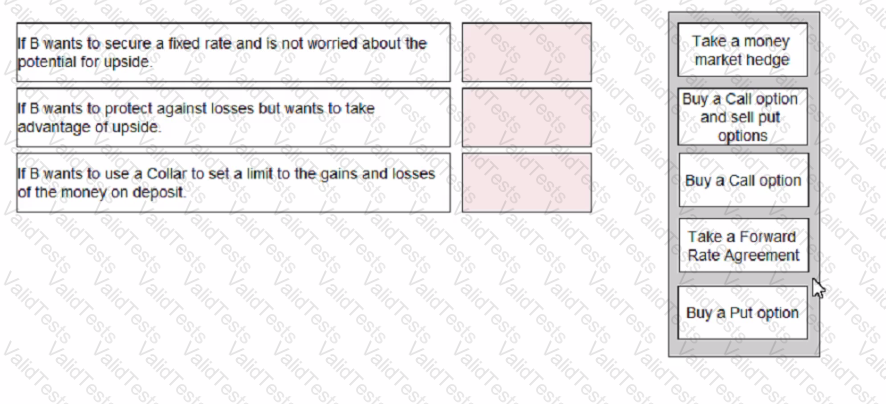
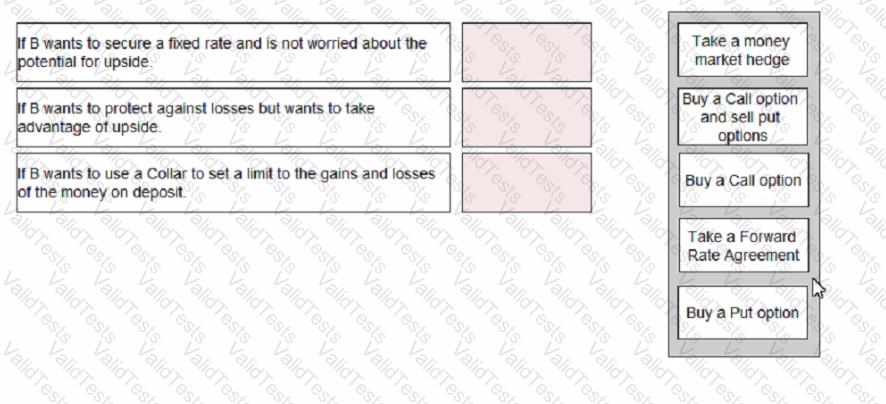
B, a European based modern art dealer, frequently imports and sells single high value items created in the United States. The price is fixed at the date of sale but the items are commissioned and made to order with a lead time of three to nine months depending on the individual specification
B holds payment for his customers from the point of purchase and passes funds when the items are shipped However, despite putting the money on short term deposit, there have been times when B's profits have been almost entirely eroded by adverse movements m interest rates Advise B by matching the appropriate instrument to B's requirements.
A geared and profitable company is evaluating the best method of financing the purchase of new machinery. It is considering either buying the machinery outright, financed by a secured bank borrowingand selling the machinery at the end of a fixed period of time or obtain the machinery under a lease for the same period of time.
Which is the correct discount rate to use when discounting the incremental cash flows of the lease against those of the buy and borrow alternative?
A company has a covenant on its 5% long-term bond, stipulating that its retained earnings must not fall below $2 million.
The company has 100 million shares in issue.
Its most recent dividend was $0.045 per share. It has committed to grow the dividend per share by 4% each year.
The nominal value of the bond is $60 million. It is currently trading at 80% of its nominal value.
Next year's earnings before interest and taxation are projected to be $11.25 million.
The rate of corporate tax is 20%.
If the company increases the dividend by 4%, advise the Board of Directors if the level of retained earnings will comply with the covenant?