Pre-Summer Special Limited Time 70% Discount Offer - Ends in 0d 00h 00m 00s - Coupon code: validbest

Pass the Cisco CCNP Data Center 300-620 Questions and answers with ValidTests

Exam 300-620 All Questions
Exam 300-620 Premium Access

View all detail and faqs for the 300-620 exam

Viewing page 2 out of 8 pages
Viewing questions 11-20 out of questions
Questions # 11:

What is the result of selecting the On Demand attribute in the Deploy Immediacy feature during VMM domain association to an EPG?

Options:

A.

The EPG policy is downloaded to the leaf when a hypervisor is connected, and a VM is placed in a port group.

B.

The EPG policy is programmed in the hardware policy CAM only when the first packet is received through the data path.

C.

The EPG policy is programmed in the hardware policy CAM as soon as the policy is downloaded in the leaf software.

D.

The EPG policy is downloaded to the leaf when a hypervisor is attached to a DVS. and CDP or LLDP adjacency is formed.

Expert Solution
Questions # 12:

A customer must deploy three Cisco ACI based data centers. Each site must be separated from the others. Which characteristic of Cisco ACI Multi-Pod makes it unsuitable for this deployment?

Options:

A.

creates a virtual pod in the remote location

B.

requires all pods to share the same Cisco APIC cluster

C.

has distance and scale limitations

D.

places leaf switches in the remote site that belong to the same fabric as at the headquarters site

Expert Solution
Questions # 13:

A network administrator configures AAA inside the Cisco ACI fabric. The authentication goes through the local users if the TACACS+ server is not reachable. If the Cisco APIC is out of the cluster, the access must be granted through the fallback domain. Which configuration set meets these requirements?
Options:

A.

Ping Check: True

Default Authentication Realm: Local

Fallback Check: True

B.

Ping Check: True

Default Authentication Realm: TACACS+

Fallback Check: False

C.

Ping Check: False

Default Authentication Realm: Local

Fallback Check: False

D.

Ping Check: False

Default Authentication Realm: TACACS+

Fallback Check: True

Expert Solution
Questions # 14:

Question # 14

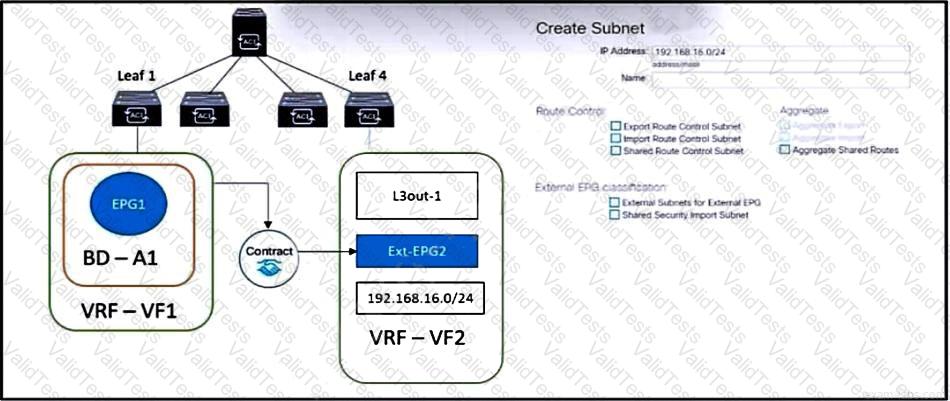
Refer to the exhibit. The external subnet and internal EPG1 must communicate with each other, and the L3Out traffic must leak into the VRF named "VF1". Which configuration set accomplishes these goals?

Options:

A.

Export Route Control Subnet

Import Route Control Subnet

Aggregate Shared Routes

B.

External Subnets for External EPG

Shared Route Control Subnet

Shared Security Import Subnet

C.

External Subnets for External EPG

Import Route Control Subnet

Shared Route Control Subnet

D.

Export Route Control Subnet

Shared Security Import Subnet

Aggregate Shared Routes

Expert Solution
Questions # 15:

Refer to the exhibit.

Question # 15

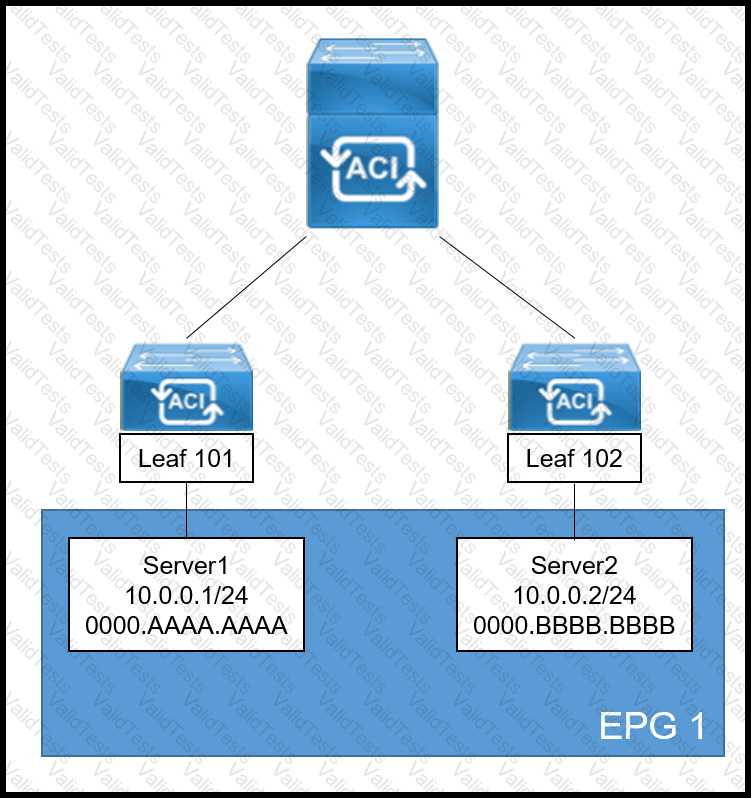
A systems engineer is implementing the Cisco ACI fabric. However, the Server2 information is missing from the Leaf 101 endpoint table and the COOP database of the spine. The requirement is for the bridge domain configuration to enforce the ACI fabric to forward the unicast packets generated by Server1 destined to Server2. Which action must be taken to meet these requirements?

Options:

A.

Enable ARP Flooding

B.

Set L2 Unknown Unicast to Flood

C.

Set IP Data-Plane Learning to No

D.

Enable Unicast Routing

Expert Solution
Questions # 16:

An engineer configured a bridge domain with the hardware-proxy option for Layer 2 unknown unicast traffic. Which statement is true about this configuration?

Options:

A.

The leaf switch drops the Layer 2 unknown unicast packet if it is unable to find the MAC address in the local forwarding tables.

B.

The Layer 2 unknown hardware proxy lacks support of the topology change notification.

C.

The leaf switch forwards the Layers 2 unknown unicast packets to all other leaf switches if it is unable to find the MAC address in its local forwarding tables.

D.

The spine switch drops the Layer 2 unknown unicast packet if it is unable to find the MAC address in the proxy database.

Expert Solution
Questions # 17:

Which routing protocol is supported between Cisco ACI spines and IPNs in a Cisco ACI Multi-Pod environment?

Options:

A.

OSPF

B.

ISIS

C.

BGP

D.

EIGRP

Expert Solution
Questions # 18:

An engineer configures SNMP for an ACI fabric and created an SNMP Monitoring Destination Group called snmp_dgroup1. Snmp_dgroup1 is configured with the server hostname and Community password. An SNMP policy called snmp_podpolicy1 is configured to enable SNMP and add an SNMP Client Group Profile called snmp_clgroup1. Snmp_podpolicy1 is associated default pod profile via a pod policy group named podl. Which configuration set must the engineer enable to complete the SNMP configuration?

Options:

A.

Configure an SNMP management contract to permit all traffic. Associate snmp_podpolicy1 with an SNMP pod profile.

B.

Configure the OOB management contract to permit all traffic. Associate snmp_clgroup1 with the SNMP management EPG.

C.

Configure the OOB management contract to permit UDP 162. Associate snmp_dgroupl with the OOB management EPG.

D.

Configure an SNMP management contract to permit UDP 162. Associate the SNMP Source to snmp_clgroup1.

Expert Solution
Questions # 19:

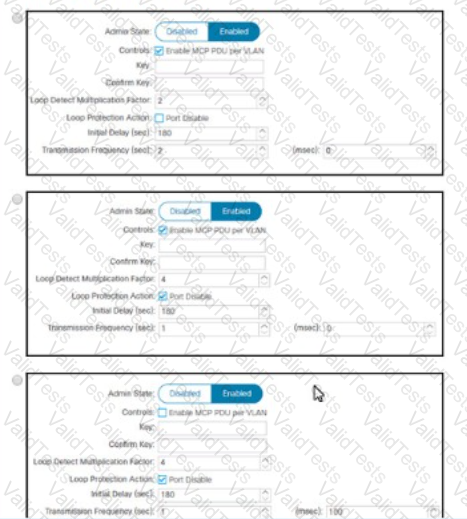
A network engineer must configure a Cisco ACI system to detect network loops for untagged and tagged traffic The loop must be detected and slopped by disabling an interface within 4 seconds Which configuration must be used?
Question # 19

Options:

A.

Option A

B.

Option B

C.

Option C

Expert Solution
Questions # 20:

Question # 20

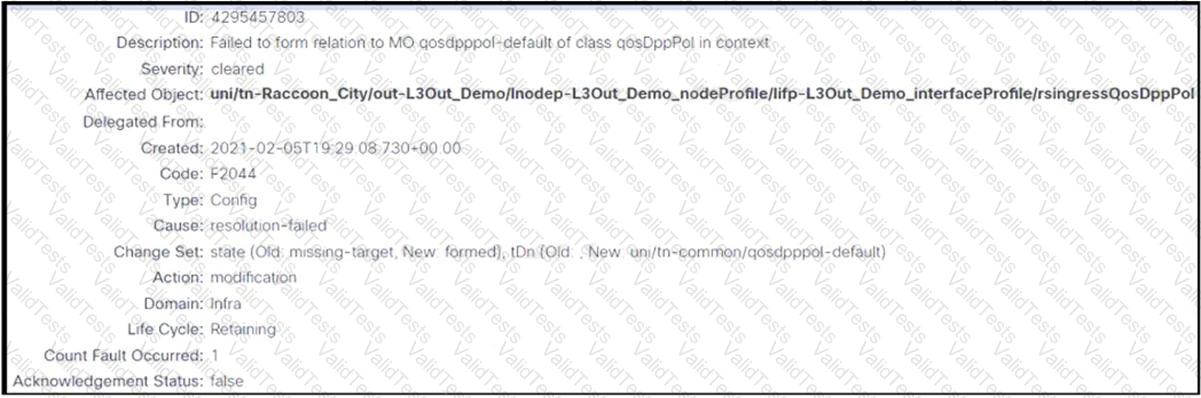
Refer to the exhibit. An engineer configures an L3Out but receives the error presented. Which action clears the fault?

Options:

A.

Acknowledge the QoS-related error.

B.

Associate a custom QoS class.

C.

Create a custom QoS policy.

D.

Set the QoS policy to Level 3.

Expert Solution
Viewing page 2 out of 8 pages
Viewing questions 11-20 out of questions