Pre-Summer Special Limited Time 70% Discount Offer - Ends in 0d 00h 00m 00s - Coupon code: validbest

Pass the MuleSoft Certified Architect MCIA-Level-1 Questions and answers with ValidTests

Exam MCIA-Level-1 All Questions
Exam MCIA-Level-1 Premium Access

View all detail and faqs for the MCIA-Level-1 exam

Viewing page 3 out of 7 pages
Viewing questions 21-30 out of questions
Questions # 21:

An organization's IT team follows an API-led connectivity approach and must use Anypoint Platform to implement a System AP\ that securely accesses customer data. The organization uses Salesforce as the system of record for all customer data, and its most important objective is to reduce the overall development time to release the System API.

The team's integration architect has identified four different approaches to access the customer data from within the implementation of the System API by using different Anypoint Connectors that all meet the technical requirements of the project.

Options:

A.

Use the Anypoint Connector for Database to connect to a MySQL database to access a copy of the customer data

B.

Use the Anypoint Connector for HTTP to connect to the Salesforce APIs to directly access the customer data

C.

Use the Anypoint Connector for Salesforce to connect to the Salesforce APIs to directly access the customer data

D.

Use the Anypoint Connector tor FTP to download a file containing a recent near-real time extract of the customer data

Expert Solution
Questions # 22:

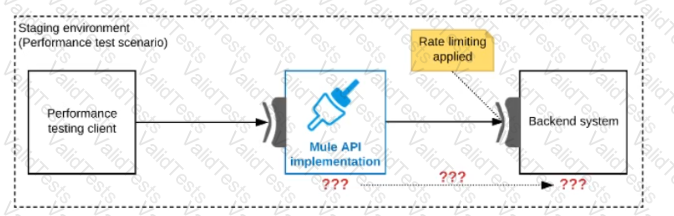
Refer to the exhibit.

Question # 22

One of the backend systems invoked by an API implementation enforces rate limits on the number of requests a particular client can make. Both the backend system and the API implementation are deployed to several non-production environments in addition to production.

Rate limiting of the backend system applies to all non-production environments. The production environment, however, does NOT have any rate limiting.

What is the most effective approach to conduct performance tests of the API implementation in a staging (non-production) environment?

Options:

A.

Create a mocking service that replicates the backend system's production performance characteristics. Then configure the API implementation to use the mocking service and conduct the performance tests

B.

Use MUnit to simulate standard responses from the backend system then conduct performance tests to identify other bottlenecks in the system

C.

Include logic within the API implementation that bypasses invocations of the backend system in a performance test situation. Instead invoking local stubs that replicate typical backend system responses then conduct performance tests using this API Implementation

D.

Conduct scaled-down performance tests in the staging environment against the rate limited backend system then upscale performance results to full production scale

Expert Solution
Questions # 23:

An API client is implemented as a Mule application that includes an HTTP Request operation using a default configuration. The HTTP Request operation invokes an external API that follows standard HTTP status code conventions, which causes the HTTP Request operation to return a 4xx status code.

What is a possible cause of this status code response?

Options:

A.

An error occurred inside the external API implementation when processing the HTTP request that was received from the outbound HTTP Request operation of the Mule application

B.

The external API reported that the API implementation has moved to a different external endpoint

C.

The HTTP response cannot be interpreted by the HTTP Request operation of the Mule application after it was received from the external API

D.

The external API reported an error with the HTTP request that was received from the outbound HTTP Request operation of the Mule application

Expert Solution
Questions # 24:

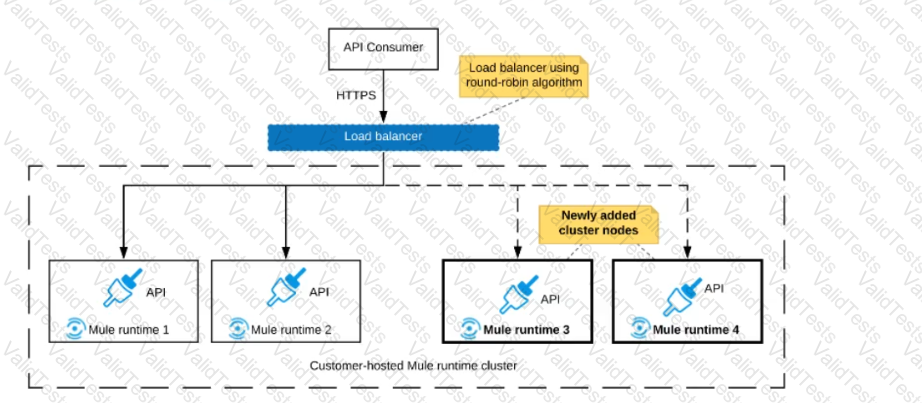
Refer to the exhibit.

Question # 24

An organization uses a 2-node Mute runtime cluster to host one stateless API implementation. The API is accessed over HTTPS through a load balancer that uses round-robin for load distribution.

Two additional nodes have been added to the cluster and the load balancer has been configured to recognize the new nodes with no other change to the load balancer.

What average performance change is guaranteed to happen, assuming all cluster nodes are fully operational?

Options:

A.

50% reduction in the response time of the API

B.

100% increase in the throughput of the API

C.

50% reduction In the JVM heap memory consumed by each node

D.

50% reduction In the number of requests being received by each node

Expert Solution
Questions # 25:

A company is designing an integration Mule application to process orders by submitting them to a back-end system for offline processing. Each order will be received by the Mule application through an HTTP5 POST and must be acknowledged immediately.

Once acknowledged the order will be submitted to a back-end system. Orders that cannot be successfully submitted due to the rejections from the back-end system will need to be processed manually (outside the banking system).

The mule application will be deployed to a customer hosted runtime and will be able to use an existing ActiveMQ broker if needed. The ActiveMQ broker is located inside the organization's firewall. The back-end system has a track record of unreliability due to both minor network connectivity issues and longer outages.

Which combination of Mule application components and ActiveMQ queues are required to ensure automatic submission of orders to the back-end system while supporting but minimizing manual order processing?

Options:

A.

One or more On Error scopes to assist calling the back-end system An Untill successful scope containing VM components for long retries A persistent dead-letter VM queue configure in Cloud hub

B.

An Until Successful scope to call the back-end system One or more ActiveMQ long-retry queues One or more ActiveMQ dead-letter queues for manual processing

C.

One or more on-Error scopes to assist calling the back-end system one or more ActiveMQ long-retry queues A persistent dead-letter Object store configuration in the CloudHub object store service

D.

A batch job scope to call the back in system An Untill successful scope containing Object Store components for long retries. A dead-letter object store configured in the Mule application

Expert Solution
Questions # 26:

An integration team uses Anypoint Platform and follows MuleSoft's recommended approach to full lifecycle API development.

Which step should the team's API designer take before the API developers implement the AP! Specification?

Options:

A.

Generate test cases using MUnit so the API developers can observe the results of running the API

B.

Use the scaffolding capability of Anypoint Studio to create an API portal based on the API specification

C.

Publish the API specification to Exchange and solicit feedback from the API's consumers

D.

Use API Manager to version the API specification

Expert Solution
Questions # 27:

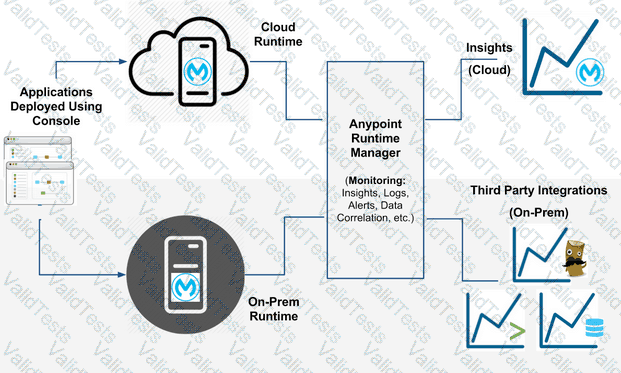
An organization uses Mule runtimes which are managed by Anypoint Platform - Private Cloud Edition. What MuleSoft component is responsible for feeding analytics data to non-MuleSoft analytics platforms?

Options:

A.

Anypoint Exchange

B.

The Mule runtimes

C.

Anypoint API Manager

D.

Anypoint Runtime Manager

Expert Solution
Questions # 28:

What limits if a particular Anypoint Platform user can discover an asset in Anypoint Exchange?

Options:

A.

Design Center and RAML were both used to create the asset

B.

The existence of a public Anypoint Exchange portal to which the asset has been published

C.

The type of the asset in Anypoint Exchange

D.

The business groups to which the user belongs

Expert Solution
Questions # 29:

An organization is choosing between API-led connectivity and other integration approaches.

According to MuleSoft, which business benefits is associated with an API-led connectivity approach using Anypoint Platform?

Options:

A.

improved security through adoption of monolithic architectures

B.

Increased developer productivity through sell-service of API assets

C.

Greater project predictability through tight coupling of systems

D.

Higher outcome repeatability through centralized development

Expert Solution
Questions # 30:

A corporation has deployed Mule applications to different customer-hosted Mule runtimes. Mule applications deployed to these Mule runtimes are managed by Anypoint Platform.

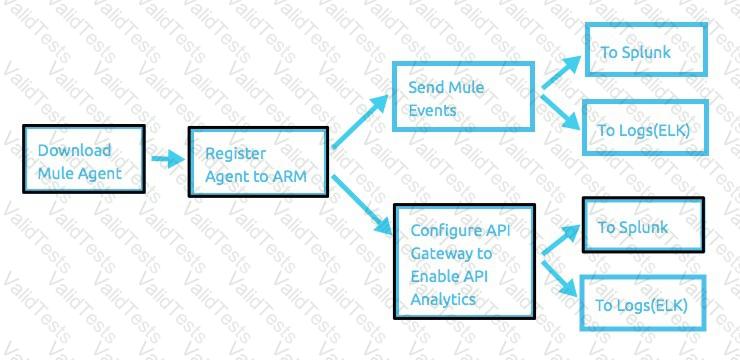
What needs to be installed or configured (if anything) to monitor these Mule applications from Anypoint Monitoring, and how is monitoring data from each Mule application sent to Anypoint Monitoring?

Options:

A.

Enable monitoring of individual Mule applications from the Runtime Manager

application settings.

Runtime Manager sends monitoring data to Anypoint Monitoring for each deployed Mule application.

B.

Install a Runtime Manager agent on each Mule runtime.

Each Runtime Manager agent sends monitoring data from the Mule applications

running in its Mule runtime to Runtime Manager, then Runtime Manager sends

monitoring data to Anypoint Monitoring.

C.

Leave the out-of-the-box Anypoint Monitoring agent unchanged in its default Mule

runtime installation.

Each Anypoint Monitoring agent sends monitoring data from the Mule applications

running in its Mule runtime to Runtime Manager, then Runtime Manager sends

monitoring data to Anypoint Monitoring.

D.

Install an Anypoint Monitoring agent on each Mule runtime.

Each Anypoint Monitoring agent sends monitoring data from the Mule applications

running in its Mule runtime to Anypoint Monitoring.

Expert Solution
Viewing page 3 out of 7 pages
Viewing questions 21-30 out of questions