Refer to the exhibit.
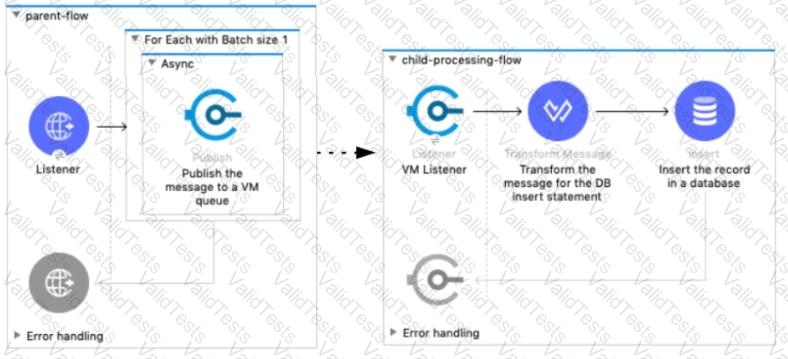
A Mule 4 application has a parent flow that breaks up a JSON array payload into 200 separate items, then sends each item one at a time inside an Async scope to a VM queue.
A second flow to process orders has a VM Listener on the same VM queue. The rest of this flow processes each received item by writing the item to a database.
This Mule application is deployed to four CloudHub workers with persistent queues enabled.
What message processing guarantees are provided by the VM queue and the CloudHub workers, and how are VM messages routed among the CloudHub workers for each invocation of the parent flow under normal operating conditions where all the CloudHub workers remain online?
A project team uses RAML specifications to document API functional requirements and deliver API definitions. As per the current legal requirement, all designed API definitions to be augmented with an additional non-functional requirement to protect the services from a high rate of requests according to define service level agreements.
Assuming that the project is following Mulesoft API governance and policies, how should the project team convey the necessary non-functional requirement to stakeholders?
An integration Mule application is deployed to a customer-hosted multi-node Mule 4 runtime duster. The Mule application uses a Listener operation of a JMS connector to receive incoming messages from a JMS queue.
How are the messages consumed by the Mule application?
A Mule application is being designed for deployment to a single CloudHub worker. The Mule application will have a flow that connects to a SaaS system to perform some operations each time the flow is invoked.
The SaaS system connector has operations that can be configured to request a short-lived token (fifteen minutes) that can be reused for subsequent connections within the fifteen minute time window. After the token expires, a new token must be requested and stored.
What is the most performant and idiomatic (used for its intended purpose) Anypoint Platform component or service to use to support persisting and reusing tokens in the Mule application to help speed up reconnecting the Mule application to the SaaS application?
A MuteSoft developer must implement an API as a Mule application, run the application locally, and execute unit tests against the Running application.
Which Anypoint Platform component can the developer use to full all of these requirements?
As an enterprise architect, what are the two reasons for which you would use a canonical data model in the new integration project using Mulesoft Anypoint platform ( choose two answers )
A travel company wants to publish a well-defined booking service API to be shared with its business partners. These business partners have agreed to ONLY consume SOAP services and they want to get the service contracts in an easily consumable way before they start any development. The travel company will publish the initial design documents to Anypoint Exchange, then share those documents with the business partners. When using an API-led approach, what is the first design document the travel company should deliver to its business partners?
Which Exchange asset type represents configuration modules that extend the functionality of an API and enforce capabilities such as security?
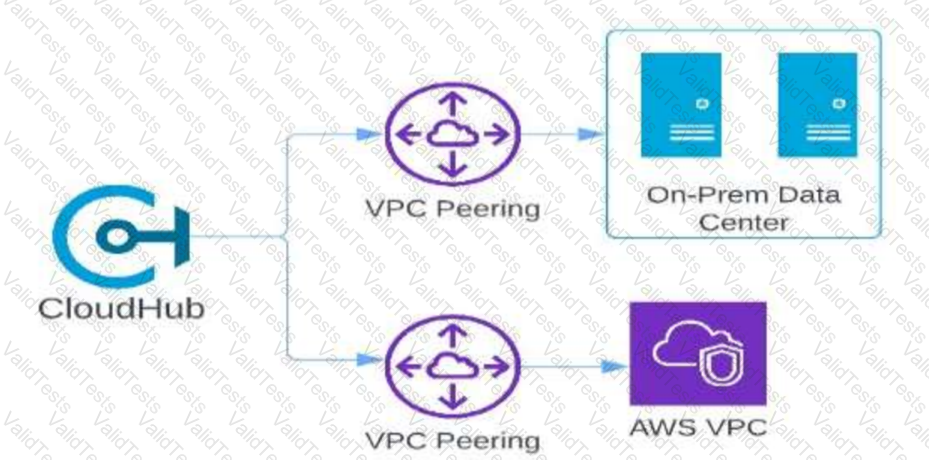
A gaming company has implemented an API as a Mule application and deployed the API implementation to a CloudHub 2.0 private space. The API implementation must connect to a mainframe application running in the customer’s on-premises corporate data center and also to a Kafka cluster running in an Amazon AWS VPC.
What is the most efficient way to enable the API to securely connect from its private space to the mainframe application and Kafka cluster?
In Runtime Manager, set up VPC peering between the CloudHub 2.0 private network and the on-premises data center.
In the AWS account, set up VPC peering between the AWS VPC and the CloudHub 2.0 private network.
B)
In the AWS account, attach the CloudHub 2.0 private space to an AWS transit gateway that routes from the Clou
Option A
Option B
Option C
Option D
A mule application designed to fulfil two requirements
a) Processing files are synchronously from an FTPS server to a back-end database using VM intermediary queues for load balancing VM events
b) Processing a medium rate of records from a source to a target system using batch job scope
Considering the processing reliability requirements for FTPS files, how should VM queues be configured for processing files as well as for the batch job scope if the application is deployed to Cloudhub workers?


