Pre-Summer Special Limited Time 70% Discount Offer - Ends in 0d 00h 00m 00s - Coupon code: validbest

Pass the MuleSoft Certified Architect MCIA-Level-1 Questions and answers with ValidTests

Exam MCIA-Level-1 All Questions
Exam MCIA-Level-1 Premium Access

View all detail and faqs for the MCIA-Level-1 exam

Viewing page 7 out of 7 pages
Viewing questions 61-70 out of questions
Questions # 61:

An insurance company is implementing a MuleSoft API to get inventory details from the two vendors. Due to network issues, the invocations to vendor applications are getting timed-out intermittently. But the transactions are successful upon reprocessing

What is the most performant way of implementing this requirement?

Options:

A.

Implement a scatter-gather scope to invoke the two vendor

applications on two different route

Use the Until-Successful scope to implement the retry mechanism

for timeout errors on each route

B.

Implement a Choice scope to invoke the two vendor applications on two different route

Use the try-catch scope to implement the retry mechanism for timeout errors on each route

C.

Implement a For-Each scope to invoke the two vendor applications

Use until successful scope to implement the retry mechanism for the timeout errors

D.

Implement Round-Robin scope to invoke the two vendor applications on two different routes

Use the Try-Catch scope to implement retry mechanism for timeout errors on each route

Expert Solution
Questions # 62:

A mule application is being designed to perform product orchestration. The Mule application needs to join together the responses from an inventory API and a Product Sales History API with the least latency.

To minimize the overall latency. What is the most idiomatic (used for its intended purpose) design to call each API request in the Mule application?

Options:

A.

Call each API request in a separate lookup call from Dataweave reduce operator

B.

Call each API request in a separate route of a Scatter-Gather

C.

Call each API request in a separate route of a Parallel For Each scope

D.

Call each API request in a separate Async scope

Expert Solution
Questions # 63:

Which component of Anypoint platform belongs to the platform control plane?

Options:

A.

Runtime Fabric

B.

Runtime Replica

C.

Anypoint Connectors

D.

API Manager

Expert Solution
Questions # 64:

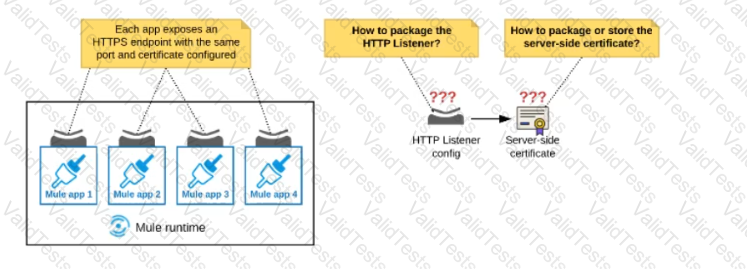
Refer to the exhibit.

Question # 64

An organization deploys multiple Mule applications to the same customer -hosted Mule runtime. Many of these Mule applications must expose an HTTPS endpoint on the same port using a server-side certificate that rotates often.

What is the most effective way to package the HTTP Listener and package or store the server-side certificate when deploying these Mule applications, so the disruption caused by certificate rotation is minimized?

Options:

A.

Package the HTTPS Listener configuration in a Mule DOMAIN project, referencing it from all Mule applications that need to expose an HTTPS endpoint Package the server-side certificate in ALL Mule APPLICATIONS that need to expose an HTTPS endpoint

B.

Package the HTTPS Listener configuration in a Mule DOMAIN project, referencing it from all Mule applications that need to expose an HTTPS endpoint. Store the server-side certificate in a shared filesystem location in the Mule runtime's classpath, OUTSIDE the Mule DOMAIN or any Mule APPLICATION

C.

Package an HTTPS Listener configuration In all Mule APPLICATIONS that need to expose an HTTPS endpoint Package the server-side certificate in a NEW Mule DOMAIN project

D.

Package the HTTPS Listener configuration in a Mule DOMAIN project, referencing It from all Mule applications that need to expose an HTTPS endpoint. Package the server-side certificate in the SAME Mule DOMAIN project Go to Set

Expert Solution
Questions # 65:

A mule application is deployed to a Single Cloudhub worker and the public URL appears in Runtime Manager as the APP URL.

Requests are sent by external web clients over the public internet to the mule application App url. Each of these requests routed to the HTTPS Listener event source of the running Mule application.

Later, the DevOps team edits some properties of this running Mule application in Runtime Manager.

Immediately after the new property values are applied in runtime manager, how is the current Mule application deployment affected and how will future web client requests to the Mule application be handled?

Options:

A.

Cloudhub will redeploy the Mule application to the OLD Cloudhub worker

New web client requests will RETURN AN ERROR until the Mule application is redeployed to the OLD Cloudhub worker

B.

CloudHub will redeploy the Mule application to a NEW Cloudhub worker

New web client requests will RETURN AN ERROR until the NEW Cloudhub worker is available

C.

Cloudhub will redeploy the Mule application to a NEW Cloudhub worker

New web client requests are ROUTED to the OLD Cloudhub worker until the NEW Cloudhub worker is available.

D.

Cloudhub will redeploy the mule application to the OLD Cloudhub worker

New web client requests are ROUTED to the OLD Cloudhub worker BOTH before and after the Mule application is redeployed.

Expert Solution
Questions # 66:

What aspects of a CI/CD pipeline for Mute applications can be automated using MuleSoft-provided Maven plugins?

Options:

A.

Compile, package, unit test, deploy, create associated API instances in API Manager

B Import from API designer, compile, package, unit test, deploy, publish to Am/point Exchange

B.

Compile, package, unit test, validate unit test coverage, deploy

C.

Compile, package, unit test, deploy, integration test

Expert Solution
Questions # 67:

A trading company handles millions of requests a day. Due to nature of its business, it requires excellent

performance and reliability within its application.

For this purpose, company uses a number of event-based API's hosted on various mule clusters that communicate across a shared message queue sitting within its network.

Which method should be used to meet the company's requirement for its system?

Options:

A.

XA transactions and XA connected components

B.

JMS transactions

C.

JMS manual acknowledgements with a reliability pattern

D.

VM queues with reliability pattern

Expert Solution
Questions # 68:

What Anypoint Connectors support transactions?

Options:

A.

Database, JMS, VM

B.

Database, 3MS, HTTP

C.

Database, JMS, VM, SFTP

D.

Database, VM, File

Expert Solution
Questions # 69:

In one of the critical payment related mule application, transaction is being used . As an enhancement to implementation , scatter gather route is introduced which is also the part of transaction group. Scatter gather route has 4 routes.

What will be the behavior of the Mule application in case of error occurs in 4th route of the scatter-gather router and transaction needs to be rolled back?

Options:

A.

Only errored route will be rolled back

B.

All routes will be rolled back

C.

Scatter Gather router cannot be part of transaction

Expert Solution
Questions # 70:

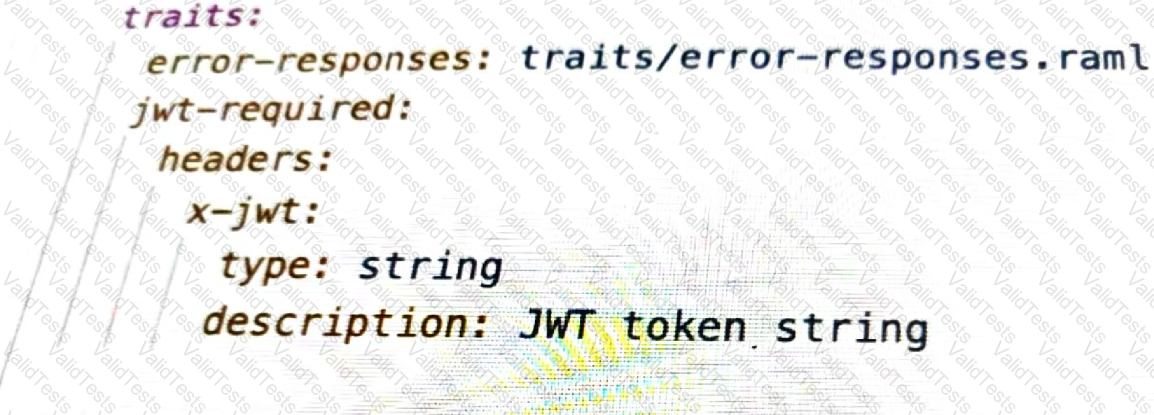
Refer to the exhibit.

Question # 70

What is the type data format shown in the exhibit?

Options:

A.

JSON

B.

XML

C.

YAML

D.

CSV

Expert Solution
Viewing page 7 out of 7 pages
Viewing questions 61-70 out of questions