An organization's security policies mandate complete control of the login credentials used to log in to Anypoint Platform. What feature of Anypoint Platform should be used to meet this requirement?
A Mule application uses the Database connector.
What condition can the Mule application automatically adjust to or recover from without needing to restart or redeploy the Mule application?
According to MuleSoft, which system integration term describes the method, format, and protocol used for communication between two system?
According to MuleSoft, a synchronous invocation of a RESTful API using HTTP to get an individual customer record from a single system is an example of which system integration interaction pattern?
In which order are the API Client, API Implementation, and API interface components called in a typical REST request?
A leading eCommerce giant will use MuleSoft APIs on Runtime Fabric (RTF) to process customer orders. Some customer-sensitive information, such as credit card information, is required in request payloads or is included in response payloads in some of the APIs. Other API requests and responses are not authorized to access some of this customer-sensitive information but have been implemented to validate and transform based on the structure and format of this customer-sensitive information (such as account IDs, phone numbers, and postal codes).
What approach configures an API gateway to hide sensitive data exchanged between API consumers and API implementations, but can convert tokenized fields back to their original value for other API requests or responses, without having to recode the API implementations?
Later, the project team requires all API specifications to be augmented with an additional non-functional requirement (NFR) to protect the backend services from a high rate of requests, according to defined service-level
agreements (SLAs). The NFR's SLAs are based on a new tiered subscription level "Gold", "Silver", or "Platinum" that must be tied to a new parameter that is being added to the Accounts object in their enterprise data model.
Following MuleSoft's recommended best practices, how should the project team now convey the necessary non-functional requirement to stakeholders?
An organization is not meeting its growth and innovation objectives because IT cannot deliver projects last enough to keep up with the pace of change required by the business.
According to MuleSoft’s IT delivery and operating model, which step should the organization lake to solve this problem?
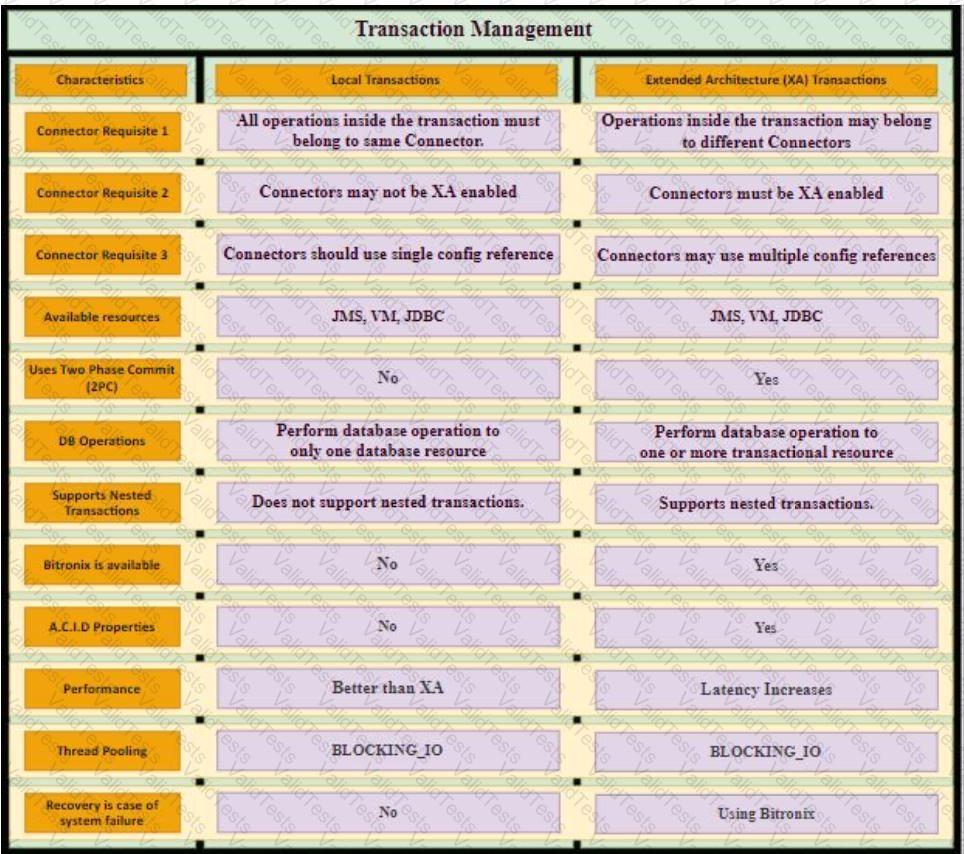
An XA transaction Is being configured that involves a JMS connector listening for Incoming JMS messages. What is the meaning of the timeout attribute of the XA transaction, and what happens after the timeout expires?
A company is building an application network and has deployed four Mule APIs: one experience API, one process API, and two system APIs. The logs from all the APIs are aggregated in an external log aggregation tool. The company wants to trace messages that are exchanged between multiple API implementations. What is the most idiomatic (based on its intended use) identifier that should be used to implement Mule event tracing across the multiple API implementations?
As a part of project , existing java implementation is being migrated to Mulesoft. Business is very tight on the budget and wish to complete the project in most economical way possible.
Canonical object model using java is already a part of existing implementation. Same object model is required by mule application for a business use case. What is the best way to achieve this?


 Graphical user interface, table
Description automatically generated with medium confidence
Graphical user interface, table
Description automatically generated with medium confidence