Pre-Summer Special Limited Time 70% Discount Offer - Ends in 0d 00h 00m 00s - Coupon code: validbest

Pass the Snowflake SnowPro Advanced: Architect ARA-C01 Questions and answers with ValidTests

Exam ARA-C01 All Questions
Exam ARA-C01 Premium Access

View all detail and faqs for the ARA-C01 exam

Viewing page 2 out of 6 pages
Viewing questions 11-20 out of questions
Questions # 11:

Consider the following scenario where a masking policy is applied on the CREDICARDND column of the CREDITCARDINFO table. The masking policy definition Is as follows:

Question # 11

Sample data for the CREDITCARDINFO table is as follows:

NAME EXPIRYDATE CREDITCARDNO

JOHN DOE 2022-07-23 4321 5678 9012 1234

if the Snowflake system rotes have not been granted any additional roles, what will be the result?

Options:

A.

The sysadmin can see the CREDICARDND column data in clear text.

B.

The owner of the table will see the CREDICARDND column data in clear text.

C.

Anyone with the Pl_ANALYTICS role will see the last 4 characters of the CREDICARDND column data in dear text.

D.

Anyone with the Pl_ANALYTICS role will see the CREDICARDND column as*** 'MASKED* **'.

Expert Solution
Questions # 12:

What are purposes for creating a storage integration? (Choose three.)

Options:

A.

Control access to Snowflake data using a master encryption key that is maintained in the cloud provider’s key management service.

B.

Store a generated identity and access management (IAM) entity for an external cloud provider regardless of the cloud provider that hosts the Snowflake account.

C.

Support multiple external stages using one single Snowflake object.

D.

Avoid supplying credentials when creating a stage or when loading or unloading data.

E.

Create private VPC endpoints that allow direct, secure connectivity between VPCs without traversing the public internet.

F.

Manage credentials from multiple cloud providers in one single Snowflake object.

Expert Solution
Questions # 13:

Which of the following ingestion methods can be used to load near real-time data by using the messaging services provided by a cloud provider?

Options:

A.

Snowflake Connector for Kafka

B.

Snowflake streams

C.

Snowpipe

D.

Spark

Expert Solution
Questions # 14:

Company A has recently acquired company B. The Snowflake deployment for company B is located in the Azure West Europe region.

As part of the integration process, an Architect has been asked to consolidate company B's sales data into company A's Snowflake account which is located in the AWS us-east-1 region.

How can this requirement be met?

Options:

A.

Replicate the sales data from company B's Snowflake account into company A's Snowflake account using cross-region data replication within Snowflake. Configure a direct share from company B's account to company A's account.

B.

Export the sales data from company B's Snowflake account as CSV files, and transfer the files to company A's Snowflake account. Import the data using Snowflake's data loading capabilities.

C.

Migrate company B's Snowflake deployment to the same region as company A's Snowflake deployment, ensuring data locality. Then perform a direct database-to-database merge of the sales data.

D.

Build a custom data pipeline using Azure Data Factory or a similar tool to extract the sales data from company B's Snowflake account. Transform the data, then load it into company A's Snowflake account.

Expert Solution
Questions # 15:

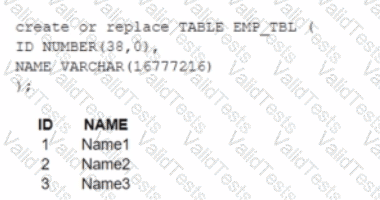
A table, EMP_ TBL has three records as shown:
Question # 15

The following variables are set for the session:

Question # 15

Which SELECT statements will retrieve all three records? (Select TWO).

Options:

A.

Select * FROM Stbl_ref WHERE Scol_ref IN ('Name1','Nam2','Name3');

B.

SELECT * FROM EMP_TBL WHERE identifier(Scol_ref) IN ('Namel','Name2', 'Name3');

C.

SELECT * FROM identifier WHERE NAME IN ($var1, $var2, $var3);

D.

SELECT * FROM identifier($tbl_ref) WHERE ID IN Cvarl','var2','var3');

E.

SELECT * FROM $tb1_ref WHERE $col_ref IN ($var1, Svar2, Svar3);

Expert Solution
Questions # 16:

How is the change of local time due to daylight savings time handled in Snowflake tasks? (Choose two.)

Options:

A.

A task scheduled in a UTC-based schedule will have no issues with the time changes.

B.

Task schedules can be designed to follow specified or local time zones to accommodate the time changes.

C.

A task will move to a suspended state during the daylight savings time change.

D.

A frequent task execution schedule like minutes may not cause a problem, but will affect the task history.

E.

A task schedule will follow only the specified time and will fail to handle lost or duplicated hours.

Expert Solution
Questions # 17:

A company has a table with that has corrupted data, named Data. The company wants to recover the data as it was 5 minutes ago using cloning and Time Travel.

What command will accomplish this?

Options:

A.

CREATE CLONE TABLE Recover_Data FROM Data AT(OFFSET => -60*5);

B.

CREATE CLONE Recover_Data FROM Data AT(OFFSET => -60*5);

C.

CREATE TABLE Recover_Data CLONE Data AT(OFFSET => -60*5);

D.

CREATE TABLE Recover Data CLONE Data AT(TIME => -60*5);

Expert Solution
Questions # 18:

An Architect needs to design a Snowflake account and database strategy to store and analyze large amounts of structured and semi-structured data. There are many business units and departments within the company. The requirements are scalability, security, and cost efficiency.

What design should be used?

Options:

A.

Create a single Snowflake account and database for all data storage and analysis needs, regardless of data volume or complexity.

B.

Set up separate Snowflake accounts and databases for each department or business unit, to ensure data isolation and security.

C.

Use Snowflake's data lake functionality to store and analyze all data in a central location, without the need for structured schemas or indexes

D.

Use a centralized Snowflake database for core business data, and use separate databases for departmental or project-specific data.

Expert Solution
Questions # 19:

A retailer's enterprise data organization is exploring the use of Data Vault 2.0 to model its data lake solution. A Snowflake Architect has been asked to provide recommendations for using Data Vault 2.0 on Snowflake.

What should the Architect tell the data organization? (Select TWO).

Options:

A.

Change data capture can be performed using the Data Vault 2.0 HASH_DIFF concept.

B.

Change data capture can be performed using the Data Vault 2.0 HASH_DELTA concept.

C.

Using the multi-table insert feature in Snowflake, multiple Point-in-Time (PIT) tables can be loaded in parallel from a single join query from the data vault.

D.

Using the multi-table insert feature, multiple Point-in-Time (PIT) tables can be loaded sequentially from a single join query from the data vault.

E.

There are performance challenges when using Snowflake to load multiple Point-in-Time (PIT) tables in parallel from a single join query from the data vault.

Expert Solution
Questions # 20:

A healthcare company wants to share data with a medical institute. The institute is running a Standard edition of Snowflake; the healthcare company is running a Business Critical edition.

How can this data be shared?

Options:

A.

The healthcare company will need to change the institute’s Snowflake edition in the accounts panel.

B.

By default, sharing is supported from a Business Critical Snowflake edition to a Standard edition.

C.

Contact Snowflake and they will execute the share request for the healthcare company.

D.

Set the share_restriction parameter on the shared object to false.

Expert Solution
Viewing page 2 out of 6 pages
Viewing questions 11-20 out of questions