Pre-Summer Special Limited Time 70% Discount Offer - Ends in 0d 00h 00m 00s - Coupon code: validbest

Pass the Snowflake SnowPro Advanced: Architect ARA-C01 Questions and answers with ValidTests

Exam ARA-C01 All Questions
Exam ARA-C01 Premium Access

View all detail and faqs for the ARA-C01 exam

Viewing page 3 out of 6 pages
Viewing questions 21-30 out of questions
Questions # 21:

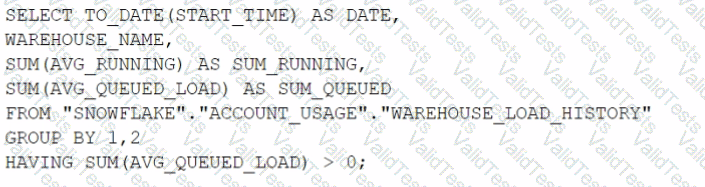
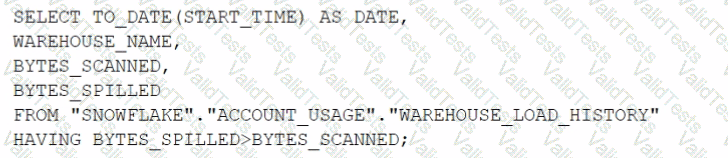
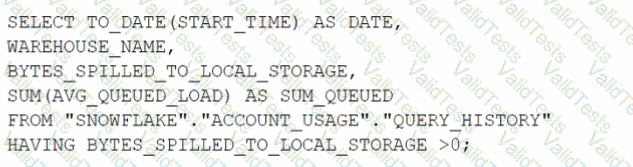
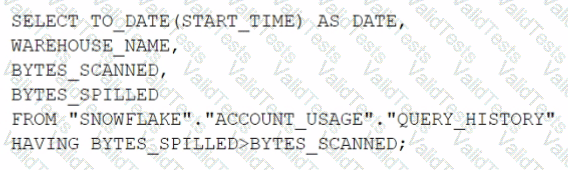
Which query will identify the specific days and virtual warehouses that would benefit from a multi-cluster warehouse to improve the performance of a particular workload?

A)
Question # 21

B)

Question # 21

C)

Question # 21

D)

Question # 21

Options:

A.

Option A

B.

Option B

C.

Option C

D.

Option D

Expert Solution
Questions # 22:

Which SQL alter command will MAXIMIZE memory and compute resources for a Snowpark stored procedure when executed on the snowpark_opt_wh warehouse?

A)Question # 22

B)Question # 22

C)Question # 22

D)Question # 22

Options:

A.

Option A

B.

Option B

C.

Option C

D.

Option D

Expert Solution
Questions # 23:

An Architect clones a database and all of its objects, including tasks. After the cloning, the tasks stop running.

Why is this occurring?

Options:

A.

Tasks cannot be cloned.

B.

The objects that the tasks reference are not fully qualified.

C.

Cloned tasks are suspended by default and must be manually resumed.

D.

The Architect has insufficient privileges to alter tasks on the cloned database.

Expert Solution
Questions # 24:

Database DB1 has schema S1 which has one table, T1.

DB1 --> S1 --> T1

The retention period of EG1 is set to 10 days.

The retention period of s: is set to 20 days.

The retention period of t: Is set to 30 days.

The user runs the following command:

Drop Database DB1;

What will the Time Travel retention period be for T1?

Options:

A.

10 days

B.

20 days

C.

30 days

D.

37 days

Expert Solution
Questions # 25:

A new table and streams are created with the following commands:

CREATE OR REPLACE TABLE LETTERS (ID INT, LETTER STRING) ;

CREATE OR REPLACE STREAM STREAM_1 ON TABLE LETTERS;

CREATE OR REPLACE STREAM STREAM_2 ON TABLE LETTERS APPEND_ONLY = TRUE;

The following operations are processed on the newly created table:

INSERT INTO LETTERS VALUES (1, 'A');

INSERT INTO LETTERS VALUES (2, 'B');

INSERT INTO LETTERS VALUES (3, 'C');

TRUNCATE TABLE LETTERS;

INSERT INTO LETTERS VALUES (4, 'D');

INSERT INTO LETTERS VALUES (5, 'E');

INSERT INTO LETTERS VALUES (6, 'F');

DELETE FROM LETTERS WHERE ID = 6;

What would be the output of the following SQL commands, in order?

SELECT COUNT (*) FROM STREAM_1;

SELECT COUNT (*) FROM STREAM_2;

Options:

A.

2 & 6

B.

2 & 3

C.

4 & 3

D.

4 & 6

Expert Solution
Questions # 26:

The following table exists in the production database:

A regulatory requirement states that the company must mask the username for events that are older than six months based on the current date when the data is queried.

How can the requirement be met without duplicating the event data and making sure it is applied when creating views using the table or cloning the table?

Options:

A.

Use a masking policy on the username column using a entitlement table with valid dates.

B.

Use a row level policy on the user_events table using a entitlement table with valid dates.

C.

Use a masking policy on the username column with event_timestamp as a conditional column.

D.

Use a secure view on the user_events table using a case statement on the username column.

Expert Solution
Questions # 27:

A Snowflake Architect is designing a multi-tenant application strategy for an organization in the Snowflake Data Cloud and is considering using an Account Per Tenant strategy.

Which requirements will be addressed with this approach? (Choose two.)

Options:

A.

There needs to be fewer objects per tenant.

B.

Security and Role-Based Access Control (RBAC) policies must be simple to configure.

C.

Compute costs must be optimized.

D.

Tenant data shape may be unique per tenant.

E.

Storage costs must be optimized.

Expert Solution
Questions # 28:

The data share exists between a data provider account and a data consumer account. Five tables from the provider account are being shared with the consumer account. The consumer role has been granted the imported privileges privilege.

What will happen to the consumer account if a new table (table_6) is added to the provider schema?

Options:

A.

The consumer role will automatically see the new table and no additional grants are needed.

B.

The consumer role will see the table only after this grant is given on the consumer side:grant imported privileges on database PSHARE_EDW_4TEST_DB to DEV_ROLE;

C.

The consumer role will see the table only after this grant is given on the provider side:use role accountadmin;Grant select on table EDW.ACCOUNTING.Table_6 to share PSHARE_EDW_4TEST;

D.

The consumer role will see the table only after this grant is given on the provider side:use role accountadmin;grant usage on database EDW to share PSHARE_EDW_4TEST ;grant usage on schema EDW.ACCOUNTING to share PSHARE_EDW_4TEST ;Grant select on table EDW.ACCOUNTING.Table_6 to database PSHARE_EDW_4TEST_DB ;

Expert Solution
Questions # 29:

An Architect is using SnowCD to investigate a connectivity issue.

Which system function will provide a list of endpoints that the network must be able to access to use a specific Snowflake account, leveraging private connectivity?

Options:

A.

SYSTEMSALLOWLIST ()

B.

SYSTEMSGET_PRIVATELINK

C.

SYSTEMSAUTHORIZE_PRIVATELINK

D.

SYSTEMSALLOWLIST_PRIVATELINK ()

Expert Solution
Questions # 30:

The IT Security team has identified that there is an ongoing credential stuffing attack on many of their organization’s system.

What is the BEST way to find recent and ongoing login attempts to Snowflake?

Options:

A.

Call the LOGIN_HISTORY Information Schema table function.

B.

Query the LOGIN_HISTORY view in the ACCOUNT_USAGE schema in the SNOWFLAKE database.

C.

View the History tab in the Snowflake UI and set up a filter for SQL text that contains the text "LOGIN".

D.

View the Users section in the Account tab in the Snowflake UI and review the last login column.

Expert Solution
Viewing page 3 out of 6 pages
Viewing questions 21-30 out of questions