Pre-Summer Special Limited Time 70% Discount Offer - Ends in 0d 00h 00m 00s - Coupon code: validbest

Pass the Snowflake SnowPro Advanced: Architect ARA-C01 Questions and answers with ValidTests

Exam ARA-C01 All Questions
Exam ARA-C01 Premium Access

View all detail and faqs for the ARA-C01 exam

Viewing page 6 out of 6 pages
Viewing questions 51-60 out of questions
Questions # 51:

Which organization-related tasks can be performed by the ORGADMIN role? (Choose three.)

Options:

A.

Changing the name of the organization

B.

Creating an account

C.

Viewing a list of organization accounts

D.

Changing the name of an account

E.

Deleting an account

F.

Enabling the replication of a database

Questions # 52:

The following statements have been executed successfully:

USE ROLE SYSADMIN;

CREATE OR REPLACE DATABASE DEV_TEST_DB;

CREATE OR REPLACE SCHEMA DEV_TEST_DB.SCHTEST WITH MANAGED ACCESS;

GRANT USAGE ON DATABASE DEV_TEST_DB TO ROLE DEV_PROJ_OWN;

GRANT USAGE ON SCHEMA DEV_TEST_DB.SCHTEST TO ROLE DEV_PROJ_OWN;

GRANT USAGE ON DATABASE DEV_TEST_DB TO ROLE ANALYST_PROJ;

GRANT USAGE ON SCHEMA DEV_TEST_DB.SCHTEST TO ROLE ANALYST_PROJ;

GRANT CREATE TABLE ON SCHEMA DEV_TEST_DB.SCHTEST TO ROLE DEV_PROJ_OWN;

USE ROLE DEV_PROJ_OWN;

CREATE OR REPLACE TABLE DEV_TEST_DB.SCHTEST.CURRENCY (

COUNTRY VARCHAR(255),

CURRENCY_NAME VARCHAR(255),

ISO_CURRENCY_CODE VARCHAR(15),

CURRENCY_CD NUMBER(38,0),

MINOR_UNIT VARCHAR(255),

WITHDRAWAL_DATE VARCHAR(255)

);

The role hierarchy is as follows (simplified from the diagram):

    ACCOUNTADMIN└─ DEV_SYSADMIN└─ DEV_PROJ_OWN└─ ANALYST_PROJ

Separately:

    ACCOUNTADMIN└─ SYSADMIN└─ MAPPING_ROLE

Which statements will return the records from the table

DEV_TEST_DB.SCHTEST.CURRENCY? (Select TWO)
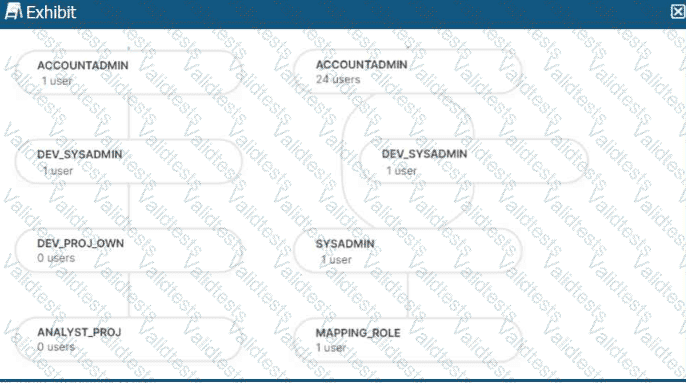
Question # 52

Options:

A.

USE ROLE DEV_PROJ_OWN;

GRANT SELECT ON DEV_TEST_DB.SCHTEST.CURRENCY TO ROLE ANALYST_PROJ;

USE ROLE ANALYST_PROJ;

SELECT * FROM DEV_TEST_DB.SCHTEST.CURRENCY;

B.

USE ROLE DEV_PROJ_OWN;

SELECT * FROM DEV_TEST_DB.SCHTEST.CURRENCY;

C.

USE ROLE SYSADMIN;

SELECT * FROM DEV_TEST_DB.SCHTEST.CURRENCY;

D.

USE ROLE MAPPING_ROLE;

SELECT * FROM DEV_TEST_DB.SCHTEST.CURRENCY;

E.

USE ROLE ACCOUNTADMIN;

SELECT * FROM DEV_TEST_DB.SCHTEST.CURRENCY;

Questions # 53:

Assuming all Snowflake accounts are using an Enterprise edition or higher, in which development and testing scenarios would be copying of data be required, and zero-copy cloning not be suitable? (Select TWO).

Options:

A.

Developers create their own datasets to work against transformed versions of the live data.

B.

Production and development run in different databases in the same account, and Developers need to see production-like data but with specific columns masked.

C.

Data is in a production Snowflake account that needs to be provided to Developers in a separate development/testing Snowflake account in the same cloud region.

D.

Developers create their own copies of a standard test database previously created for them in the development account, for their initial development and unit testing.

E.

The release process requires pre-production testing of changes with data of production scale and complexity. For security reasons, pre-production also runs in the production account.

Questions # 54:

You are a snowflake architect in an organization. The business team came to to deploy an use case which requires you to load some data which they can visualize through tableau. Everyday new data comes in and the old data is no longer required.

What type of table you will use in this case to optimize cost

Options:

A.

TRANSIENT

B.

TEMPORARY

C.

PERMANENT

Questions # 55:

Which Snowflake architecture recommendation needs multiple Snowflake accounts for implementation?

Options:

A.

Enable a disaster recovery strategy across multiple cloud providers.

B.

Create external stages pointing to cloud providers and regions other than the region hosting the Snowflake account.

C.

Enable zero-copy cloning among the development, test, and production environments.

D.

Enable separation of the development, test, and production environments.

Questions # 56:

Two queries are run on the customer_address table:

create or replace TABLE CUSTOMER_ADDRESS ( CA_ADDRESS_SK NUMBER(38,0), CA_ADDRESS_ID VARCHAR(16), CA_STREET_NUMBER VARCHAR(IO) CA_STREET_NAME VARCHAR(60), CA_STREET_TYPE VARCHAR(15), CA_SUITE_NUMBER VARCHAR(10), CA_CITY VARCHAR(60), CA_COUNTY

VARCHAR(30), CA_STATE VARCHAR(2), CA_ZIP VARCHAR(10), CA_COUNTRY VARCHAR(20), CA_GMT_OFFSET NUMBER(5,2), CA_LOCATION_TYPE

VARCHAR(20) );

ALTER TABLE DEMO_DB.DEMO_SCH.CUSTOMER_ADDRESS ADD SEARCH OPTIMIZATION ON SUBSTRING(CA_ADDRESS_ID);

Which queries will benefit from the use of the search optimization service? (Select TWO).

Options:

A.

select * from DEMO_DB.DEMO_SCH.CUSTOMER_ADDRESS Where substring(CA_ADDRESS_ID,1,8)= substring('AAAAAAAAPHPPLBAAASKDJHASLKDJHASKJD',1,8);

B.

select * from DEMO_DB.DEMO_SCH.CUSTOMER_ADDRESS Where CA_ADDRESS_ID= substring('AAAAAAAAPHPPLBAAASKDJHASLKDJHASKJD',1,16);

C.

select*fromDEMO_DB.DEMO_SCH.CUSTOMER_ADDRESSWhereCA_ADDRESS_IDLIKE ’%BAAASKD%';

D.

select*fromDEMO_DB.DEMO_SCH.CUSTOMER_ADDRESSWhereCA_ADDRESS_IDLIKE '%PHPP%';

E.

select*fromDEMO_DB.DEMO_SCH.CUSTOMER_ADDRESSWhereCA_ADDRESS_IDNOT LIKE '%AAAAAAAAPHPPL%';

Questions # 57:

A media company needs a data pipeline that will ingest customer review data into a Snowflake table, and apply some transformations. The company also needs to use Amazon Comprehend to do sentiment analysis and make the de-identified final data set available publicly for advertising companies who use different cloud providers in different regions.

The data pipeline needs to run continuously and efficiently as new records arrive in the object storage leveraging event notifications. Also, the operational complexity, maintenance of the infrastructure, including platform upgrades and security, and the development effort should be minimal.

Which design will meet these requirements?

Options:

A.

Ingest the data using copy into and use streams and tasks to orchestrate transformations. Export the data into Amazon S3 to do model inference with Amazon Comprehend and ingest the data back into a Snowflake table. Then create a listing in the Snowflake Marketplace to make the data available to other companies.

B.

Ingest the data using Snowpipe and use streams and tasks to orchestrate transformations. Create an external function to do model inference with Amazon Comprehend and write the final records to a Snowflake table. Then create a listing in the Snowflake Marketplace to make the data available to other companies.

C.

Ingest the data into Snowflake using Amazon EMR and PySpark using the Snowflake Spark connector. Apply transformations using another Spark job. Develop a python program to do model inference by leveraging the Amazon Comprehend text analysis API. Then write the results to a Snowflake table and create a listing in the Snowflake Marketplace to make the data available to other companies.

D.

Ingest the data using Snowpipe and use streams and tasks to orchestrate transformations. Export the data into Amazon S3 to do model inference with Amazon Comprehend and ingest the data back into a Snowflake table. Then create a listing in the Snowflake Marketplace to make the data available to other companies.

Questions # 58:

An Architect is troubleshooting a query with poor performance using the QUERY_HIST0RY function. The Architect observes that the COMPILATIONJHME is greater than the EXECUTIONJTIME.

What is the reason for this?

Options:

A.

The query is processing a very large dataset.

B.

The query has overly complex logic.

C.

The query is queued for execution.

D.

The query is reading from remote storage.

Questions # 59:

Which feature provides the capability to define an alternate cluster key for a table with an existing cluster key?

Options:

A.

External table

B.

Materialized view

C.

Search optimization

D.

Result cache

Questions # 60:

A company wants to Integrate its main enterprise identity provider with federated authentication with Snowflake.

The authentication integration has been configured and roles have been created in Snowflake. However, the users are not automatically appearing in Snowflake when created and their group membership is not reflected in their assigned rotes.

How can the missing functionality be enabled with the LEAST amount of operational overhead?

Options:

A.

OAuth must be configured between the identity provider and Snowflake. Then the authorization server must be configured with the right mapping of users and roles.

B.

OAuth must be configured between the identity provider and Snowflake. Then the authorization server must be configured with the right mapping of users, and the resource server must be configured with the right mapping of role assignment.

C.

SCIM must be enabled between the identity provider and Snowflake. Once both are synchronized through SCIM, their groups will get created as group accounts in Snowflake and the proper roles can be granted.

D.

SCIM must be enabled between the identity provider and Snowflake. Once both are synchronized through SCIM. users will automatically get created and their group membership will be reflected as roles In Snowflake.

Viewing page 6 out of 6 pages
Viewing questions 51-60 out of questions