Winter Special Limited Time 65% Discount Offer - Ends in 0d 00h 00m 00s - Coupon code: Bigtest65

Pass the Amazon Web Services MLA-C01 Questions and answers with ValidTests

Exam MLA-C01 All Questions
Exam MLA-C01 Premium Access

View all detail and faqs for the MLA-C01 exam

Viewing page 1 out of 7 pages
Viewing questions 1-10 out of questions
Questions # 1:

A company uses a hybrid cloud environment. A model that is deployed on premises uses data in Amazon S3 to provide customers with a live conversational engine.

The model is using sensitive data. An ML engineer needs to implement a solution to identify and remove the sensitive data.

Which solution will meet these requirements with the LEAST operational overhead?

Options:

A.

Deploy the model on Amazon SageMaker AI. Create a set of AWS Lambda functions to identify and remove the sensitive data.

B.

Deploy the model on an Amazon Elastic Container Service (Amazon ECS) cluster that uses AWS Fargate. Create an AWS Batch job to identify and remove the sensitive data.

C.

Use Amazon Macie to identify the sensitive data. Create a set of AWS Lambda functions to remove the sensitive data.

D.

Use Amazon Comprehend to identify the sensitive data. Launch Amazon EC2 instances to remove the sensitive data.

Questions # 2:

An ML engineer needs to run intensive model training jobs each month that can take 48–72 hours. The jobs can be interrupted and resumed. The engineer has a fixed budget and needs the most cost-effective compute option.

Which solution will meet these requirements?

Options:

A.

Purchase Reserved Instances with partial upfront payment.

B.

Purchase On-Demand Instances.

C.

Purchase SageMaker AI Savings Plans.

D.

Purchase Spot Instances that use automated checkpoints.

Questions # 3:

A company is creating an application that will recommend products for customers to purchase. The application will make API calls to Amazon Q Business. The company must ensure that responses from Amazon Q Business do not include the name of the company's main competitor.

Which solution will meet this requirement?

Options:

A.

Configure the competitor's name as a blocked phrase in Amazon Q Business.

B.

Configure an Amazon Q Business retriever to exclude the competitor's name.

C.

Configure an Amazon Kendra retriever for Amazon Q Business to build indexes that exclude the competitor's name.

D.

Configure document attribute boosting in Amazon Q Business to deprioritize the competitor's name.

Questions # 4:

An ML engineer develops a neural network model to predict whether customers will continue to subscribe to a service. The model performs well on training data. However, the accuracy of the model decreases significantly on evaluation data.

The ML engineer must resolve the model performance issue.

Which solution will meet this requirement?

Options:

A.

Penalize large weights by using L1 or L2 regularization.

B.

Remove dropout layers from the neural network.

C.

Train the model for longer by increasing the number of epochs.

D.

Capture complex patterns by increasing the number of layers.

Questions # 5:

A company is using Amazon SageMaker to create ML models. The company's data scientists need fine-grained control of the ML workflows that they orchestrate. The data scientists also need the ability to visualize SageMaker jobs and workflows as a directed acyclic graph (DAG). The data scientists must keep a running history of model discovery experiments and must establish model governance for auditing and compliance verifications.

Which solution will meet these requirements?

Options:

A.

Use AWS CodePipeline and its integration with SageMaker Studio to manage the entire ML workflows. Use SageMaker ML Lineage Tracking for the running history of experiments and for auditing and compliance verifications.

B.

Use AWS CodePipeline and its integration with SageMaker Experiments to manage the entire ML workflows. Use SageMaker Experiments for the running history of experiments and for auditing and compliance verifications.

C.

Use SageMaker Pipelines and its integration with SageMaker Studio to manage the entire ML workflows. Use SageMaker ML Lineage Tracking for the running history of experiments and for auditing and compliance verifications.

D.

Use SageMaker Pipelines and its integration with SageMaker Experiments to manage the entire ML workflows. Use SageMaker Experiments for the running history of experiments and for auditing and compliance verifications.

Questions # 6:

A company is developing an internal cost-estimation tool that uses an ML model in Amazon SageMaker AI. Users upload high-resolution images to the tool.

The model must process each image and predict the cost of the object in the image. The model also must notify the user when processing is complete.

Which solution will meet these requirements?

Options:

A.

Store the images in an Amazon S3 bucket. Deploy the model on SageMaker AI. Use batch transform jobs for model inference. Use an Amazon Simple Queue Service (Amazon SQS) queue to notify users.

B.

Store the images in an Amazon S3 bucket. Deploy the model on SageMaker AI. Use an asynchronous inference strategy for model inference. Use an Amazon Simple Notification Service (Amazon SNS) topic to notify users.

C.

Store the images in an Amazon Elastic File System (Amazon EFS) file system. Deploy the model on SageMaker AI. Use batch transform jobs for model inference. Use an Amazon Simple Queue Service (Amazon SQS) queue to notify users.

D.

Store the images in an Amazon Elastic File System (Amazon EFS) file system. Deploy the model on SageMaker AI. Use an asynchronous inference strategy for model inference. Use an Amazon Simple Notification Service (Amazon SNS) topic to notify users.

Questions # 7:

A company needs to analyze a large dataset that is stored in Amazon S3 in Apache Parquet format. The company wants to use one-hot encoding for some of the columns.

The company needs a no-code solution to transform the data. The solution must store the transformed data back to the same S3 bucket for model training.

Which solution will meet these requirements?

Options:

A.

Configure an AWS Glue DataBrew project that connects to the data. Use the DataBrew interactive interface to create a recipe that performs the one-hot encoding transformation. Create a job to apply the transformation and write the output back to an S3 bucket.

B.

Use Amazon Athena SQL queries to perform the one-hot encoding transformation.

C.

Use an AWS Glue ETL interactive notebook to perform the transformation.

D.

Use Amazon Redshift Spectrum to perform the transformation.

Questions # 8:

An ML engineer is using Amazon SageMaker Canvas to build a custom ML model from an imported dataset. The model must make continuous numeric predictions based on 10 years of data.

Which metric should the ML engineer use to evaluate the model’s performance?

Options:

A.

Accuracy

B.

InferenceLatency

C.

Area Under the ROC Curve (AUC)

D.

Root Mean Square Error (RMSE)

Questions # 9:

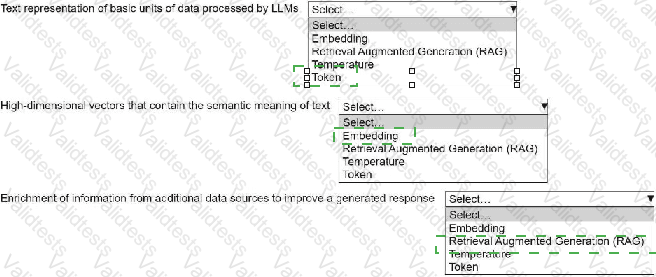
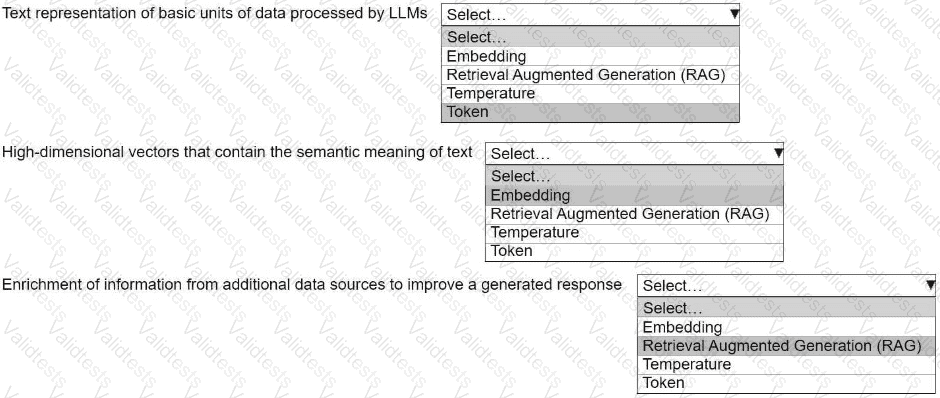
An ML engineer is building a generative AI application on Amazon Bedrock by using large language models (LLMs).

Select the correct generative AI term from the following list for each description. Each term should be selected one time or not at all. (Select three.)

• Embedding

• Retrieval Augmented Generation (RAG)

• Temperature

• Token
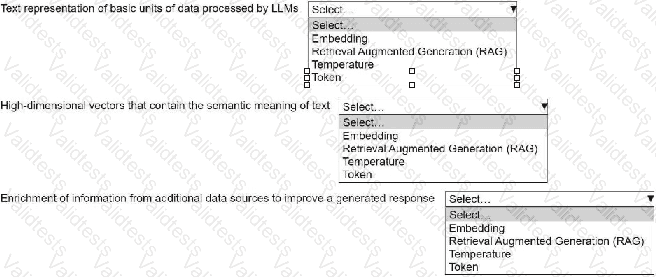
Question # 9

Options:

Questions # 10:

A company is creating an application that will recommend products for customers to purchase. The application will make API calls to Amazon Q Business. The company must ensure that responses from Amazon Q Business do not include the name of the company's main competitor.

Which solution will meet this requirement?

Options:

A.

Configure the competitor's name as a blocked phrase in Amazon Q Business.

B.

Configure an Amazon Q Business retriever to exclude the competitor’s name.

C.

Configure an Amazon Kendra retriever for Amazon Q Business to build indexes that exclude the competitor's name.

D.

Configure document attribute boosting in Amazon Q Business to deprioritize the competitor's name.

Viewing page 1 out of 7 pages
Viewing questions 1-10 out of questions