Pre-Summer Special Limited Time 70% Discount Offer - Ends in 0d 00h 00m 00s - Coupon code: validbest

Pass the Amazon Web Services MLA-C01 Questions and answers with ValidTests

Exam MLA-C01 All Questions
Exam MLA-C01 Premium Access

View all detail and faqs for the MLA-C01 exam

Viewing page 5 out of 8 pages
Viewing questions 41-50 out of questions
Questions # 41:

A company runs an Amazon SageMaker domain in a public subnet of a newly created VPC. The network is configured properly, and ML engineers can access the SageMaker domain.

Recently, the company discovered suspicious traffic to the domain from a specific IP address. The company needs to block traffic from the specific IP address.

Which update to the network configuration will meet this requirement?

Options:

A.

Create a security group inbound rule to deny traffic from the specific IP address. Assign the security group to the domain.

B.

Create a network ACL inbound rule to deny traffic from the specific IP address. Assign the rule to the default network Ad for the subnet where the domain is located.

C.

Create a shadow variant for the domain. Configure SageMaker Inference Recommender to send traffic from the specific IP address to the shadow endpoint.

D.

Create a VPC route table to deny inbound traffic from the specific IP address. Assign the route table to the domain.

Questions # 42:

A company has a team of data scientists who use Amazon SageMaker notebook instances to test ML models. When the data scientists need new permissions, the company attaches the permissions to each individual role that was created during the creation of the SageMaker notebook instance.

The company needs to centralize management of the team's permissions.

Which solution will meet this requirement?

Options:

A.

Create a single IAM role that has the necessary permissions. Attach the role to each notebook instance that the team uses.

B.

Create a single IAM group. Add the data scientists to the group. Associate the group with each notebook instance that the team uses.

C.

Create a single IAM user. Attach the AdministratorAccess AWS managed IAM policy to the user. Configure each notebook instance to use the IAM user.

D.

Create a single IAM group. Add the data scientists to the group. Create an IAM role. Attach the AdministratorAccess AWS managed IAM policy to the role. Associate the role with the group. Associate the group with each notebook instance that the team uses.

Questions # 43:

A company plans to use Amazon SageMaker AI to build image classification models. The company has 6 TB of training data stored on Amazon FSx for NetApp ONTAP. The file system is in the same VPC as SageMaker AI.

An ML engineer must make the training data accessible to SageMaker AI training jobs.

Which solution will meet these requirements?

Options:

A.

Mount the FSx for ONTAP file system as a volume to the SageMaker AI instance.

B.

Create an Amazon S3 bucket and use Mountpoint for Amazon S3 to link the bucket to FSx for ONTAP.

C.

Create a catalog connection from SageMaker Data Wrangler to the FSx for ONTAP file system.

D.

Create a direct connection from SageMaker Data Wrangler to the FSx for ONTAP file system.

Questions # 44:

A healthcare company wants to detect irregularities in patient vital signs that could indicate early signs of a medical condition. The company has an unlabeled dataset that includes patient health records, medication history, and lifestyle changes.

Which algorithm and hyperparameter should the company use to meet this requirement?

Options:

A.

Use the Amazon SageMaker AI XGBoost algorithm. Set max_depth to greater than 100 to regulate tree complexity.

B.

Use the Amazon SageMaker AI k-means clustering algorithm. Set k to determine the number of clusters.

C.

Use the Amazon SageMaker AI DeepAR algorithm. Set epochs to the number of training iterations.

D.

Use the Amazon SageMaker AI Random Cut Forest (RCF) algorithm. Set num_trees to greater than 100.

Questions # 45:

A company has an application that uses different APIs to generate embeddings for input text. The company needs to implement a solution to automatically rotate the API tokens every 3 months.

Which solution will meet this requirement?

Options:

A.

Store the tokens in AWS Secrets Manager. Create an AWS Lambda function to perform the rotation.

B.

Store the tokens in AWS Systems Manager Parameter Store. Create an AWS Lambda function to perform the rotation.

C.

Store the tokens in AWS Key Management Service (AWS KMS). Use an AWS managed key to perform the rotation.

D.

Store the tokens in AWS Key Management Service (AWS KMS). Use an AWS owned key to perform the rotation.

Questions # 46:

A company is building an Amazon SageMaker AI pipeline for an ML model. The pipeline uses distributed processing and distributed training.

An ML engineer needs to encrypt network communication between instances that run distributed jobs. The ML engineer configures the distributed jobs to run in a private VPC.

What should the ML engineer do to meet the encryption requirement?

Options:

A.

Enable network isolation.

B.

Configure traffic encryption by using security groups.

C.

Enable inter-container traffic encryption.

D.

Enable VPC flow logs.

Questions # 47:

A company uses Amazon SageMaker Studio to develop an ML model. The company has a single SageMaker Studio domain. An ML engineer needs to implement a solution that provides an automated alert when SageMaker compute costs reach a specific threshold.

Which solution will meet these requirements?

Options:

A.

Add resource tagging by editing the SageMaker user profile in the SageMaker domain. Configure AWS Cost Explorer to send an alert when the threshold is reached.

B.

Add resource tagging by editing the SageMaker user profile in the SageMaker domain. Configure AWS Budgets to send an alert when the threshold is reached.

C.

Add resource tagging by editing each user's IAM profile. Configure AWS Cost Explorer to send an alert when the threshold is reached.

D.

Add resource tagging by editing each user's IAM profile. Configure AWS Budgets to send an alert when the threshold is reached.

Questions # 48:

A company has an existing Amazon SageMaker AI model (v1) on a production endpoint. The company develops a new model version (v2) and needs to test v2 in production before substituting v2 for v1.

The company needs to minimize the risk of v2 generating incorrect output in production and must prevent any disruption of production traffic during the change.

Which solution will meet these requirements?

Options:

A.

Create a second production variant for v2. Assign 1% of the traffic to v2 and 99% to v1. Collect all output of v2 in Amazon S3. If v2 performs as expected, switch all traffic to v2.

B.

Create a second production variant for v2. Assign 10% of the traffic to v2 and 90% to v1. Collect all output of v2 in Amazon S3. If v2 performs as expected, switch all traffic to v2.

C.

Deploy v2 to a new endpoint. Turn on data capture for the production endpoint. Send 100% of the input data to v2.

D.

Deploy v2 into a shadow variant that samples 100% of the inference requests. Collect all output in Amazon S3. If v2 performs as expected, promote v2 to production.

Questions # 49:

An ML engineer is training an XGBoost regression model in Amazon SageMaker AI. The ML engineer conducts several rounds of hyperparameter tuning with random grid search. After these rounds of tuning, the error rate on the test hold-out dataset is much larger than the error rate on the training dataset.

The ML engineer needs to make changes before running the hyperparameter grid search again.

Which changes will improve the model's performance? (Select TWO.)

Options:

A.

Increase the model complexity by increasing the number of features in the dataset.

B.

Decrease the model complexity by reducing the number of features in the dataset.

C.

Decrease the model complexity by reducing the number of samples in the dataset.

D.

Increase the value of the L2 regularization parameter.

E.

Decrease the value of the L2 regularization parameter.

Questions # 50:

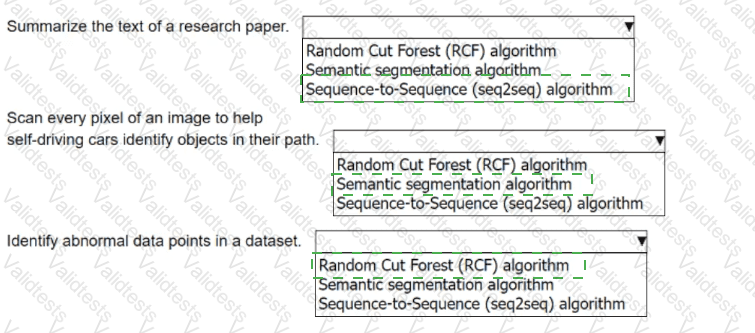
An ML engineer must choose the appropriate Amazon SageMaker algorithm to solve specific AI problems.

Select the correct SageMaker built-in algorithm from the following list for each use case. Each algorithm should be selected one time.

• Random Cut Forest (RCF) algorithm

• Semantic segmentation algorithm

• Sequence-to-Sequence (seq2seq) algorithm
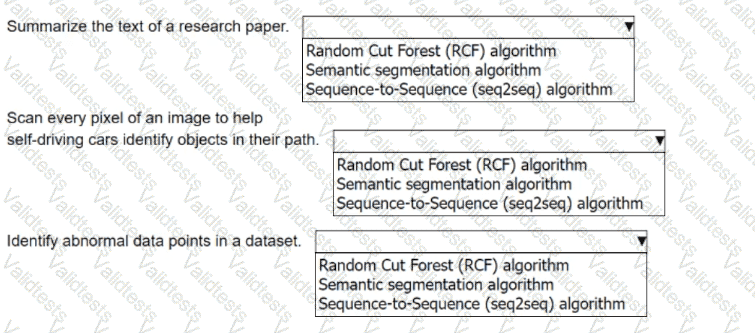
Question # 50

Options:

Viewing page 5 out of 8 pages
Viewing questions 41-50 out of questions