An ML engineer is training a simple neural network model. The ML engineer tracks the performance of the model over time on a validation dataset. The model's performance improves substantially at first and then degrades after a specific number of epochs.
Which solutions will mitigate this problem? (Choose two.)
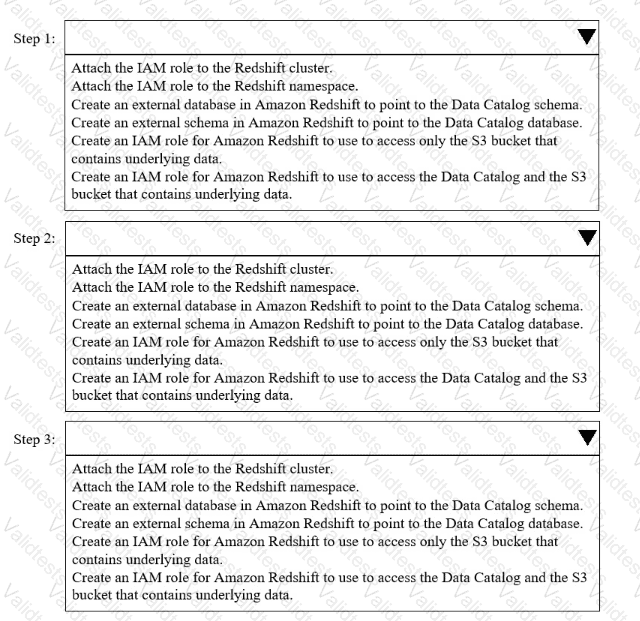
A company needs to combine data from multiple sources. The company must use Amazon Redshift Serverless to query an AWS Glue Data Catalog database and underlying data that is stored in an Amazon S3 bucket.
Select and order the correct steps from the following list to meet these requirements. Select each step one time or not at all. (Select and order three.)
• Attach the IAM role to the Redshift cluster.
• Attach the IAM role to the Redshift namespace.
• Create an external database in Amazon Redshift to point to the Data Catalog schema.
• Create an external schema in Amazon Redshift to point to the Data Catalog database.
• Create an IAM role for Amazon Redshift to use to access only the S3 bucket that contains underlying data.
• Create an IAM role for Amazon Redshift to use to access the Data Catalog and the S3 bucket that contains underlying data.
An ML engineer uses one ML framework to train multiple ML models. The ML engineer needs to optimize inference costs and host the models on Amazon SageMaker AI.
Which solution will meet these requirements MOST cost-effectively?
A company ' s dataset for prediction analytics contains duplicate records, missing data, and unusually extreme high or low values. The company needs a solution to resolve the data quality issues quickly. The solution must maintain data integrity and have the LEAST operational overhead.
Which solution will meet these requirements?
A company wants to deploy an Amazon SageMaker AI model that can queue requests. The model needs to handle payloads of up to 1 GB that take up to 1 hour to process. The model must return an inference for each request. The model also must scale down when no requests are available to process.
Which inference option will meet these requirements?
A company has a large collection of chat recordings from customer interactions after a product release. An ML engineer needs to create an ML model to analyze the chat data. The ML engineer needs to determine the success of the product by reviewing customer sentiments about the product.
Which action should the ML engineer take to complete the evaluation in the LEAST amount of time?
A company uses an Amazon SageMaker AI model for real-time inference with auto scaling enabled. During peak usage, new instances launch before existing instances are fully ready, causing inefficiencies and delays.
Which solution will optimize the scaling process without affecting response times?
An ML engineer wants to deploy an Amazon SageMaker AI model for inference. The payload sizes are less than 3 MB. Processing time does not exceed 45 seconds. The traffic patterns will be irregular or unpredictable.
Which inference option will meet these requirements MOST cost-effectively?
An ML engineer normalized training data by using min-max normalization in AWS Glue DataBrew. The ML engineer must normalize production inference data in the same way before passing the data to the model.
Which solution will meet this requirement?
An ML engineer has trained a neural network by using stochastic gradient descent (SGD). The neural network performs poorly on the test set. The values for training loss and validation loss remain high and show an oscillating pattern. The values decrease for a few epochs and then increase for a few epochs before repeating the same cycle.
What should the ML engineer do to improve the training process?



