Pre-Summer Special Limited Time 70% Discount Offer - Ends in 0d 00h 00m 00s - Coupon code: validbest

Pass the Amazon Web Services MLA-C01 Questions and answers with ValidTests

Exam MLA-C01 All Questions
Exam MLA-C01 Premium Access

View all detail and faqs for the MLA-C01 exam

Viewing page 3 out of 8 pages
Viewing questions 21-30 out of questions
Questions # 21:

An ML engineer is analyzing a classification dataset before training a model in Amazon SageMaker AI. The ML engineer suspects that the dataset has a significant imbalance between class labels that could lead to biased model predictions. To confirm class imbalance, the ML engineer needs to select an appropriate pre-training bias metric.

Which metric will meet this requirement?

Options:

A.

Mean squared error (MSE)

B.

Difference in proportions of labels (DPL)

C.

Silhouette score

D.

Structural similarity index measure (SSIM)

Questions # 22:

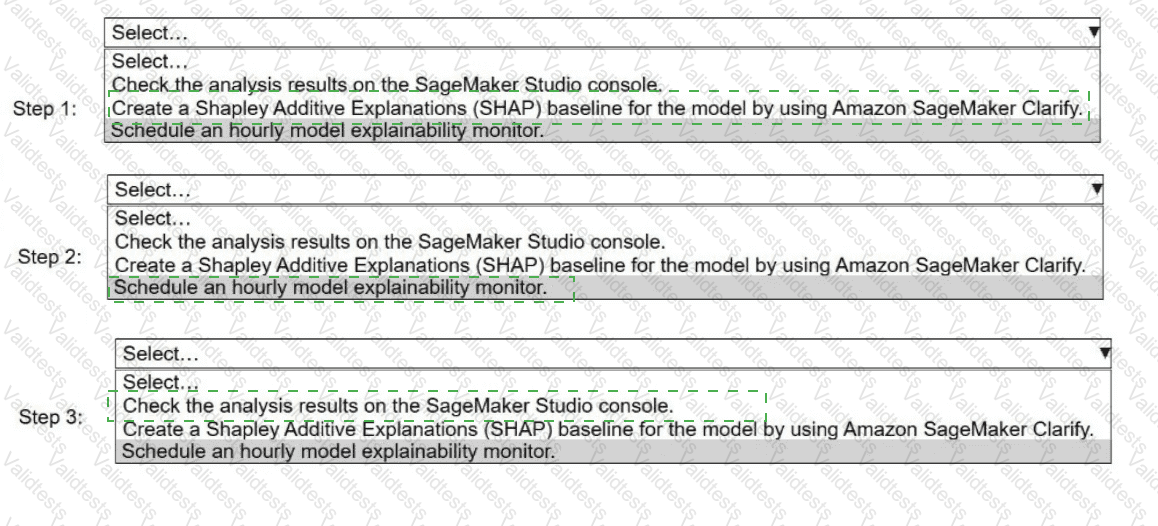
A company has deployed a model to predict the churn rate for its games by using Amazon SageMaker Studio. After the model is deployed, the company must monitor the model performance for data drift and inspect the report. Select and order the correct steps from the following list to model monitor actions. Select each step one time. (Select and order THREE.) .

Check the analysis results on the SageMaker Studio console. .

Create a Shapley Additive Explanations (SHAP) baseline for the model by using Amazon SageMaker Clarify.

Schedule an hourly model explainability monitor.
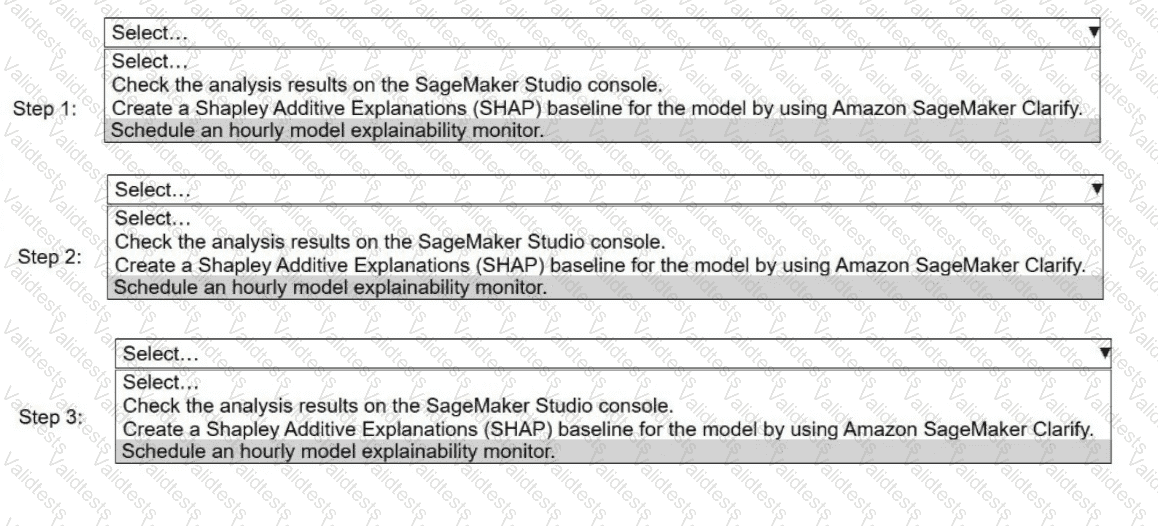
Question # 22

Options:

Questions # 23:

An ML engineer needs to use an Amazon EMR cluster to process large volumes of data in batches. Any data loss is unacceptable.

Which instance purchasing option will meet these requirements MOST cost-effectively?

Options:

A.

Run the primary node, core nodes, and task nodes on On-Demand Instances.

B.

Run the primary node, core nodes, and task nodes on Spot Instances.

C.

Run the primary node on an On-Demand Instance. Run the core nodes and task nodes on Spot Instances.

D.

Run the primary node and core nodes on On-Demand Instances. Run the task nodes on Spot Instances.

Questions # 24:

An ML engineer is setting up a continuous integration and continuous delivery (CI/CD) pipeline for an ML workflow in Amazon SageMaker AI. The pipeline needs to automate model re-training, testing, and deployment whenever new data is uploaded to an Amazon S3 bucket. New data files are approximately 10 GB in size. The ML engineer wants to track model versions for auditing.

Which solution will meet these requirements?

Options:

A.

Use AWS CodePipeline, Amazon S3, and AWS CodeBuild to retrain and deploy the model automatically and to track model versions.

B.

Use SageMaker Pipelines with the SageMaker Model Registry to orchestrate model training and version tracking.

C.

Create an AWS Lambda function to re-train and deploy the model. Use Amazon EventBridge to invoke the Lambda function. Reference the Lambda logs to track model versions.

D.

Use SageMaker AI notebook instances to manually re-train and deploy the model when needed. Reference AWS CloudTrail logs to track model versions.

Questions # 25:

Case Study

A company is building a web-based AI application by using Amazon SageMaker. The application will provide the following capabilities and features: ML experimentation, training, a

central model registry, model deployment, and model monitoring.

The application must ensure secure and isolated use of training data during the ML lifecycle. The training data is stored in Amazon S3.

The company is experimenting with consecutive training jobs.

How can the company MINIMIZE infrastructure startup times for these jobs?

Options:

A.

Use Managed Spot Training.

B.

Use SageMaker managed warm pools.

C.

Use SageMaker Training Compiler.

D.

Use the SageMaker distributed data parallelism (SMDDP) library.

Questions # 26:

A company has a Retrieval Augmented Generation (RAG) application that uses a vector database to store embeddings of documents. The company must migrate the application to AWS and must implement a solution that provides semantic search of text files. The company has already migrated the text repository to an Amazon S3 bucket.

Which solution will meet these requirements?

Options:

A.

Use an AWS Batch job to process the files and generate embeddings. Use AWS Glue to store the embeddings. Use SQL queries to perform the semantic searches.

B.

Use a custom Amazon SageMaker AI notebook to run a custom script to generate embeddings. Use SageMaker Feature Store to store the embeddings. Use SQL queries to perform the semantic searches.

C.

Use the Amazon Kendra S3 connector to ingest the documents from the S3 bucket into Amazon Kendra. Query Amazon Kendra to perform the semantic searches.

D.

Use an Amazon Textract asynchronous job to ingest the documents from the S3 bucket. Query Amazon Textract to perform the semantic searches.

Questions # 27:

A company has deployed an ML model that detects fraudulent credit card transactions in real time in a banking application. The model uses Amazon SageMaker Asynchronous Inference. Consumers are reporting delays in receiving the inference results.

An ML engineer needs to implement a solution to improve the inference performance. The solution also must provide a notification when a deviation in model quality occurs.

Which solution will meet these requirements?

Options:

A.

Use SageMaker real-time inference for inference. Use SageMaker Model Monitor for notifications about model quality.

B.

Use SageMaker batch transform for inference. Use SageMaker Model Monitor for notifications about model quality.

C.

Use SageMaker Serverless Inference for inference. Use SageMaker Inference Recommender for notifications about model quality.

D.

Keep using SageMaker Asynchronous Inference for inference. Use SageMaker Inference Recommender for notifications about model quality.

Questions # 28:

A company has a conversational AI assistant that sends requests through Amazon Bedrock to an Anthropic Claude large language model (LLM). Users report that when they ask similar questions multiple times, they sometimes receive different answers. An ML engineer needs to improve the responses to be more consistent and less random.

Which solution will meet these requirements?

Options:

A.

Increase the temperature parameter and the top_k parameter.

B.

Increase the temperature parameter. Decrease the top_k parameter.

C.

Decrease the temperature parameter. Increase the top_k parameter.

D.

Decrease the temperature parameter and the top_k parameter.

Questions # 29:

A company stores training data as a .csv file in an Amazon S3 bucket. The company must encrypt the data and must control which applications have access to the encryption key.

Which solution will meet these requirements?

Options:

A.

Create a new SSH access key and use the AWS Encryption CLI to encrypt the file.

B.

Create a new API key by using Amazon API Gateway and use it to encrypt the file.

C.

Create a new IAM role with permissions for kms:GenerateDataKey and use the role to encrypt the file.

D.

Create a new AWS Key Management Service (AWS KMS) key and use the AWS Encryption CLI with the KMS key to encrypt the file.

Questions # 30:

An ML engineer is designing an AI-powered traffic management system. The system must use near real-time inference to predict congestion and prevent collisions.

The system must also use batch processing to perform historical analysis of predictions over several hours to improve the model. The inference endpoints must scale automatically to meet demand.

Which combination of solutions will meet these requirements? (Select TWO.)

Options:

A.

Use Amazon SageMaker real-time inference endpoints with automatic scaling based on ConcurrentInvocationsPerInstance.

B.

Use AWS Lambda with reserved concurrency and SnapStart to connect to SageMaker endpoints.

C.

Use an Amazon SageMaker Processing job for batch historical analysis. Schedule the job with Amazon EventBridge.

D.

Use Amazon EC2 Auto Scaling to host containers for batch analysis.

E.

Use AWS Lambda for historical analysis.

Viewing page 3 out of 8 pages
Viewing questions 21-30 out of questions