Pre-Summer Special Limited Time 70% Discount Offer - Ends in 0d 00h 00m 00s - Coupon code: validbest

Pass the Amazon Web Services MLA-C01 Questions and answers with ValidTests

Exam MLA-C01 All Questions
Exam MLA-C01 Premium Access

View all detail and faqs for the MLA-C01 exam

Viewing page 4 out of 8 pages
Viewing questions 31-40 out of questions
Questions # 31:

An ML engineer is using an Amazon SageMaker Studio notebook to train a neural network by creating an estimator. The estimator runs a Python training script that uses Distributed Data Parallel (DDP) on a single instance that has more than one GPU.

The ML engineer discovers that the training script is underutilizing GPU resources. The ML engineer must identify the point in the training script where resource utilization can be optimized.

Which solution will meet this requirement?

Options:

A.

Use Amazon CloudWatch metrics to create a report that describes GPU utilization over time.

B.

Add SageMaker Profiler annotations to the training script. Run the script and generate a report from the results.

C.

Use AWS CloudTrail to create a report that describes GPU utilization and GPU memory utilization over time.

D.

Create a default monitor in Amazon SageMaker Model Monitor and suggest a baseline. Generate a report based on the constraints and statistics the monitor generates.

Questions # 32:

An ML engineer wants to run a training job on Amazon SageMaker AI. The training job will train a neural network by using multiple GPUs. The training dataset is stored in Parquet format.

The ML engineer discovered that the Parquet dataset contains files too large to fit into the memory of the SageMaker AI training instances.

Which solution will fix the memory problem?

Options:

A.

Attach an Amazon Elastic Block Store (Amazon EBS) Provisioned IOPS SSD volume to the instance. Store the files in the EBS volume.

B.

Repartition the Parquet files by using Apache Spark on Amazon EMR. Use the repartitioned files for the training job.

C.

Change the instance type to Memory Optimized instances with sufficient memory for the training job.

D.

Use the SageMaker AI distributed data parallelism (SMDDP) library with multiple instances to split the memory usage.

Questions # 33:

An ML engineer is collecting data to train a classification ML model by using Amazon SageMaker AI. The target column can have two possible values: Class A or Class B. The ML engineer wants to ensure that the number of samples for both Class A and Class B are balanced, without losing any existing training data. The ML engineer must test the balance of the training data.

Which solution will meet this requirement?

Options:

A.

Use SageMaker Clarify to check for class imbalance (CI). If the value is equal to 0, then use random undersampling in SageMaker Data Wrangler to balance the classes.

B.

Use SageMaker Clarify to check for class imbalance (CI). If the value is greater than 0, then use synthetic minority oversampling technique (SMOTE) in SageMaker Data Wrangler to balance the classes.

C.

Use SageMaker JumpStart to generate a class imbalance (CI) report. If the value is greater than 0, then use random undersampling in SageMaker Studio to balance the classes.

D.

Use SageMaker JumpStart to generate a class imbalance (CI) report. If the value is equal to 0, then use synthetic minority oversampling technique (SMOTE) in SageMaker Studio to balance the classes.

Questions # 34:

An ML engineer wants to deploy an Amazon SageMaker AI model for inference. The payload sizes are less than 3 MB. Processing time does not exceed 45 seconds. The traffic patterns will be irregular or unpredictable.

Which inference option will meet these requirements MOST cost-effectively?

Options:

A.

Asynchronous inference

B.

Real-time inference

C.

Serverless inference

D.

Batch transform

Questions # 35:

A company regularly receives new training data from the vendor of an ML model. The vendor delivers cleaned and prepared data to the company's Amazon S3 bucket every 3-4 days.

The company has an Amazon SageMaker pipeline to retrain the model. An ML engineer needs to implement a solution to run the pipeline when new data is uploaded to the S3 bucket.

Which solution will meet these requirements with the LEAST operational effort?

Options:

A.

Create an S3 Lifecycle rule to transfer the data to the SageMaker training instance and to initiate training.

B.

Create an AWS Lambda function that scans the S3 bucket. Program the Lambda function to initiate the pipeline when new data is uploaded.

C.

Create an Amazon EventBridge rule that has an event pattern that matches the S3 upload. Configure the pipeline as the target of the rule.

D.

Use Amazon Managed Workflows for Apache Airflow (Amazon MWAA) to orchestrate the pipeline when new data is uploaded.

Questions # 36:

An ML engineer is training an ML model to identify medical patients for disease screening. The tabular dataset for training contains 50,000 patient records: 1,000 with the disease and 49,000 without the disease.

The ML engineer splits the dataset into a training dataset, a validation dataset, and a test dataset.

What should the ML engineer do to transform the data and make the data suitable for training?

Options:

A.

Apply principal component analysis (PCA) to oversample the minority class in the training dataset.

B.

Apply Synthetic Minority Oversampling Technique (SMOTE) to generate new synthetic samples of the minority class in the training dataset.

C.

Randomly oversample the majority class in the validation dataset.

D.

Apply k-means clustering to undersample the minority class in the test dataset.

Questions # 37:

An ML engineer is using Amazon Quick Suite (previously known as Amazon QuickSight) anomaly detection to detect very high or very low machine operating temperatures compared to normal. The ML engineer sets the Severity parameter to Low and above. The ML engineer sets the Direction parameter to All.

What effect will the ML engineer observe in the anomaly detection results if the ML engineer changes the Direction parameter to Lower than expected?

Options:

A.

Increased anomaly identification frequency and increased recall

B.

Decreased anomaly identification frequency and decreased recall

C.

Increased anomaly identification frequency and decreased recall

D.

Decreased anomaly identification frequency and increased recall

Questions # 38:

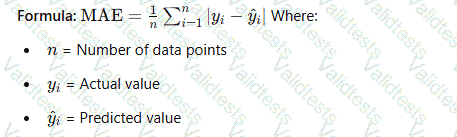
An ML engineer needs to use an ML model to predict the price of apartments in a specific location.

Which metric should the ML engineer use to evaluate the model's performance?

Options:

A.

Accuracy

B.

Area Under the ROC Curve (AUC)

C.

F1 score

D.

Mean absolute error (MAE)

Questions # 39:

An ML engineer is using Amazon SageMaker to train a deep learning model that requires distributed training. After some training attempts, the ML engineer observes that the instances are not performing as expected. The ML engineer identifies communication overhead between the training instances.

What should the ML engineer do to MINIMIZE the communication overhead between the instances?

Options:

A.

Place the instances in the same VPC subnet. Store the data in a different AWS Region from where the instances are deployed.

B.

Place the instances in the same VPC subnet but in different Availability Zones. Store the data in a different AWS Region from where the instances are deployed.

C.

Place the instances in the same VPC subnet. Store the data in the same AWS Region and Availability Zone where the instances are deployed.

D.

Place the instances in the same VPC subnet. Store the data in the same AWS Region but in a different Availability Zone from where the instances are deployed.

Questions # 40:

An ML engineer is preparing a dataset that contains medical records to train an ML model to predict the likelihood of patients developing diseases.

The dataset contains columns for patient ID, age, medical conditions, test results, and a "Disease" target column.

How should the ML engineer configure the data to train the model?

Options:

A.

Remove the patient ID column.

B.

Remove the age column.

C.

Remove the medical conditions and test results columns.

D.

Remove the "Disease" target column.

Viewing page 4 out of 8 pages
Viewing questions 31-40 out of questions